Pte
Isaac Clause

Information about birth
|
Date of birth: 11/08/1900 |
|
Place of birth: Sixty-Nine Corners, Ontario, Canada |
General information
|
Last known residence: Sixty-Nine Corners, Ontario, Canada |
|
Profession: Labourer |
|
Religion: Church of England |
Army information
|
Country: Canada |
|
Force: Canadian Expeditionary Force |
|
Rank: Private |
|
Service number: 739758 |
|
Enlistment date: 26/03/1916 |
|
Enlistment place: Ohsweken, Ontario, Canada |
|
Units: — Canadian Infantry, 1st Bn. (Ontario Regiment) (Last known unit) |
Information about death
|
Date of death: 06/11/1917 |
|
Place of death: Meetcheele, Passchendaele, Belgium |
|
Cause of death: Killed in action (K.I.A.) |
|
Age: 17 |
Cemetery
|
Passchendaele New British Cemetery Plot: VIII Row: C Grave: 6 |
Points of interest 5
| #1 | Place of birth | ||
| #2 | Last known residence | ||
| #3 | Enlistment place | ||
| #4 | Place of death (approximate) | ||
| #5 | Sterfteplaats |
My story
Isaac Clause was born on 11 August 1900 in the Township of Tuscarora, Brant County, Ontario (Canada). His father, Aaron Clause, a farmer by trade, had previously been married to Lucy Hill, with whom he had four children. After her death in 1894, he remarried Deborah Lickers. Three more children were born from this marriage. The censuses of 1901 and 1911 indicate that the family belonged to the First Nations. Isaac worked as a labourer.
On 26 March 1916, he enlisted in the Canadian Army, giving his date of birth as 11 August 1897. He was assigned to the 114th Canadian Infantry Battalion. On 31 October 1916, he embarked at Halifax bound for Liverpool. After arriving in Great Britain, he was transferred to the 35th Canadian Infantry Battalion. On 4 January 1917, he was transferred again, this time to the 4th Canadian Reserve Battalion. He arrived in France on 18 May 1917 and was posted to the 1st Canadian Infantry Battalion, part of the 1st Canadian Infantry Brigade, 1st Canadian Division.
On 13 July 1917, he was admitted to the 93rd Field Ambulance suffering from burns to his left foot. These injuries had been sustained accidentally. He was subsequently treated at No. 7 Canadian General Hospital. By 31 August 1917, he had rejoined the 1st Canadian Infantry Battalion.
During the night of 4-5 November 1917, two companies and the battalion headquarters of the 1st Canadian Infantry Battalion relieved the 16th Canadian Infantry Battalion in the vicinity of Meetcheele, near Passchendaele. The following night, the remaining two companies were also moved into the front line. Before the attack began on 6 November, between 4:30 a.m. and 5:15 a.m., the battalion's positions came under heavy German artillery fire, causing several casualties. One company commander was wounded and had to be evacuated, while another officer was also wounded but remained with his unit.
The attack commenced at 6:00 a.m. on 6 November 1917, following a ten-minute artillery bombardment. German resistance was initially relatively weak and consisted mainly of scattered riflemen occupying shell holes. Further ahead, however, the Canadians encountered increasing resistance from machine-gun nests, bunkers and ruins. The German defenders occupying the ruins of Mosselmarkt were surprised by the assault and were captured in the cellars. By 7:45 a.m., the final objective had been secured: the line Vapour Farm – Valour Farm – Vindictive Crossroads.
The German response consisted of heavy artillery fire and low-flying aircraft during the afternoon. By about 6:00 p.m., there were several indications of an imminent German counter-attack, but it was broken up by Canadian artillery before it could develop.
The 1st Canadian Infantry Battalion was relieved on the evening of 7 November 1917. The battalion had entered the battle with 22 officers and 524 other ranks. Six officers were killed and five were wounded. Among the rank and file, casualties amounted to 278 killed, missing and wounded.
One of those killed was Private Isaac Clause, who was in fact only seventeen years old at the time. In 1920, his body was exhumed from a battlefield grave between Meetcheele and Graf Farm and reburied in Passchendaele New British Cemetery, Plot VIII, Row C, Grave 6.
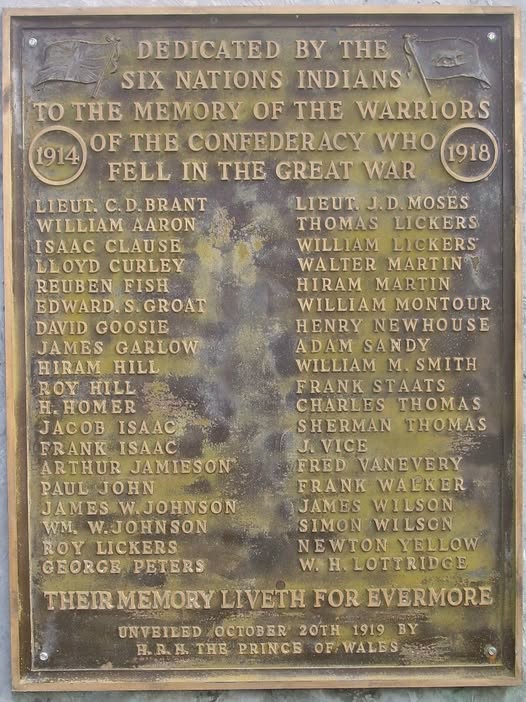
He is also commemorated on the memorial plaque dedicated to the fallen members of the Six Nations, unveiled on 20 October 1919 by the Prince of Wales.
Sources 2
|
Isaac Clause, ancestry.com https://www.ancestry.com/family-tree/person/tree/120064763/person/290191368588/facts Sources used |
|
War diaries - 1st Canadian Infantry Battalion, RG9-III-D-3, Volume number: 4913, Microfilm reel number: T-10704--T-10705, File number: 351, Library and Archives Canada https://central.bac-lac.gc.ca/.redirect?app=fonandcol&id=1883205&lang=eng&ecopy=e001074087 Sources used |
More information 4
|
CWGC https://www.cwgc.org/find-records/find-war-dead/casualty-details/461185 |
|
The Canadian Virtual War Memorial https://www.veterans.gc.ca/en/remembrance/memorials/canadian-virtual-war-memorial/detail/597319 |
|
A Street Near You https://astreetnearyou.org/person/461185/ |
|
Namenlijst (In Flanders Fields Museum) https://namenlijst.org/publicsearch/#/person/_id=6359e0f7-beb5-4a55-bb5c-181eac236198 |