Pte
Harry Smith Duxbury
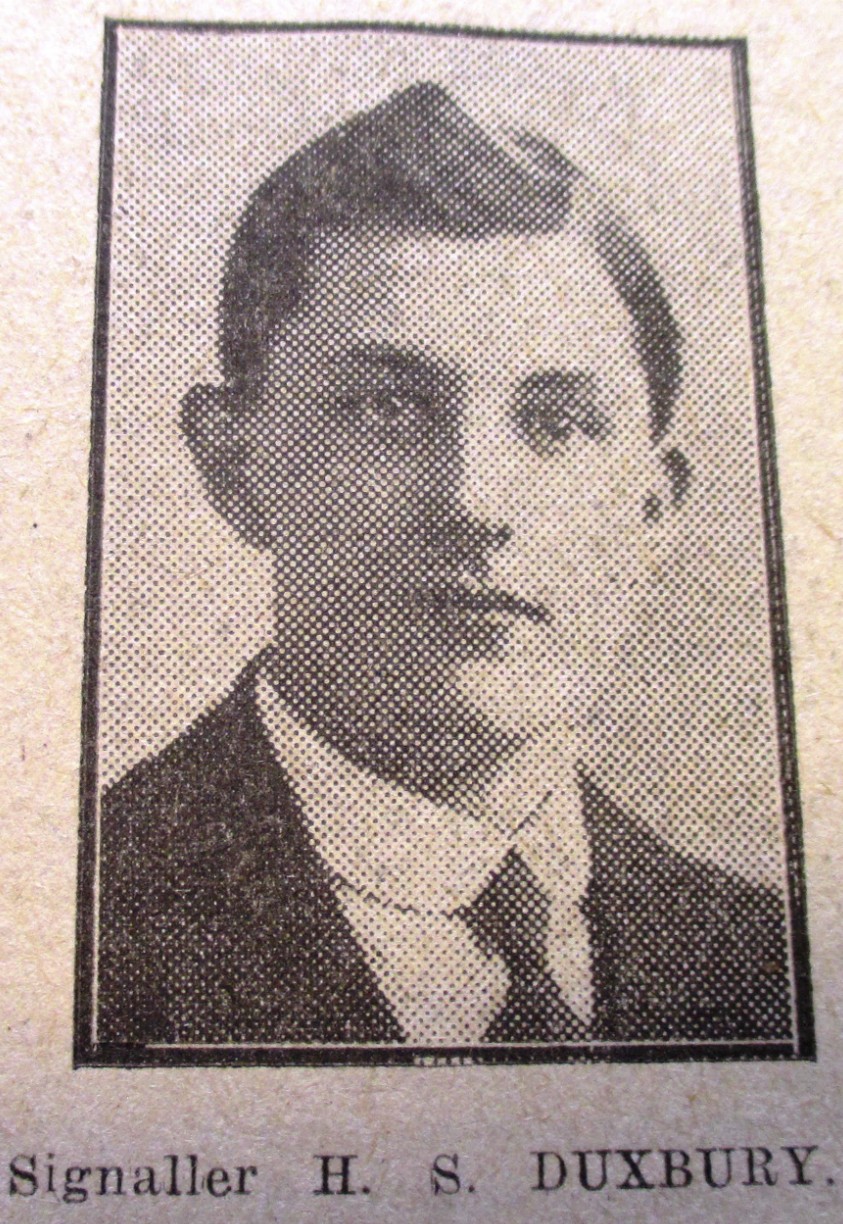
Information about birth
|
Date of birth: 10/04/1897 |
|
Place of birth: Clayton-le-Moors, Lancashire, England, United Kingdom |
General information
|
Last known residence: 15 Dryden Street, Clayton-le-Moors, Lancashire, England, United Kingdom |
|
Profession: Grocer's assistant |
|
Religion: Church of England |
Army information
|
Country: Verenigd Koninkrijk |
|
Force: British Expeditionary Force |
|
Rank: Private |
|
Service number: 23976 |
|
Enlistment date: 26/04/1916 |
|
Enlistment place: Great Harwood, Lancashire, England, United Kingdom |
|
Units: — King's Own (Royal Lancaster Regiment), 1/4th Bn. (Last known unit) |
Information about death
|
Date of death: 31/07/1917 |
|
Place of death: Pommern Castle & Redoubt, Saint-Julien, Belgium |
|
Cause of death: Killed in action (K.I.A.) |
|
Age: 20 |
Cemetery
|
Tyne Cot Cemetery Plot: VIII Row: D Grave: 12 |
Distinctions and medals 2
|
British War Medal Medal |
|
Victory Medal Medal |
Points of interest 5
| #1 | Place of birth | ||
| #2 | Last known residence | ||
| #3 | Enlistment place | ||
| #4 | Place of death (approximate) | ||
| #5 | Sterfteplaats |
My story
Harry Duxbury was born on 10 April 1897 in Clayton-le-Moors, Lancashire, England. He was the son of Marcy and John Duxbury and worked as a grocer’s assistant when he enlisted in the British Army on 26 April 1916. He was initially assigned to the East Lancashire Regiment, but was soon transferred to the King’s Own Royal Lancaster Regiment, where he was trained as a Signaller. In the spring of 1917, he crossed to France, where he joined the 1/4th Battalion, King’s Own Royal Lancaster Regiment (164th Brigade, 55th Division).
The 164th Brigade, of which the 1/4th Battalion, King’s Own Royal Lancaster Regiment, formed part, launched its attack on 31 July with the objective of capturing the Green Line, the final objective of the 55th Division, in the area of Schuler Farm and Kansas Cross. These positions were taken during the morning, but counter-attacks followed in the afternoon. The battalion was eventually forced to withdraw to the Black Line.
Harry was killed in action on 31 July 1917 near Pommern Castle at the age of twenty. After the war, his body was reinterred in Tyne Cot Cemetery.
Sources 12
|
4 Battalion King's Own Royal Lancaster Regiment (The National Archives, Kew (TNA), WO 95/2922/2. https://www.nationalarchives.gov.uk/ Sources used |
|
British Army World War I Medal Rolls Index Cards, 1914-1920 (The National Archives, Kew (TNA), WO 372). https://www.nationalarchives.gov.uk/ Sources used |
|
Census Returns of England and Wales, 1901 (The National Archives, Kew (TNA), RG13). https://www.nationalarchives.gov.uk/ Sources used |
|
Census Returns of England and Wales, 1911 (The National Archives, Kew (TNA), RG14). https://www.nationalarchives.gov.uk/ Sources used |
|
Harry Smith Duxbury on ancestry https://www.ancestry.com/family-tree/person/tree/10480977/person/112317191132/facts Sources used |
|
Hutton, John. Kitchener's Men: The King's Own Royal Lancasters On The Western Front 1915-1918 (South Yorkshire: Penn & Sword Books Ltd, 2008), 159-160. Sources used |
|
Koch, Koen. De Derde Slag Bij Ieper 1917 (Antwerpen: Uitgeverij Manteau, 2007), 188-196. Sources used |
|
McCarthy, Chris. Passchendaele The Day By Day Account (Londen: Uniform 2018), 85 Sources used |
|
Soldiers' Effects Records (National Army Museum, Chelsea (NAM) 1901-60; NAM Accession Number: 1991-02-333). https://www.nam.ac.uk/ Sources used |
|
Soldiers’ Documents (The National Archives, Kew (TNA), WO 363). https://www.nationalarchives.gov.uk/ Sources used |
|
UK, World War I Pension Ledgers and Index Cards, 1914-1923, (Western Front Association: 675/03d https://www.westernfrontassociation.com/ Sources used |
|
War Office and Air Ministry: Service Medal and Award Rolls, First World War (The National Archives, Kew (TNA), WO 329). https://www.nationalarchives.gov.uk/ Sources used |
More information 3
|
CWGC https://www.cwgc.org/find-records/find-war-dead/casualty-details/462646 |
|
Namenlijst (In Flanders Fields Museum) https://namenlijst.org/publicsearch/#/person/_id=923b79d6-e570-4471-8c58-fe474952b5df |
|
Lives of the First World War (Imperial War Museum) https://livesofthefirstworldwar.iwm.org.uk/lifestory/2411922 |