Pte
Albert Edward Mumford
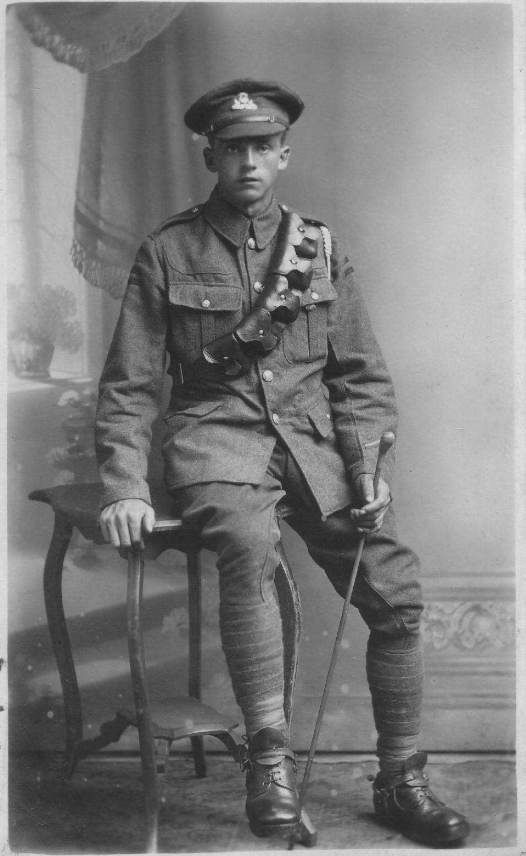
Information about birth
|
Year of birth: 1891 |
|
Place of birth: Salford, Lancashire, England, United Kingdom |
General information
|
Last known residence: 108 Worsley Road, Patricroft, Eccles, Manchester, England, United Kingdom |
|
Profession: Warehouseman |
Army information
|
Country: England, United Kingdom |
|
Force: British Expeditionary Force |
|
Rank: Private |
|
Service number: 41639 |
|
Enlistment place: Manchester, Lancashire, England, United Kingdom |
|
Units: — Lancashire Fusiliers, 2/5th Bn. (Last known unit) |
Information about death
|
Date of death: 31/07/1917 |
|
Place of death: Winnipeg, St. Julien, Belgium |
|
Cause of death: Killed in action (K.I.A.) |
|
Age: 26 |
Cemetery
|
Tyne Cot Cemetery Plot: X Row: D Grave: 17 |
Distinctions and medals 2
|
British War Medal Medal |
|
Victory Medal Medal |
Points of interest 4
| #1 | Place of birth | ||
| #2 | Last known residence | ||
| #3 | Enlistment place | ||
| #4 | Place of death (approximate) |
My story
Albert Edward Mumford was born around 1891 in Salford, Lancashire, United Kingdom. He was the son of Alfred Mumford and Mary Elizabeth Grimshaw. Albert enlisted in Manchester, Lancashire, and was assigned to the 2nd/5th Battalion Lancashire Fusiliers (164th Brigade, 55th (West Lancashire) Division).
Albert was killed in action on 31 July 1917 during the Battle of Pilkem, which was part of the Battle of Passchendaele. On 30 July, the battalion moved to the jump-off positions for the attack on 31 July, located just east of Sint-Jan at Congreve Walk and Liverpool Trench. The attack was to be carried out by battalions of the following three brigades: the 165th, 166th, and 164th. The 166th and 165th formed the first assault wave. Their first objective was the trench system running from Cheddar Villa to just past Uhlan Farm. Once that was taken, the brigades would advance further toward the second objective line running from Fortuin to Pommern Castle. Then, four hours and forty minutes after the start of the attack, companies of the 2nd/5th Battalion Lancashire Fusiliers would move toward the second objective line. Once reached, the battalion would attack the third objective line running from Winnipeg near Sint-Juliaan to just beyond Fokker Farm.
The attack for the 2nd/5th Battalion Lancashire Fusiliers began at 8 a.m. As the troops crossed the Hanebeek on their way to the second objective line, they came under fire for the first time. Then, 200 meters from the second objective line, they were fired upon again from positions including: Wine House, Spree Farm, Capricon Support, Capricorn Keep, Pond Farm, and Hindu Cottage. Actions were taken to silence and capture Wine House, Spree Farm, and Capricon Support before advancing. These actions resulted in numerous casualties. After reaching the second objective line, the battalion advanced further to the third objective line. That line was reached and consolidation work was immediately undertaken. Ten men under the command of Captain Bodington also attempted to reach Wurst Farm, but this section was reduced to 2 men. Due to a lack of supporting units on the flanks, rising casualties, failed communications, and German counterattacks, the third objective line was abandoned, and the troops withdrew to Winnipeg near Sint-Juliaan. That position could also not be held, and they withdrew again to Jew Hill between Sint-Juliaan and Winnipeg. Meanwhile, consolidation work continued along the second objective line, and the entire battalion was engaged in a retreat to that line. At Schuler Farm, 130 men under the command of Captain Bodington managed to hold off the German counterattack to some extent. Eventually, the 10 survivors and Captain Bodington returned to the second objective line, where the rest of the battalion was located. The next day, the survivors of the battalion were withdrawn to Bilge Trench near Wieltje Farm. The 2nd/5th Battalion Lancashire Fusiliers had gone into the frontline with 19 officers and 593 men. The battalion returned with 120 men and 1 officer, Captain Bodington. The casualties were: 38 killed, 209 wounded, and 244 missing.
Albert Edward Mumford was killed at the age of 26. His body was found near Winnipeg, close to Sint-Juliaan. After the war, Albert was reburied at Tyne Cot Cemetery, plot X, row D, grave 17.
Sources 6
|
1891 England Census (The National Archives, Kew (TNA), RG12). https://discovery.nationalarchives.gov.uk/ Sources used |
|
1911 England Census (The National Archives, Kew (TNA), RG14). https://discovery.nationalarchives.gov.uk/ Sources used |
|
2/5 Battalion Lancashire Fusiliers Regiment (The National Archives, KEW (TNA), WO/95/2923/2/02). http://nationalarchives.gov.uk Sources used |
|
Albert Edward Mumford, ancestry.com https://www.ancestry.com/family-tree/person/tree/159114929/person/392331434981/facts Sources used |
|
Chris McCarthy, Passchendaele: The Day-By-Day Account (Londen: Arms & Armour, 2018), 28-29. Sources used |
|
Military-Genealogy.com, comp. UK, Soldiers Died in the Great War, 1914-1919 [database on-line]. Provo, UT, USA: Ancestry.com Operations Inc, 2008. http://ancestry.com Sources used |
More information 3
|
Commonwealth War Graves Commission Database https://www.cwgc.org/find-records/find-war-dead/casualty-details/464038 |
|
Lives of the First World War (Imperial War Museum) https://livesofthefirstworldwar.iwm.org.uk/lifestory/3166454 |
|
Namenlijst (In Flanders Fields Museum) https://namenlijst.org/publicsearch/#/person/_id=6ddf81a0-619c-4949-9a10-216b8a4865ab |