Pte
Thomas Michael Halloran
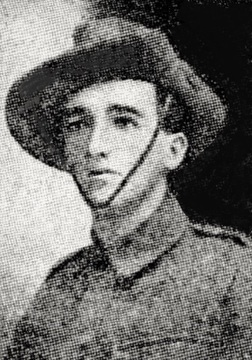
Information about birth
|
Date of birth: 15/05/1895 |
|
Place of birth: Atherton, Queensland, Australia |
General information
|
Last known residence: Tolga, Queensland, Australia |
|
Profession: Grocer |
|
Religion: Roman Catholic |
Army information
|
Country: Australia |
|
Force: Australian Imperial Force |
|
Rank: Private |
|
Service number: 3447 |
|
Enlistment date: 28/10/1916 |
|
Enlistment place: Cairns, Queensland, Australia |
|
Units: — Australian Infantry, 47th Bn. (Last known unit) |
Information about death
|
Date of death: 12/10/1917 |
|
Place of death: Decline Copse, Passchendaele, Belgium |
|
Cause of death: Killed in action (K.I.A.) |
|
Age: 22 |
Cemetery
|
Tyne Cot Cemetery Plot: XL Row: A Grave: 4 |
Distinctions and medals 2
|
British War Medal Medal |
|
Victory Medal Medal |
Points of interest 4
| #1 | Place of birth | ||
| #2 | Last known residence | ||
| #3 | Enlistment place | ||
| #4 | Place of death (approximate) |
My story
Thomas Michael Halloran was born on 15 May 1895 in Atherton, Queensland, the son of Michael and Kate Halloran. Before the war, he worked as a grocer and lived in Tolga, Queensland. He enlisted on 28 October 1916 and served in the 47th Battalion Australian Infantry (12th Australian Brigade, 4th Australian Division).
Thomas was killed on 12 October 1917 during the First Battle of Passchendaele, part of the Battle of Passchendaele. The objective of the 12th Brigade was to advance via the Broodseinde ridge towards Keiberg Spur, thus flanking the 3rd Australian Division, which was advancing north of the Ypres–Roulers railway towards Passchendaele. The brigade’s start lines were positioned just in front of Nieuwemolen. The 47th Battalion was assigned to capture the first objectives in the area around Rhine, after which the 48th Battalion would take over.
The attack immediately encountered setbacks. The soldiers were exhausted from marching through the mud. The battalion headquarters, located in a bunker on the Broodseinde ridge, was also hit. Nearly all signallers and runners became casualties, making communication with the forward lines much more difficult. The 47th Battalion succeeded in reaching the ridge, but the attack of the 48th Battalion was delayed due to the great distance from the 9th Brigade. Around 15.00 reports arrived of a possible German counterattack, which began an hour later from Assyria Ridge. Although the counterattack was repulsed, the troops were eventually forced to withdraw to a line just beyond the start positions.
During the actions of 12 October 1917, the 47th Battalion Australian Infantry suffered heavy losses. Among them was the 22-year-old Thomas Michael Halloran. After the war, his body was found near Decline Copse. His remains were reburied at Tyne Cot Cemetery, where he still rests today.
Sources 5
|
47th Australian Infantry Battalion, (Australian War Memorial, Campbell (AWM), AWM4 23/64/17). https://www.awm.gov.au/ Sources used |
|
Deayton Craig. Battle Scarred: the 47th Battalion in the First World War (Newport: Big Sky publishing Ltd, 2011), 156-188. Sources used |
|
First Australian Imperial Force Personnel Dossiers, 1914-1920 (National Archives of Australia, Canberra (NAA), B2455, HALLORAN T M). https://recordsearch.naa.gov.au/ Sources used |
|
McCarthy, Chris. Passchendaele: The Day by Day Account (Londen: Arms & Armour Press, 2018), 129-132. Sources used |
|
Unit Embarkation nominall rolls, 1914-18 War (Australian War Memorial, Campbell (AWM), AWM8). https://www.awm.gov.au/ Sources used |
More information 4
|
Commonwealth War Graves Commission Database https://www.cwgc.org/find-records/find-war-dead/casualty-details/463028 |
|
Namenlijst (In Flanders Fields Museum) https://namenlijst.org/publicsearch/#/person/_id=76df7292-e888-4052-875a-f86db8b5026a |
|
Lives of the First World War (Imperial War Museum) https://livesofthefirstworldwar.iwm.org.uk/lifestory/7452620 |
|
The AIF Project (UNSW Canberra) https://aif.adfa.edu.au/showPerson?pid=123887 |