L/Cpl
Alfred Octavius Croxon

Information about birth
|
Date of birth: 16/01/1886 |
|
Place of birth: Kensington, Middlesex, England, United Kingdom |
General information
|
Last known residence: Regina, Sakatchewan, Canada |
|
Profession: Clerk |
|
Religion: Presbyterian |
Army information
|
Country: Canada |
|
Force: Canadian Expeditionary Force |
|
Rank: Lance Corporal |
|
Service number: 427124 |
|
Enlistment date: 13/06/1915 |
|
Enlistment place: Regina, Saskatchewan, Canada |
|
Units: — Canadian Infantry, 46th Bn. (South Saskatchewan) (Last known unit) |
Information about death
|
Date of death: 26/10/1917 |
|
Place of death: Tiber, Passchendaele, Belgium |
|
Cause of death: Killed in action (K.I.A.) |
|
Age: 31 |
Cemetery
|
Tyne Cot Cemetery Plot: XV Row: G Grave: 4 |
Points of interest 4
| #1 | Place of birth | ||
| #2 | Enlistment place | ||
| #3 | Place of death (approximate) | ||
| #4 | Cemetery |
My story
According to his birth registration Alfred Octavius Croxon (son of Alfred and Clara) was born on 16 Jan. 1886 Kensington, Middelsex, UK. (His attestation paper states incorrectly 1888 as year of birth and Burham-on-Crouch as place of birth). In 1910 he worked as a clerk, but immigrated the same year to Canada to become a farmer. Winnipeg is, as we read on the passenger list, his final destination. Eventually he ends up in Regina,SK where he voluntarily enrolls in the 46th (South Saskatchewan) on 13 June 1915. The 46the Battalion embarked for Britain on 23 October 1915, arriving in England on 30 Oct. 1915. After almost nine months of training in Bramshott Camp (UK) the battalion was sent to overseas. On 11 August 1916 it disembarked in France, where it fought with the 10th Infantry Brigade, 4th Canadian Division in major offensives in France, such as Somme (1916), ARRAS and HILL 70 (1917). After HILL 70 the 46th was sent over to Flanders to participate in the Third Battle of Ypres, also known as Battle of Passchendaele.
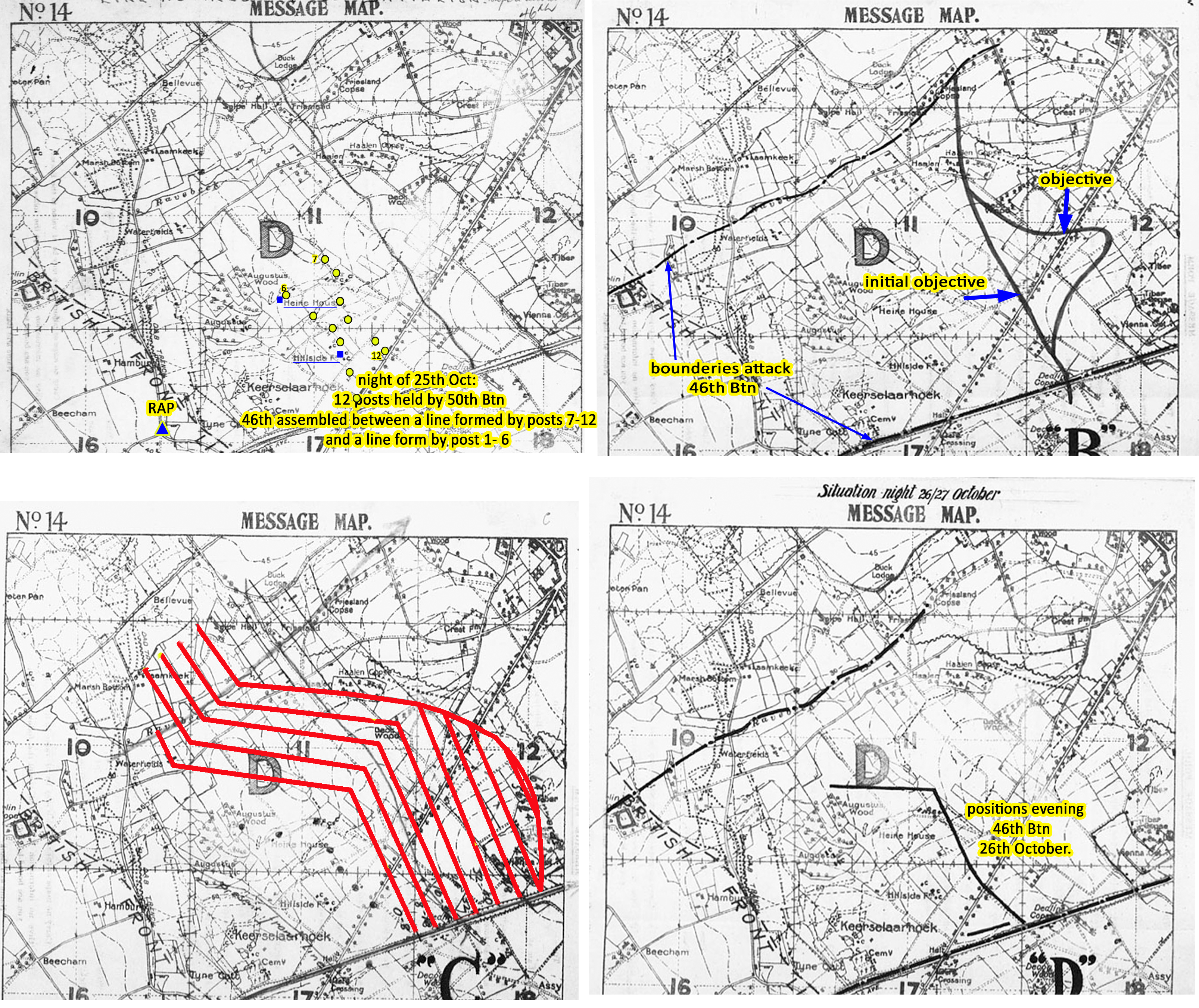
On 21 October 1917, the Canadian 10th Infantry Brigade (including the 46th Battalion) arrived in the Ypres front area. On the 22nd, the brigade took over the front line south of Passchendaele, with the 50th Battalion in the front line and the 46th Battalion directly behind it in support. While waiting for the attack (scheduled for the 26th), the men took shelter in shell holes, with their groundsheets as their only protection. Rain and cold made conditions particularly harsh. German shelling caused heavy casualties. In preparation for the attack, on the evening of the 25th, the 46th Battalion moved to positions in the front line near Heine House and Hillside Farm.
The artillery bombardment began at 5.40 a.m., but fell short, causing many casualties among their own ranks even before the troops could advance. During the attack, the 46th Battalion suffered heavy losses from both friendly and German artillery fire, as well as intense German machine gun fire. With the support of the 50th Battalion, all objectives were captured and reinforced before noon.
Around 4 p.m., the enemy launched a heavy artillery bombardment on the lines and launched several counterattacks. Due to the high number of casualties, the weak defensive line and the lack of artillery support, the 46th Battalion withdrew towards Zonnebeke, mainly using the Zonnebeke-Passendale road. After some regrouping, the battalion held its ground in a line close to the positions from which they had departed that morning.
In the evening, the 46th Battalion was relieved and withdrew to Levis Corner, near the center of Zonnebeke. The Germans fired gas grenades and other ammunition at that area, resulting in further casualties.
According to the report by Lt. Col. Dawson, who commanded the 46th, the battalion suffered 402 casualties (53 killed, 287 wounded, 62 missing), which amounts to 70%. The website CWGC.org lists 98 men from the 46th who were killed on 26 October, 75of whom are commemorated on the Ypres (Menin Gate) Memorial and 11 buried at Tyne Cot Cemetery. Within days of the attack, another 16 men from the 46th Battalion died of their wounds in field hospitals. The very high losses during this and other operations in the First World War earned the battalion the nickname “The Suicide Battalion”.
Alfred Octavius Croxon was killed in action on the 26th and was buried south of Crest Farm, near the farthest boundary that the 46th battalion reached during the attack. His body was exhumed in 1920 and reburied in Tyne Cot Cemetery plot XV. G. 4
Sources 9
|
1901 England Census, RG13; Piece: 1593; Folio: 161; Page: 7 http://www.ancestry.com Sources used |
|
Circumstance of Death (Library and Archives Canada, Ottawa (LAC), RG150, 1992-93/314, 169) https://library-archives.canada.ca/ Sources used |
|
Commonwealth War Graves Registers, First World War (Library and Archives Canada, Ottawa (LAC), RG150, 1992-93/314, 16) https://library-archives.canada.ca/ Sources used |
|
Library and Archives Canada; Ottawa, ON, Canada; Passenger Lists, 1865-1935; Series: RG 76-C; Roll: T-4766 https://www.ancestry.com/ Sources used |
|
London Metropolitan Archives; London, England, UK; Electoral Register https://www.ancestry.com/ Sources used |
|
London Metropolitan Archives; London, England, UK; London Church of England Parish Registers; Reference Number: P84/TRI1/001 https://www.ancestry.com/ Sources used |
|
newspaperclipping from Saskatoon Daily Star, Tue, Nov 27, 1917 ·Page 13 https://www.newspapers.com/image/508201947 Sources used |
|
Personnel Records of the First World War (Library and Archives Canada, Ottawa (LAC), RG 150, Accession 1992-93/166, Box 2185 - 17) https://library-archives.canada.ca/ Sources used |
|
War diaries: 46th Canadian Infantry Battalion (Library and Archives Canada, Ottawa (LAC), RG9-III-D-3, Volume number: 4939, Microfilm reel number: T-10745--T-10746, File number: 43 https://library-archives.canada.ca/ Sources used |
More information 5
|
Namenlijst (In Flanders Fields Museum) https://namenlijst.org/publicsearch/#/person/_id=9d95cddb-fc06-4927-841a-b9115d9e6239 |
|
Lives of the First World War (Imperial War Museum) https://livesofthefirstworldwar.iwm.org.uk/lifestory/5604258 |
|
Commonwealth War Graves Commission Database https://www.cwgc.org/find-records/find-war-dead/casualty-details/462440 |
|
A Street Near You https://astreetnearyou.org/person/462440// |
|
The Canadian Virtual War Memorial https://www.veterans.gc.ca/en/remembrance/memorials/canadian-virtual-war-memorial/detail/597966 |