Pte
Charles Leslie Harding Mcadam
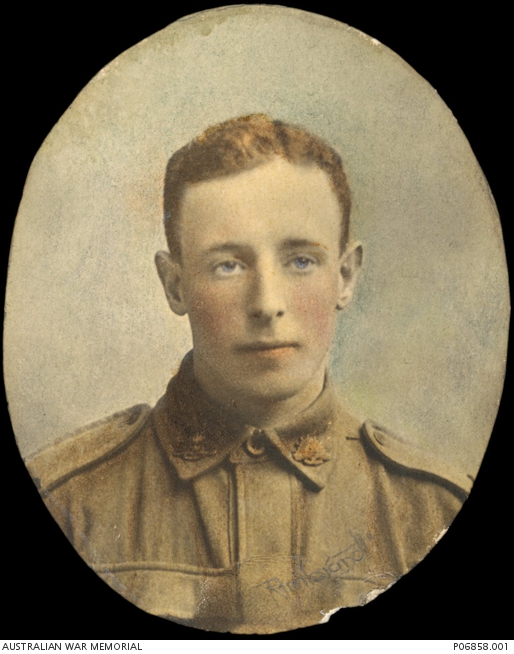
Information about birth
|
Year of birth: 1895 |
|
Place of birth: Hawthorn, Victoria, Australia |
General information
|
Last known residence: Canterbury, Victoria, Australia |
|
Profession: Stationer |
|
Religion: Church of England |
Army information
|
Country: Australia |
|
Force: Australian Imperial Force |
|
Rank: Private |
|
Service number: 2336 |
|
Enlistment date: 16/02/1916 |
|
Enlistment place: Melbourne, Victoria, Australia |
|
Units: — Australian Infantry, 39th Bn. (Last known unit) |
Information about death
|
Date of death: 04/10/1917 |
|
Place of death: Tulip Cottages, Zonnebeke, Belgium |
|
Cause of death: Killed in action (K.I.A.) |
|
Age: 22 |
Cemetery
|
Tyne Cot Cemetery Plot: XVI Row: G Grave: 11 |
Distinctions and medals 2
|
British War Medal Medal |
|
Victory Medal Medal |
Points of interest 5
| #1 | Place of birth | ||
| #2 | Last known residence | ||
| #3 | Enlistment place | ||
| #4 | Place of death (approximate) | ||
| #5 | Sterfteplaats |
My story
Charles McAdam was born around 1895 in Hawthorn, Victoria, Australia. He was the son of Ellen and Charles William Harding. He worked as a bookseller. In September 1916, he enlisted in the 10th Brigade, 39th Btn. However, he was not new to the army, as he had previously served in the 48th Infantry. He left for England in early 1917. There, he was detained and convicted for allegedly helping a prisoner, George Wilson, to escape. He pleaded not guilty but was nevertheless found guilty.
To break through to the coast, the Passchendaele Ridge had to be captured. The Battle of Broodseinde was part of this effort and began on 4 October at 6:00 a.m. For this attack, the Australian divisions fought side by side—this would be the only time during the war. The 39th Btn. advanced under heavy rifle fire coming from bunkers, the so-called pillboxes. It was therefore crucial to eliminate the gunners in these pillboxes. The 39th Btn. succeeded in doing so on their way to their first objective near Berlin Wood. There they were overtaken by the 40th Btn., and many men of the 39th Btn. decided to continue advancing with them in order to reach the final objective at Tyne Cot. They reached it before 11:00 a.m. Around 9:00 p.m., they were relieved by the 198th Brigade, 66th Imperial Division. It was a very heavy battle with many casualties. Nevertheless, this was a success for the Australians.
It was during this early morning that Charles died from a gunshot wound to the abdomen. He was 22 years old. Lionel Savage testified that he saw Charles’s body, which lay there peacefully. Lionel collected his belongings to return them to his parents. Another soldier, Richie, also testified that he saw Charles die. He saw him being struck by a bullet in the abdomen, and he died about an hour later. He was buried at Levi Cottage by a Canadian chaplain, but was later reinterred at Tyne Cot Cemetery. There was initially some uncertainty about his identity, but the Commonwealth War Graves Commission eventually determined that this was indeed Charles’s grave, and he still rests there today.
Sources 6
|
Australian Red Cross Wounded and Missing Enquiry Bureau (Australian War Memorial, Campbell (AWM), RCDIG1046686 https://www.awm.gov.au/ Sources used |
|
First Australian Imperial Force Personnel Dossiers, 1914-1920 (National Archives of Australia, Canberra (NAA), B2455, McAdam C.L.H. https://recordsearch.naa.gov.au/ Sources used |
|
Koch, Koen. De derde slag bij Ieper 1917 (Antwerpen: Manteau, 2007), 204-208 Sources used |
|
McCarthy, Chris. Passchendaele: The Day by Day Account (Londen: Arms & Armour Press, 2018), 113 Sources used |
|
Patterson A.T. The Thirty-Ninth, The History of the 39th Battalion Australian Imperial Force (Uckfield; The Naval & Military Press Ltd, 2006), 135-151 Sources used |
|
Reid, Richard. Ieper 1917: Australiërs aan het westelijk front (Canberra: Department of Veteran’s Affairs, 2007), 13-14, 18 Sources used |
More information 2
|
CWGC https://www.cwgc.org/find-records/find-war-dead/casualty-details/463701 |
|
The AIF Project (UNSW Canberra) https://aif.adfa.edu.au/showPerson?pid=192533 |