L/Sjt
Walter Wild
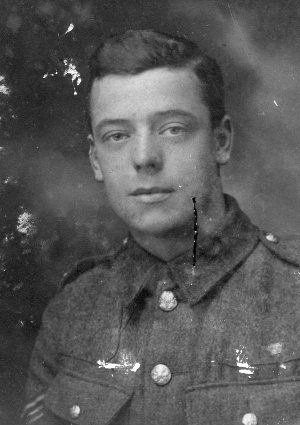
Information about birth
|
Date of birth: 22/11/1893 |
|
Place of birth: Hadfield, Derbyshire, England, United Kingdom |
General information
|
Last known residence: Burnley, Lancashire, England, United Kingdom |
|
Profession: Cotton Mill Worker |
|
Religion: Church of England |
Army information
|
Country: Verenigd Koninkrijk |
|
Force: British Expeditionary Force |
|
Rank: Lance Serjeant |
|
Service number: 241528 |
|
Enlistment date: 03/09/1914 |
|
Enlistment place: Burnley, Lancashire, England, United Kingdom |
|
Units: — East Lancashire Regiment, 2/5th Bn. (Last known unit) |
Information about death
|
Date of death: 09/10/1917 |
|
Place of death: Fleet Cottage, 's Graventafel, Belgium |
|
Cause of death: Killed in action (K.I.A.) |
|
Age: 23 |
Cemetery
|
Tyne Cot Cemetery Plot: XX Row: E Grave: 5 |
Distinctions and medals 2
|
British War Medal Medal |
|
Victory Medal Medal |
Points of interest 4
| #1 | Place of birth | ||
| #2 | Last known residence | ||
| #3 | Enlistment place | ||
| #4 | Sterfteplaats |
My story
Walter Wild, a former Cotton Mill Worker, was born on the 22nd of November 1893 in Hadfield, Derbyshire in England, The United Kingdom. He was the son of Arthur and Mary Wild and had 3 sisters named Elsie, Elizabeth and Ada. Later on he married Rosamund Alderson.
Walter Wild enlisted in Burnley, Lancashire in England, The United Kingdom. He would later on serve as a Lance Serjeant in the 2/5th Battalion of the East Lancashire Regiment, part of the 198th brigade, of the 66th division.
In early October 1917, the 2/5th Battalion East Lancashire Regiment, part of the 198th Brigade of the 66th Division, began preparations for an upcoming offensive near Ypres. On 4 October, the battalion moved from Godewaersvelde to Winnezeele, and over the following days, it prepared for front-line deployment, shedding all non-essential equipment. On 6 and 7 October, the battalion bivouacked in open fields east of Ypres. On 8 October, they moved closer to the front, southwest of the Frezenberg Ridge, and late that evening were guided by Australian engineers to their assembly area, which they reached at 12:30 AM on 9 October.
At 5:20 AM on 9 October, the battalion advanced in support of the 2/4th East Lancashires and 2/9th Manchesters, aiming to reach the Blue Line. Progress was severely impeded by deep mud, waterlogged trenches, and enfilade machine-gun fire from strongpoints such as Bellevue and Hamburg Redoubt. The attacking battalions were halted approximately 300 yards short of their objective, and the 2/5th, under fire, was unable to advance further. By midday, consolidation began.
In the evening, the 2/5th was pulled back behind the front-line units in readiness for counter-attacks. At dusk, a German counter-attack was launched but successfully repulsed with artillery and small-arms fire, with the 2/5th playing a key defensive role.
The battalion held its position under continued fire until relieved by the 42nd Australian Infantry on the evening of 11 October. Total casualties were 2 officers and 34 other ranks killed, 229 wounded, and 8 who later died of wounds.
Lance Serjeant Wild, aged 23, was killed in action on the 9th of October 1917. His body was initially buried near Fleet Cottage, ‘s Graventafel at 28.D.10.a.10.40. The remains were later exhumed and interred at The Tyne Cot Cemetery, Plot XX, Row E, Grave 5.
Sources 7
|
2/5 Battalion East Lancashire Regiment. (The National Archives, KEW (TNA), WO 95/3141/5). https://www.nationalarchives.gov.uk/ Sources used |
|
Burnley Roll Of Honour, (Burnley In The Great War - Andrew Gill). https://burnleyinthegreatwar.info/rollofhonour.htm Sources used |
|
Census Returns of England and Wales, 1901, (The National Archives, KEW (TNA), RG14). https://www.nationalarchives.gov.uk/ Sources used |
|
Census Returns of England and Wales, 1911, (The National Archives, KEW (TNA), RG14). https://www.nationalarchives.gov.uk/ Sources used |
|
McCarthy Chris, Passchendaele: The Day by Day Account, (London, Arms & Armour Press, 1995), pp. 118 - 127. Sources used |
|
Soldiers' Effects Records, (National Army Museum, Chelsea (NAM) 1901-60; NAM Accession Number: 1991-02-333). https://www.nam.ac.uk/ Sources used |
|
War Office and Air Ministry: Service Medal and Award Rolls, First World War, (The National Archives, KEW (TNA), WO 329). https://www.nationalarchives.gov.uk/ Sources used |
More information 4
|
CWGC https://www.cwgc.org/find-records/find-war-dead/casualty-details/465178 |
|
Namenlijst (In Flanders Fields Museum) https://namenlijst.org/publicsearch/#/person/_id=1b44506a-4667-43f7-9262-1daf88904d7c |
|
Lives of the First World War (Imperial War Museum) https://livesofthefirstworldwar.iwm.org.uk/lifestory/4744617 |
|
A Street Near You https://astreetnearyou.org/person/465178/ |