L/Cpl
George Astin
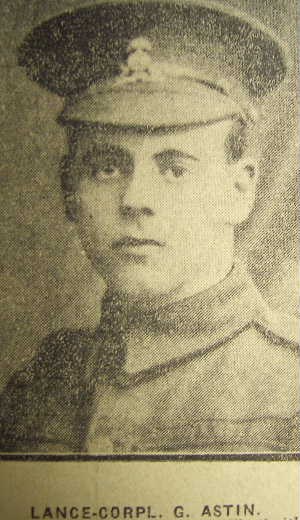
Information about birth
|
Year of birth: 1895 |
|
Place of birth: Burnley, Lancashire, England, United Kingdom |
General information
|
Last known residence: 31, Albert Street, Burnley, Lancashire, England, United Kingdom |
|
Profession: Cotton weaver |
|
Religion: Church of England |
Army information
|
Country: England, United Kingdom |
|
Force: British Expeditionary Force |
|
Rank: Lance Corporal |
|
Service number: 282553 |
|
Enlistment date: 07/09/1914 |
|
Enlistment place: Nelson, Lancashire, England, United Kingdom |
|
Units: — Lancashire Fusiliers, 2/7th Bn. (Last known unit) — Lancashire Fusiliers, 11th Bn. — Lancashire Fusiliers, 3rd Bn. |
Information about death
|
Date of death: 28/07/1917 |
|
Place of death: Nieuwpoort-Bad, Belgium |
|
Cause of death: Killed in action (K.I.A.) |
|
Age: 22 |
Cemetery
|
Coxyde Military Cemetery Plot: 2 Row: A Grave: 17 |
Distinctions and medals 3
|
1914-15 Star Medal |
|
British War Medal Medal |
|
Victory Medal Medal |
Points of interest 2
| #1 | Place of birth | ||
| #2 | Enlistment place |
My story
George Astin was born in 1895 and grew up in the family of George William and Sarah Emma Astin. He had a younger brother, John. He spent his youth in Burnley, Lancashire, England, where he found work as a cotton weaver as a young man. When war broke out, he enlisted in the British Army on 7 September 1914. However, it was not until 25 September 1915 that he was posted to active service.
George served with the Lancashire Fusiliers, initially with the regimental number 7812 in the 11th Battalion. He was later transferred to the 3rd Battalion and finally to the 2/7th Battalion, where he received the service number 282553. This battalion formed part of the 197th Brigade of the 66th Division. From April to September 1917, British troops took over the positions held by the French along the Flemish coast and the Yser at Nieuport. The 66th Division was responsible for the defence of the coastline. On 10 July 1917, the Germans launched a major attack in the Lombardsijde sector, capturing the right bank of the Yser from the British 1st Division. The artillery of both sides was particularly active, using both conventional shells and gas shells. On 15 July, the battalion moved to Nieuport Bains. Its duties consisted mainly of strengthening defensive positions, including cellars and trenches. During the night, patrols were sent across the water to observe German activity. On 28 July 1917, German artillery carried out heavy bombardments of Nieuwpoort-Bad and the surrounding rear area, where the 2/7th Battalion was resting. The British artillery responded with a fierce counter-bombardment. On 29 July, the battalion was relieved in the Nieuport Bains sector by the 2/9th Battalion, Manchester Regiment.
Lance Corporal George Astin, aged 22, was killed during these bombardments. He was buried in Coxyde Military Cemetery, Plot II, Row A, Grave 17.
Sources 8
|
197 Brigade Lancaster Fusiliers (The National Archives, Kew (TNA), WO 95/3134/2_4). https://www.nationalarchives.gov.uk Sources used |
|
2/7 Battalion Lancashire Fusiliers. War Diaries for March 1918 not included, reported... (The National Archives, KEW (TNA), WO 95/3136/5). https://discovery.nationalarchives.gov.uk/details/r/C14303 Sources used |
|
British Army World War I Medal Rolls Index Cards, 1914-1920 (The National Archives, Kew (TNA), WO 372). https://www.nationalarchives.gov.uk/ Sources used |
|
Census Returns of England and Wales, 1901 (The National Archives, Kew (TNA), RG13). https://www.ancestry.com/ Sources used |
|
Census Returns of England and Wales, 1911 (The National Archives, Kew (TNA), RG14). https://www.ancestry.com/ Sources used |
|
Soldiers' Effects Records (National Army Museum, Chelsea (NAM) 1901-60; NAM Accession Number: 1991-02-333). https://www.nam.ac.uk/ Sources used |
|
Vanacker Luc, De Britten aan de Belgische kust, de Noordzee als frontlijn tijdens WWI (1914-1918), (Gent, Academia Press, 2017), p70-83. Sources used |
|
War Office and Air Ministry: service medals and award rolls, First World War (the National Archives, kew (TNA), WO 329). https://www.nationalarchives.gov.uk/ Sources used |
More information 4
|
Commonwealth War Graves Commission Database https://www.cwgc.org/find-records/find-war-dead/casualty-details/89242 |
|
Namenlijst (In Flanders Fields Museum) https://namenlijst.org/publicsearch/#/person/_id=139113b0-faa0-492d-b715-acef9f15a2d2 |
|
Lives of the First World War (Imperial War Museum) https://livesofthefirstworldwar.iwm.org.uk/lifestory/88779 |
|
A Street Near You https://astreetnearyou.org/person/89242/ |