Pte
Christopher Gibson
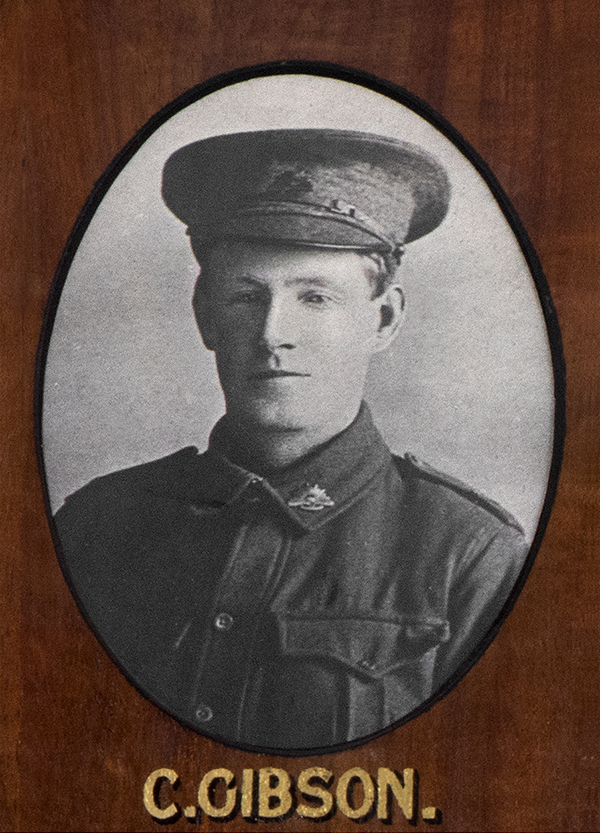
Information about birth
|
Date of birth: 24/12/1887 |
|
Place of birth: Melbourne, Victoria, Australia |
General information
|
Last known residence: Horsham, Victoria, Australia |
|
Profession: Farm Labourer |
|
Religion: Methodist |
Army information
|
Country: Australia |
|
Force: Australian Imperial Force |
|
Rank: Private |
|
Service number: 2080 |
|
Enlistment date: 01/06/1916 |
|
Enlistment place: Ballarat, Victoria, Australia |
|
Units: — Australian Infantry, 39th Bn. (Last known unit) |
Information about death
|
Date of death: 12/10/1917 |
|
Place of death: Hamburg, Passendale, Belgium |
|
Cause of death: Killed in action (K.I.A.) |
|
Age: 29 |
Cemetery
|
Tyne Cot Cemetery Plot: XXII Row: F Grave: 8 |
Distinctions and medals 2
|
British War Medal Medal |
|
Victory Medal Medal |
Points of interest 5
| #1 | Place of birth | ||
| #2 | Last known residence | ||
| #3 | Enlistment place | ||
| #4 | Place of death (approximate) | ||
| #5 | Sterfteplaats |
My story
Christopher Gibson, a former Farm Labourer, was born on the 24th of December 1887 in Melbourne, Victoria in Australia. He was the son of Hugh Wilson and Mary Gibson and had one brother named Arthur Glasbrough who also served for Australia in the First World War. Arthur Enlisted on the 15th of September 1915 and would return home on the 8th of April 1919.
Christopher enlisted on the 1st of June 1916 in Ballarat, Victoria in Australia. He would later on serve as a Private in the 39th Battalion Australian Infantry, Part of the 10th Australian Brigade, of the 3rd Australian Division. His Unit embarked from Adelaide on the 28th of August 1916.
In early October 1917, the 39th Battalion of the Australian Infantry, part of the 10th Brigade in the 3rd Australian Division, was engaged in preparatory and support activities around the Ypres sector. From 6 to 10 October, the battalion was occupied with drying clothing, equipping, and carrying ammunition for artillery batteries. On 11 October, final preparations were made at Hussar Farm, followed by an approach march to the assembly point under intermittent German shelling, including gas.
The plan for the 39th Battalion on 12 October was to support the 10th Brigade’s attack south of the Ravebeek, as part of the broader 3rd Division assault launched at 5.25 AM. The battalion moved during the night and reached the assembly point around 4 AM, despite delays and enemy shelling along K Track. At the start of the attack, elements of the battalion lost contact with officers, causing disorganisation. Attempts to reorganise and push forward were met with strong resistance from German snipers and machine guns near Augustus Wood and Waterfields.
By midday, many men began withdrawing, and the commanding officer ordered remaining troops to dig in along a line stretching from the railway junction to the crossroads near Waterfields. The attack failed to reach its final objectives, and the battalion held this line until relief by the 11th Brigade began at 7 PM on 13 October and was completed by 8.30 PM. The return march was difficult due to poor track conditions.
At the beginning of 12 October, the 39th Battalion was near Beecham Farm; by the end of the day, it was holding a defensive line south of Augustus Wood. On 14 October, the unit rested at Hussar Camp, recovering from the severe conditions.
Private Gibson, aged 29, was Killed In Action on the 12th of October 1917. His body was initially buried near Hamburg, Passchendaele at 28.D.16.a.70.60. The remains were later exhumed and interred at The Tyne Cot Cemetery, Plot XXII, Row F, Grave 8.
Connection to other soldiers 1
|
Arthur Glasbrough Gibson
Brother |
Sources 5
|
39 Australian Infantry Battalion OF 10 Brigade, (Australian War Memorial, Campbell (AWM), AWM4 23/60/14). https://www.awm.gov.au/ Sources used |
|
Australian Red Cross Wounded and Missing Enquiry Bureau (Australian War Memorial, Campbell (AWM), (RCDIG1067669). https://www.awm.gov.au/ Sources used |
|
First Australian Imperial Force Personnel Dossiers, 1914-1920 (National Archives of Australia, Canberra (NAA), B2455, G C). https://recordsearch.naa.gov.au/ Sources used |
|
McCarthy, Chris. Passchendaele: The Day by Day Account (Londen: Arms & Armour Press, 1995), p 128-139 Sources used |
|
Unit embarkation nominal rolls, 1914-18 War (Australian War Memorial, Campbell (AWM), AWM8). https://www.awm.gov.au/ Sources used |
More information 4
|
CWGC https://www.cwgc.org/find-records/find-war-dead/casualty-details/462869 |
|
Namenlijst (In Flanders Fields Museum) https://namenlijst.org/publicsearch/#/person/_id=de4ee3b0-a4dc-45f5-8d78-7e24249894b9 |
|
Lives of the First World War (Imperial War Museum) https://livesofthefirstworldwar.iwm.org.uk/lifestory/7474059 |
|
The AIF Project (UNSW Canberra) https://aif.adfa.edu.au/showPerson?pid=110037 |