Pte
Samuel Mitchell
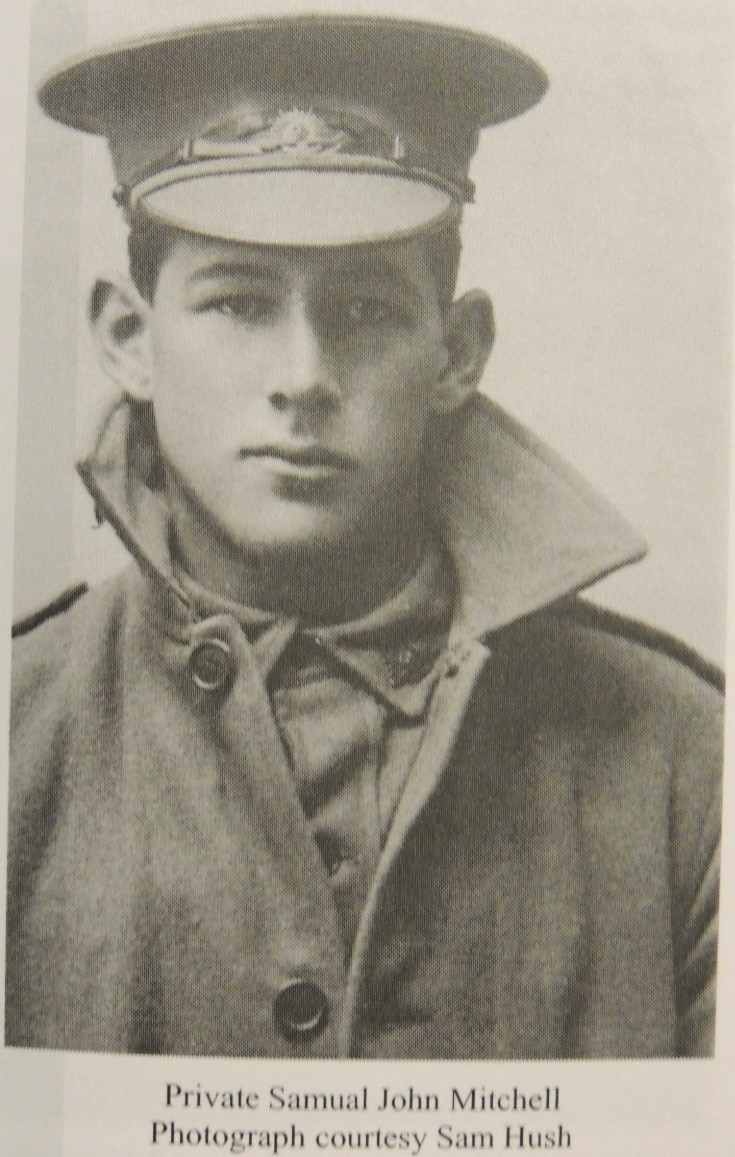
Information about birth
|
Year of birth: 1896 |
|
Place of birth: Moonan Flat, New South Wales, Australia |
General information
|
Last known residence: Uloola, New South Wales, Australia |
|
Profession: Grazier (sheep or cattle farmer) |
|
Religion: Presbyterian |
Army information
|
Country: Australia |
|
Force: Australian Imperial Force |
|
Rank: Private |
|
Service number: 1850 |
|
Enlistment date: 26/01/1916 |
|
Enlistment place: West Maitland, New South Wales, Australia |
|
Units: — Australian Infantry, 34th Bn. (Last known unit) |
Information about death
|
Date of death: 12/10/1917 |
|
Place of death: Hamburg, Passendale, Belgium |
|
Cause of death: Killed in action (K.I.A.) |
|
Age: 21 |
Cemetery
|
Tyne Cot Cemetery Plot: XXIII Row: C Grave: 16 |
Distinctions and medals 2
|
British War Medal Medal |
|
Victory Medal Medal |
Points of interest 4
| #1 | Place of birth | ||
| #2 | Last known residence | ||
| #3 | Enlistment place | ||
| #4 | Place of death (approximate) |
My story
Samuel Mitchell was born around 1896 in Moonan Flat, New South Wales, Australia. He was the son of John and Margaret Louisa Mitchell. Before enlisting, he worked as a stockman. On 26 January 1916, at the age of 20, he enlisted in Newcastle, New South Wales. He was subsequently assigned to the 34th Australian Infantry Battalion, 9th Brigade, 3rd Division, First Australian Imperial Force.
Samuel was killed in action on 12 October 1917 during the First Battle of Passchendaele, which was part of the Battle of Passchendaele. On 11 October, the 34th Australian Infantry Battalion marched towards Zonnebeke Station via the Ypres-Roulers railway line. The journey was difficult due to enemy artillery fire and the shattered ground. On the night of 11–12 October, the men assembled in their start positions, which stretched from Dabble Avenue to just southwest of Augustus Wood. Their objective on 12 October was to capture the first objective line, which ran from Deck Wood to the Ypres-Roulers railway line, just south of Vienna Cottages. Once captured, the 35th and 36th Australian Infantry Battalions were to pass through and advance towards the second and third objective lines, respectively, which ran from the current Passendale Street to the Ypres-Roulers railway line, and from Exert Farm to Echo Cops.
Between the arrival at the starting positions and the moment of the attack, the troops were subjected to heavy artillery fire. The attack began at 5:25 a.m., simultaneously with a weak Allied barrage. The attack advanced slowly through the sea of mud. Some men disappeared completely into the mud, while others had to be helped out. The first resistance was encountered from bunkers at Augustus Wood and Heine House, but these were eliminated by the attacking troops. During the advance towards the first objective line, the troops were subjected to heavy machine gun fire from Belle Vue, Meetcheele, Tiber, Tiber Copse, and from the railway embankment. The position in the railway embankment was silenced when the first objective line was reached. This was then immediately consolidated. Due to the high number of casualties in the 35th and 36th Battalions, it was decided to continue the attack towards the second objective line. This was eventually reached and consolidated after eliminating positions in Tiber Copse. However, due to the intensity of enemy artillery and machine gun fire, it was decided around 3:00 p.m. to withdraw to positions running from Delve Crossing to Waterfields. Both the first and second objective lines were surrendered back to the enemy. On October 19th, the battalion was withdrawn from the front line and sent to Ypres. Of the 528 men who went to the front line on October 11th, 262 returned.
Samuel was killed at the age of 21. His body was found and reburied at Tyne Cot Cemetery, Plot XXIII, Row C, Grave 16, after the war near Hamburg, Passchendaele.
Sources 6
|
34th Australian Infantry Battalion, (Australian War Memorial, Campbell (AWM), AWM4 23/51/12). https://www.awm.gov.au/collection/C1338583 Sources used |
|
Beaver E. and Meldrum J.W.G, A Short History of the 34th Battalion, AIF, (Carlton, Illawarra Press, 1957), p 22-25. Sources used |
|
First Australian Imperial Force Personnel Dossiers, 1914-1920, (National Archives of Australia, Canberra (NAA), B2455, MITCHELL SAMUEL). https://recordsearch.naa.gov.au/SearchNRetrieve/Interface/SearchScreens/NameSearch.aspx. Sources used |
|
McCarthy C., The Third Ypres Passchendaele. The Day-by-Day Account, (London, Arms & Armour Press, 1995), pp. 113-115. Sources used |
|
Samuel John Mitchell, ancestry.com https://www.ancestry.com/family-tree/person/tree/32787326/person/142280563482/facts Sources used |
|
Unit embarkation nominal rolls, 1914-18 War (Australian War Memorial, Campbell (AWM), AWM8 23/51/1). https://www.awm.gov.au/ Sources used |
More information 4
|
Commonwealth War Graves Commission Database https://www.cwgc.org/find-records/find-war-dead/casualty-details/463981 |
|
The AIF Project (UNSW Canberra) https://aif.adfa.edu.au/showPerson?pid=showPerson?pid=210816 |
|
Lives of the First World War (Imperial War Museum) https://livesofthefirstworldwar.iwm.org.uk/lifestory/7644195 |
|
Namenlijst (In Flanders Fields Museum) https://namenlijst.org/publicsearch/#/person/_id=73923f47-561f-41ba-bdd7-55e6fa8aa893 |