Pte
Harry / Henry Steadman

Information about birth
|
Date of birth: 27/10/1890 |
|
Place of birth: Keighley, Yorkshire, England, United Kingdom |
General information
|
Last known residence: 80 Frishot Street, Toronto, Ontario, Canada |
|
Profession: Teamster |
|
Religion: Church of England |
Army information
|
Country: England, United Kingdom |
|
Force: Canadian Expeditionary Force |
|
Rank: Private |
|
Service number: 775184 |
|
Enlistment date: 12/01/1916 |
|
Enlistment place: Toronto, Ontario, Canada |
|
Units: — Canadian Infantry, 38th Bn. (Ottawa) (Last known unit) |
Information about death
|
Date of death: 30/10/1917 |
|
Place of death: Hillside Farm, Keerselaarhoek, Belgium |
|
Cause of death: Killed in action (K.I.A.) |
|
Age: 27 |
Cemetery
|
Tyne Cot Cemetery Plot: XXIV Row: H Grave: 2 |
Distinctions and medals 2
|
British War Medal Medal |
|
Victory Medal Medal |
Points of interest 4
| #1 | Place of birth | ||
| #2 | Enlistment place | ||
| #3 | Place of death (approximate) | ||
| #4 | Sterfteplaats |
My story
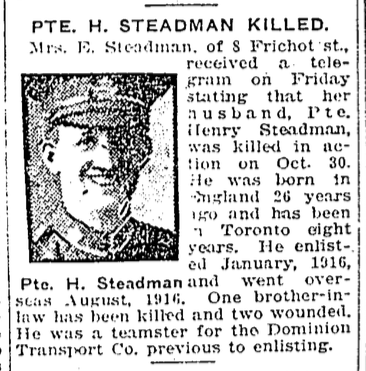
Harry (Henry, according to the Civil Registration Birth Index) Steadman was born on 27 October 1890 in Keighley, Yorkshire, England. He was the son of John Steadman (1852–1932) and Thirza Slack (1855–1937). In March 1910, Harry left England behind and emigrated to Canada. He set sail from Liverpool on the SS Canada and disembarked at the port of Portland, Maine (USA). From Portland, he travelled by train to Toronto, his final destination. In Toronto, he met Emma Adams, whom he married in 1911. Both were 20 years old at the time. He was a labourer; she worked in a factory. Later, Harry would work as a teamster for Dominion Transport Co., one of the largest transport firms of the time in Montreal and Toronto. Harry spent one year with the 10th Battalion, Royal Grenadiers of the Canadian Non-Permanent Active Militia, which was based in Toronto.
In January 1916, he volunteered for service with the 126th Battalion, CEF, also known as the ‘Peel Battalion’ because the battalion mainly recruited its men from Peel County (West Toronto and Brampton).
During his first few months in the army, Pte Steadman received basic military training at an army camp near Toronto.
In August, he and his regiment boarded a troop ship in Halifax bound for the United Kingdom, where he received advanced training.
In early December 1916, Pte Steadman was (on paper) transferred to the 38th Battalion, CEF, and sent to France. After brief stays at the Base Depot and the Entrenching Battalions (training and distribution camps), he finally joined his new unit in the field on 16 March 1917. The 38th Battalion was then stationed in the vicinity of Villers-au-Bois (F). There, the 38th Battalion was making preparations for the major offensive at Vimy and was constantly rotating between the front line, the support line and rest or training camps near Château de la Haie (Villers-au-Bois). The troops carried out small-scale operations, repaired trenches and conducted reconnaissance of the German lines.
After a brief rest period, the battalion took part in the Battle of Vimy Ridge and launched an attack on 9 April 1917. All objectives were achieved, but at a heavy cost in casualties. After another brief period of rest, the battalion resumed fighting near Lens (La Coulotte and Avion).
In July 1917, the battalion was withdrawn from the front for three weeks for reorganisation and training. The months of August and September were spent back at the front near Avion.
In October 1917, the 12th Canadian Infantry Brigade (comprising the 38th, 72nd, 78th and 85th Battalions and the 12th MGC) was withdrawn from the front in northern France to be deployed in Flanders (Belgium).
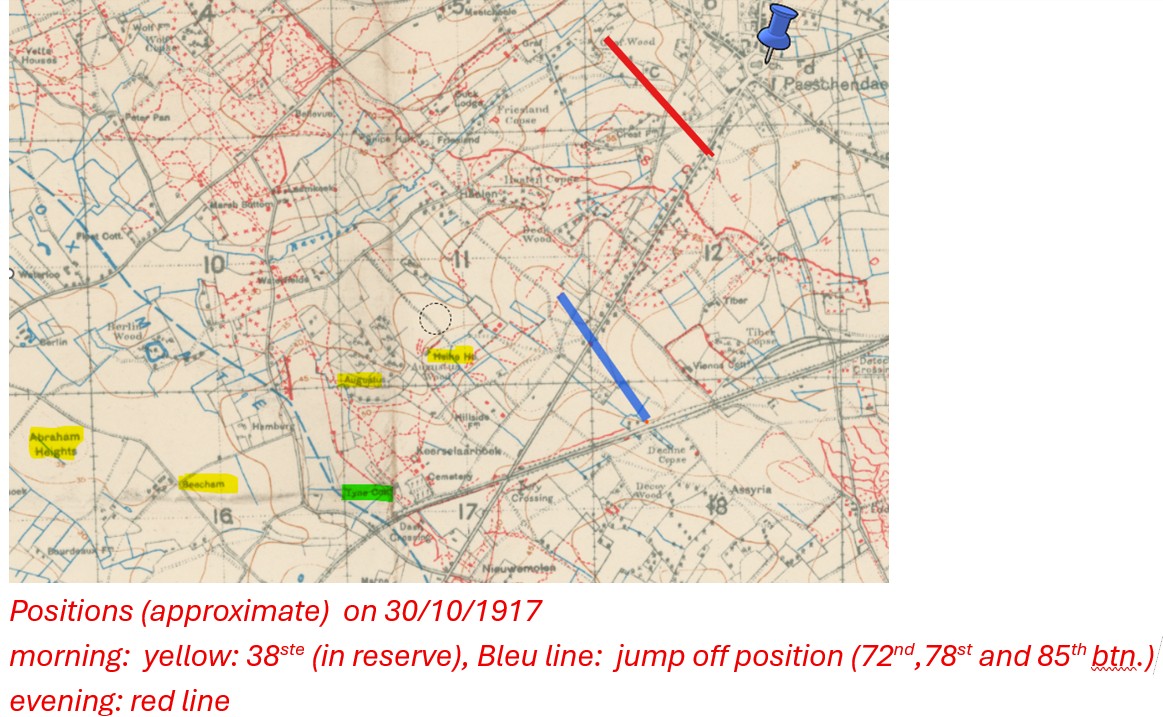
The 38th arrived in the vicinity of Poperinge (Belgium) on 23 October and, five days later, marched via Ypres to a camp in Pottijze, where they prepared for the coming battles: the brigade was to launch an attack on 30 October with the 85th, 72nd and 78th Battalions, whilst the 38th Battalion was to be held in reserve.
During the night of 29–30 October, the three battalions took up their positions on the front line, with the 38th just behind them in support. The 38th’s positions were as follows: B and D Companies at Augustus and Hillside Farm, and A and C Companies at Beecham and Abraham Heights.
The attack was launched at 05.40 on 30 October 1917. Despite heavy enemy shelling, the three battalions managed to capture their objectives fairly quickly. German artillery also targeted the positions of the 38th, which was being held in reserve. The 38th suffered considerable casualties; B Company, in particular, suffered heavy losses. The heavy German shelling continued for almost the entire day. The Germans appeared to be deliberately sparing the aid post at Tyne Cottage. In the afternoon, B, C and D Companies of the 38th were sent forward to consolidate the newly captured positions.
It was during the fighting on 30 October that Private Steadman was killed. He was buried at or near the spot where he fell.
On 31 October and 1 November, the 38th remained on the front line to reinforce and hold the forward positions captured on 30 October. There were no organised German counter-attacks, but German artillery continued to shell the Canadians heavily, causing heavy casualties. Among other things, ‘A’ Company helped to bring in supplies and evacuate the wounded. Late in the evening of 2 November, the 38th was relieved.
Back at the camp near Pottijze, the battalion (according to the War Diary) recorded its casualties*: killed in action: 1 officer and 48 men / wounded: 4 officers and 163 men / missing: 22 men.
On 3 November, the 38th left the Ypres Salient to return to France.
*According to CWGC.org: The Battle of Passchendaele ultimately cost the lives of 79 men from the 38th, 14 of whom are buried at Tyne Cot Cemetery. A further 37 have unmarked graves; their names are engraved on Panel 28 of the Menin Gate.
After the war, Pte Steadman’s grave was located at plot 28.D.17.A.90.40. His remains were exhumed and reburied at Tyne Cot Cemetery in Plot 24, Row H, Grave 4.
Sources 3
|
Commonwealth War Graves Registers, First World War (Library and Archives Canada, Ottawa (LAC), RG150, 1992-93/314, 124) https://library-archives.canada.ca/ Sources used |
|
Personnel Records of the First World War (Library and Archives Canada, Ottawa (LAC), RG 150, Accession 1992-93/166, Box 9249 - 43) https://library-archives.canada.ca/ Sources used |
|
War diaries: 38th Canadian Infantry Battalion (Library and Archives Canada, Ottawa (LAC), RG9-III-D-3, Volume number: 4938, Microfilm reel number: T-10743, File number: 432, File part: 1=1916/08/13-1917/12/31;2=1918/01/01-1919/05/31) https://library-archives.canada.ca/ Sources used |
More information 5
|
CWGC https://www.cwgc.org/find-records/find-war-dead/casualty-details/464752 |
|
Namenlijst (In Flanders Fields Museum) https://namenlijst.org/publicsearch/#/person/_id=dc4d1098-38ab-493b-879e-aa536fdef3b3 |
|
The Canadian Virtual War Memorial https://www.veterans.gc.ca/en/remembrance/memorials/canadian-virtual-war-memorial/detail/598732 |
|
Lives of the First World War (Imperial War Museum) https://livesofthefirstworldwar.iwm.org.uk/lifestory/TBD |
|
A Street Near You https://astreetnearyou.org/person/464752/ |