Pte
Arthur Noel Brown
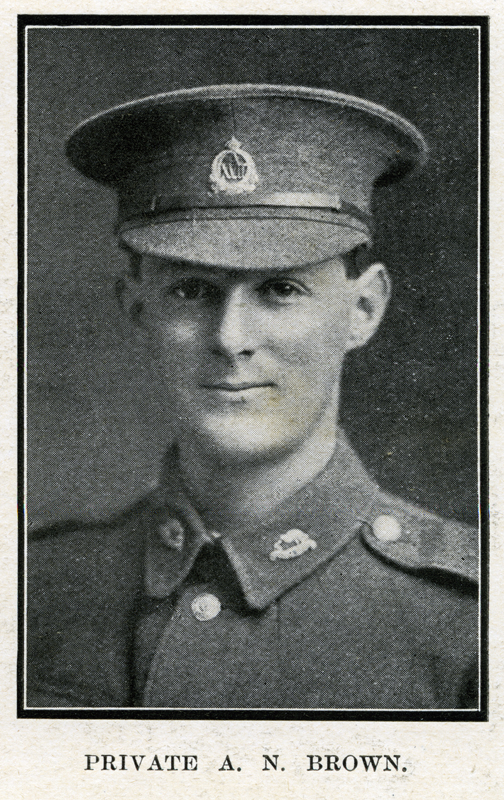
Information about birth
|
Date of birth: 21/12/1896 |
|
Place of birth: Whangarata, Waikato, New Zealand |
General information
|
Last known residence: Warkworth, Auckland, New Zealand |
|
Profession: Fruit Grower |
|
Religion: Church of England |
Army information
|
Country: New Zealand |
|
Force: New Zealand Expeditionary Force |
|
Rank: Private |
|
Service number: 26784 |
|
Enlistment date: 31/05/1916 |
|
Enlistment place: Trentham, Wellington, New Zealand |
|
Units: — Auckland Infantry Regiment, 2nd Bn. (Last known unit) |
Information about death
|
Date of death: 04/10/1917 |
|
Place of death: Vacher Farm, Wallemolen, Belgium |
|
Cause of death: Killed in action (K.I.A.) |
|
Age: 20 |
Cemetery
|
Tyne Cot Cemetery Plot: XXXIV Row: B Grave: 7 |
Distinctions and medals 2
|
British War Medal Medal |
|
Victory Medal Medal |
Points of interest 4
| #1 | Place of birth | ||
| #2 | Last known residence | ||
| #3 | Enlistment place | ||
| #4 | Place of death (approximate) |
My story
Arthur Noel Brown was the son of Francis Hamilton and Emily Brown. He was born on 21 December 1896 in Whangarata, Waikato. Before the war he worked as a fruit grower and lived in Warkworth, Auckland. Arthur enlisted in the New Zealand Army in May 1916, where he served in the 2nd Battalion Auckland Regiment (1st New Zealand Infantry Brigade, New Zealand Division).
Arthur died on 4 October 1917 during the Battle of Broodseinde, part of the Battle of Passchendaele. For the New Zealand Division, two attacks were scheduled that day: the 1st and 4th Brigade, of which Arthur’s battalion was also part, were tasked with capturing Graventafel and Abraham Heights, after which the 2nd and 3rd Brigade would pass them and push on to the foot of the Bellevue Spur.
The attack on Graventafel and Abraham Heights consisted of two phases. A first group would cross the Hannebeek and seize the German fortified positions and trenches up to the top of the ridge. Then a second group, including the 2nd Battalion Auckland Regiment, would pass them and advance to the foot of the Bellevue Spur.
During the night of 3 to 4 October, Arthur’s battalion occupied shell holes in the Canvas–Capricorn system. Until the morning of 4 October the German artillery bombardments were heavy. The first group managed to reach its objective. However, at the top of the ridge was the heavily defended German Korek Bunker. The 2nd Battalion Auckland Regiment soon became involved in the fighting for that bunker. One section advanced further and suffered casualties from rifle fire. Others succeeded in encircling the German troops, after which they surrendered. The New Zealand troops advanced along the ridge toward their second objective, the Bellevue Spur.
The attack was considered successful, and the consolidation of the captured positions began. German artillery remained active, but no counterattack followed. The next day, 5 October, artillery bombardments were again heavy. During the night of 5 to 6 October, the troops were relieved.
The losses of the 2nd Battalion Auckland Regiment were significant: 41 men were killed, 179 wounded and 40 missing. Arthur also lost his life on 4 October, at the age of 20. His body was found after the war near Vacher Farm, Wallemolen. His remains were reburied at Tyne Cot Cemetery, where he still rests.
Sources 3
|
Burton O.E. The Auckland regiment N.Z.E.F. 1914-1919. Being an account of the doings on active service of the first, second and third battalions of the Auckland Regiment (Auckland, Whitcombe & Tombs, 1922), 172-179. Sources used |
|
McCarthy, Chris. Passchendaele: The Day by Day Account (Londen: Arms & Armour Press, 1995), 113-114. Sources used |
|
New Zealand Defence Force Personnel Records (Archives New Zealand, Wellington (ANZ), R21899626). https://www.archives.govt.nz/ Sources used |
More information 3
|
Commonwealth War Graves Commission Database https://www.cwgc.org/find-records/find-war-dead/casualty-details/462070 |
|
Namenlijst (In Flanders Fields Museum) https://namenlijst.org/publicsearch/#/person/_id=89744160-2ece-42ca-a0a2-86e2a121e12f |
|
The NZEF Project (UNSW Canberra) https://nzef.adfa.edu.au/showPerson?pid=29808 |