Pte
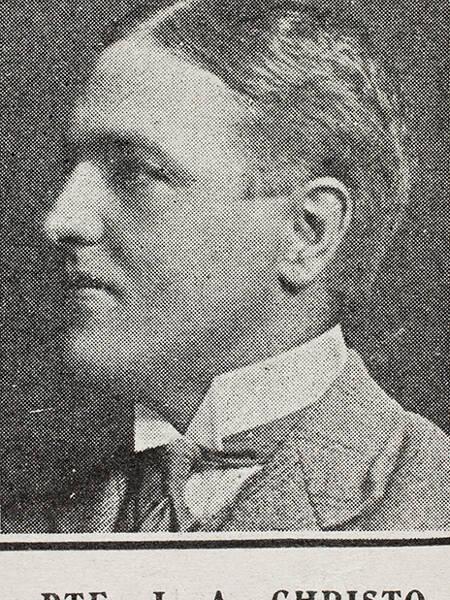
Julian Anthony Christophers
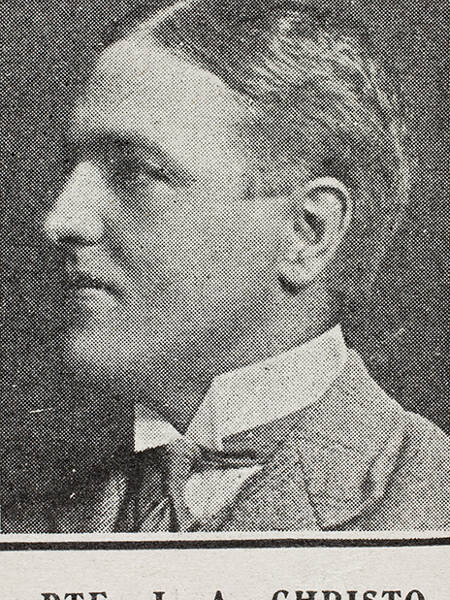
Information about birth
|
Date of birth: 28/05/1884 |
|
Place of birth: Dunedin, Otago, New Zealand |
General information
|
Last known residence: Wairoa, Hawke's Bay, New Zealand |
|
Profession: Business Manager |
|
Religion: Church of England |
Army information
|
Country: New Zealand |
|
Force: New Zealand Expeditionary Force |
|
Rank: Private |
|
Service number: 45998 |
|
Enlistment date: 18/12/1916 |
|
Enlistment place: Wairoa, Hawke's Bay, New Zealand |
|
Units: — Canterbury Regiment, 1st Bn. (Last known unit) |
Information about death
|
Date of death: 05/12/1917 |
|
Place of death: Lijssenthoek, Remy Siding, No. 10 Casualty Clearing Station, Belgium |
|
Cause of death: Died of wounds (D.O.W.) |
|
Age: 33 |
Cemetery
|
Lijssenthoek Military Cemetery Plot: XXVI Row: B Grave: 17 |
Distinctions and medals 2
|
British War Medal Medal |
|
Victory Medal Medal |
Points of interest 5
| #1 | Place of birth | ||
| #2 | Last known residence | ||
| #3 | Enlistment place | ||
| #4 | Place of wounding | ||
| #5 | Place of death (approximate) |
My story
Julian Christophers was born in 1884 in Dunedin, New Zealand, as the second son of Anthony and Juliet Mary Christophers. He grew up in Invercargill together with his four brothers. On 21 April 1908, he married Earle Featherston Bremner in Wellington. The couple had a daughter, Juliet, in 1909. Between 1902 and 1903, he played for the Southland Rugby Team and was captain of the Invercargill rugby team. From 1910 onwards, he worked as Branch Manager for Dalgety and Co. in Wairoa, Hawkes Bay, New Zealand.
There, on 18 December 1916, he enlisted in the New Zealand Expeditionary Force and was assigned to the 25th Reinforcements. He embarked at Wellington on 26 February 1917 and arrived at Devonport on 20 July 1917. Further military training followed in Great Britain. On 9 September 1917, he arrived in France, where he was posted to the 1st Battalion Canterbury Regiment, part of the 1st New Zealand Brigade of the New Zealand Division.
As the New Zealand Division was suffering from German machine-gun fire coming from the area around the ruins of Polderhoek Château, it was decided to launch a limited attack on 3 December 1917 to capture the position. In an attempt to surprise the Germans, the assault was scheduled to begin at midday. The 1st Battalion Otago Regiment attacked on the left flank along the Reutelbeek, while the 1st Battalion Canterbury Regiment advanced on the right flank along the Scheriabeek. The castle ruins lay within the sector of the 1st Battalion Otago Regiment; the 1st Battalion Canterbury Regiment was mainly tasked with forming a defensive flank towards Geluveld.
Both battalions attacked with two companies. Losses from earlier fighting had been replaced by fresh reinforcements, most of whom had little combat experience. During the attack, the 1st Battalion Canterbury Regiment came under heavy flanking fire from the direction of Geluveld. In addition, several German pillboxes that had not been neutralised provided stubborn resistance. As casualties mounted, the New Zealanders were eventually forced to dig in. Their new positions were established immediately in front of the ruins of Polderhoek Château, while gains were also made along the Scheriabeek.
Despite several German counter-attacks, the New Zealanders managed to hold their ground. They were relieved on 4 December 1917. However, a German counter-attack just over a week later erased the territorial gains that had been achieved.
During the fighting at Polderhoek, 33-year-old Private Julian Anthony Christophers was severely wounded. He was evacuated to Casualty Clearing Station No. 10 near Poperinge, where he succumbed to his wounds later that same day. He was buried in Lijssenthoek Military Cemetery, Plot XXVI, Row B, Grave 17.
Julian was the third son of the family to lose his life in the war. His brother Victor James Christophers was killed at Gallipoli on 31 May 1915, and Herbert Henry Christophers was killed near Armentières on 2 June 1916. The eldest son, Reginald Gillon Christophers, was also killed, near Beaulencourt, on 13 October 1918.
Sources 5
|
Archives New Zealand, New Zealand Defence Force, Personnal Archives, Box 64, Record 0024827. https://www.archives.govt.nz/ Sources used |
|
Ferguson David, The History of the Canterbury Regiment, NZEF 1914-1919, (Uckfield: the Naval & Military Press Ltd, RidgewoodIndustrial Park, 1921), 214-216. Sources used |
|
Gray John H., Quid Non Pro Patria, the Short, Distinguished Military Life of Henry James Nicholas VC MM, (Christchurch, Christchurch City Councel, Copyright John H Gray 2007), 18-21. Sources used |
|
Kiwi family lost four out of five sons in World War I. https://www.stuff.co.nz/national/last-post-first-light/78445761/ Sources used |
|
Stewart H., The New Zealand Division 1916-1919, (Londen, Intype London Ltd.,NN), 311-315. Sources used |
More information 5
|
Commonwealth War Graves Commission Database https://www.cwgc.org/find-records/find-war-dead/casualty-details/433100 |
|
Namenlijst (In Flanders Fields Museum) https://namenlijst.org/publicsearch/#/person/_id=aed7a80d-1290-4cd2-b45b-03d2cb6ccf34 |
|
Lives of the First World War (Imperial War Museum) https://livesofthefirstworldwar.iwm.org.uk/lifestory/7172424 |
|
The NZEF Project (UNSW Canberra) https://nzef.adfa.edu.au/showPerson?pid=44907 |
|
Online Cenotaph (Auckland Museum) https://www.aucklandmuseum.com/war-memorial/online-cenotaph/record/C2597 |