Pte
James George Billings
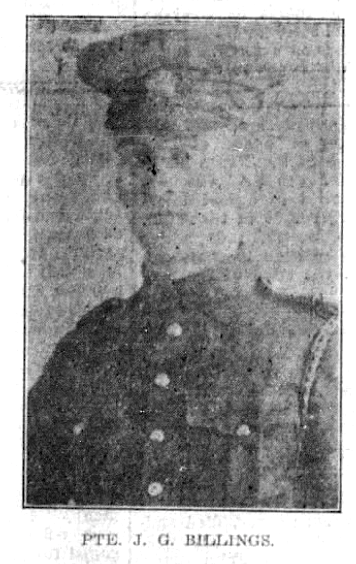
Information about birth
|
Date of birth: 14/01/1887 |
|
Place of birth: Brockville, Eastern Ontario, Canada |
General information
|
Last known residence: Wellington Street, Kingston, Eastern Ontario, Canada |
|
Profession: Street car conductor |
|
Religion: Church of England |
Army information
|
Country: Canada |
|
Force: Canadian Expeditionary Force |
|
Rank: Private |
|
Service number: 8074 |
|
Enlistment date: 22/09/1914 |
|
Enlistment place: Valcartier, Quebec, Canada |
|
Units: — Canadian Infantry, 2nd Bn. (Eastern Ontario) (Attached) |
Information about death
|
Date of death: 28/04/1915 |
|
Place of death: Turpin Crossing, Ten Brielen, Belgium |
|
Cause of death: Died of wounds (D.O.W.) |
|
Age: 28 |
Cemetery
|
Tyne Cot Cemetery Plot: LXVI Row: D Grave: 7 |
Points of interest 3
| #1 | Place of birth | ||
| #2 | Last known residence | ||
| #3 | Place of death (approximate) |
My story
James George Billings, a former street car conductor, was born on the 14th of January of 1887 in Brockville, East Ontario in the country of Canada. He was the son of Henry and Laura Beckinsale Billings and had a sister named Carrie. On the 8th of December 1909 he married Pearl Ethel Warren.
James George enlisted on the 22nd of September of 1914 in Valcartier, Quebec in Canada. He would later on serve as a private in the 2nd Battalion, Canadian Infantry, part of the 1st Canadian Brigade, of the 1st Canadian Division.
In the final weeks of April 1915, during the Second Battle of Ypres, the 2nd Battalion, Canadian Infantry, part of the 1st Canadian Brigade, 1st Canadian Division, played a crucial role in the fighting around St-Julien. On April 23rd, the battalion arrived near Vlamertinghe and was ordered forward to support a counterattack by the 10th and 16th Battalions. No.1 Company launched an assault on an enemy-held trench but was stopped by intense machine-gun fire from both flanks. The remaining companies dug in, establishing a defensive line with No.2 Company securing ground east toward St-Julien.
The following day, April 24th, German forces launched a strong infantry attack. They breached lines to the right, though No.2 and No.4 Companies held firm, repelling assaults and inflicting heavy casualties. As the 3rd Battalion was forced back, the 2nd Battalion’s right flank became exposed, and a withdrawal was ordered under fire, resulting in significant losses.
On April 25th and 26th, the battalion moved between front-line trenches and billets near La Brique and Vlamertinghe, before being repositioned near Brielen. April 27th saw them return to previously dug positions near the Yser Canal.
April 28th was marked by relentless German shelling. The battalion held its ground under heavy artillery fire, suffering casualties while maintaining positions in open terrain. That night, they provided a covering party for entrenching operations under dangerous conditions, displaying remarkable endurance and discipline.
The covering party returned on April 29th with two wounded. The next day, April 30th, the battalion focused on reorganizing, inspecting equipment, and recovering at Vlamertinghe—closing a harrowing week of battle with a brief moment of rest.
Private Billings, aged 28, Died of wounds while taken prisoner of war on the 28th of April 1915. His body was initially buried near Turpin Crossing, Ten Brielen at 28.P.23.b.7.6. The remains were later exhumed and interred at The Tyne Cot Cemetery, Plot LXVI, Row D, Grave 7.