Cpl
James Wallis
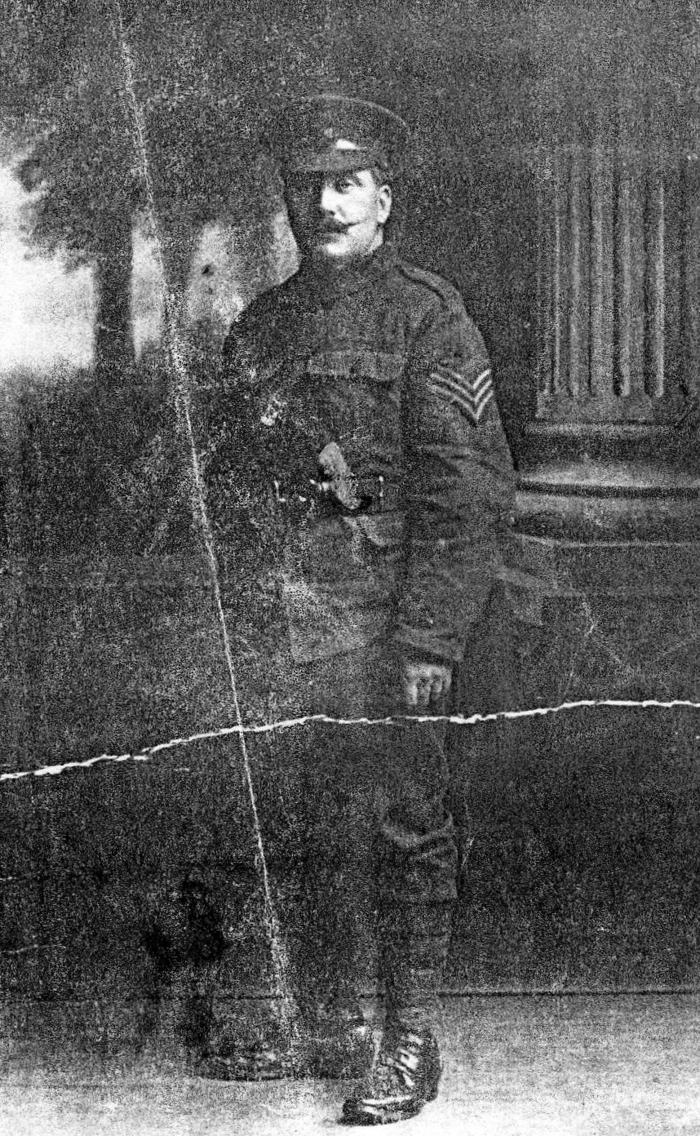
Information about birth
|
Year of birth: 1884 |
|
Place of birth: St George in the East, Middlesex, England, United Kingdom |
General information
|
Last known residence: 11 Devonport Street, St George in the East, Middlesex, England, United Kingdom |
|
Profession: Dock Labourer |
Army information
|
Country: Ireland, United Kingdom |
|
Force: British Expeditionary Force |
|
Rank: Corporal |
|
Service number: 42193 |
|
Enlistment place: Stepney, Middlesex, England, United Kingdom |
|
Units: — Royal Irish Rifles, 13th Bn. (1st County Down) (Last known unit) |
Information about death
|
Date of death: 16/08/1917 |
|
Place of death: Somme - Wiesengut, Saint-Julien, Belgium |
|
Cause of death: Killed in action (K.I.A.) |
|
Age: 33 |
Cemetery
|
Tyne Cot Cemetery Plot: IV Row: G Grave: 22 |
Distinctions and medals 2
|
British War Medal Medal |
|
Victory Medal Medal |
Points of interest 4
| #1 | Place of birth | ||
| #2 | Last known residence | ||
| #3 | Enlistment place | ||
| #4 | Place of death (approximate) |
My story
James Wallis was born around 1884 in St George in the East, Middlesex, near London. His parents, James and Ellen Wallis, were Irish immigrants. His father worked nearby as a dock labourer. What is now a gentrified London neighbourhood was then a harsh, impoverished dockland district. In 1896, his father passed away. His mother struggled to make ends meet, and at the age of twelve, James ended up in the St George-in-the-East Workhouse — a place where the destitute were put to work.
Two years later, he escaped poverty by lying about his age and enlisting in the army as an 18-year-old. The tattooed, scarred 16-year-old was assigned to the Army Service Corps as a Driver. James was the very image of the average soldier: poor and tough — though far from exemplary. His record was riddled with offences: brawling, desertion, disobedience, uniform infractions — often committed under the influence.
In 1908, after leaving the army, James married Beatrice Maud. They had four children: sons Eugene James and Cornelius John, and daughters Ann and Beatrice Mary. Like his father, James found work on the docks — a hard life shaped by the tides of the Thames. But history was about to turn.
James, like so many, was swept into the First World War. The Londoner of Irish descent served on the Western Front in the 13th Battalion (1st County Down) of the Royal Irish Rifles, part of the 108th Brigade in the 36th (Ulster) Division.
On 16 August 1917, the 36th Division took up positions just south of the village of Sint-Juliaan. The division advanced with two brigades: the 109th on the left, and the 108th on the right. The 16th (Irish) Division was to their right. Battalions of the 108th that took part included the 9th Royal Irish Fusiliers and the 13th Royal Irish Rifles; the 12th supported, and the 11th remained in reserve.
At 4:45 a.m., the attack began behind a creeping barrage. But the boggy terrain slowed the advance. The field was strewn with flooded craters and waterlogged trenches. The leading troops came under heavy machine-gun and rifle fire from bunkers at Somme Farm. They passed it but couldn’t take it, and the companies were forced to dig in nearby.
Support and reserves were sent forward but were pinned down by fire from Gallipoli, Hindu Cottage, and Aisne Farm to the right, and from Pond Farm and again Hindu Cottage to the left. Within an hour, the battalion had withdrawn. Another attempt to capture Somme, with reinforcement from battalion HQ, failed under intense crossfire. The 108th Brigade's lines were in disarray, and officers began reorganising survivors and reinforcing the position. The following day, the 107th Brigade took over.
The attack was a disaster. The two Irish divisions made little to no progress. No further attacks were launched by the 36th Division that day.
The Thames would not carry James home again. The 33-year-old Acting Sergeant, father of four — the youngest born in 1915 — was killed on 16 August 1917. He was initially buried in front of the line near Somme. After the war, he was laid to rest at Tyne Cot Cemetery, Plot IV, Row G, Grave 22.
Sources 8
|
13 Battalion Royal Irish Rifles (The National Archives, KEW (TNA), WO 95/2506/3). https://www.nationalarchives.gov.uk/ Sources used |
|
Census Returns of England and Wales, 1881 (The National Archives, Kew (TNA), RG11). https://www.nationalarchives.gov.uk/ Sources used |
|
Census Returns of England and Wales, 1891 (The National Archives, Kew (TNA), RG12). https://www.nationalarchives.gov.uk/ Sources used |
|
Census Returns of England and Wales, 1901 (The National Archives, Kew (TNA), RG13). https://www.nationalarchives.gov.uk/ Sources used |
|
Census Returns of England and Wales, 1911 (The National Archives, Kew (TNA), RG14). https://www.nationalarchives.gov.uk/ Sources used |
|
McCarthy Chris., Passchendaele. The Day-by-Day Account (London, Unicorn Publishing Group, 2018) 52-55. Sources used |
|
War Office: Soldiers' Documents (The National Archives, Kew (TNA) WO 363). https://www.nationalarchives.gov.uk/ Sources used |
|
Workhouse Admission and Discharge Records, 1764-1921 (London Metropolitan Archives, London, SOBG/106/78). https://www.thelondonarchives.org/ Sources used |
More information 3
|
Commonwealth War Graves Commission Database https://www.cwgc.org/find-records/find-war-dead/casualty-details/465031 |
|
Namenlijst (In Flanders Fields Museum) https://namenlijst.org/publicsearch/#/person/_id=57653d65-0400-4b22-aebf-f5cb139ecc1a |
|
Lives of the First World War (Imperial War Museum) https://livesofthefirstworldwar.iwm.org.uk/lifestory/4589058 |