Pte
Jonathan Horn
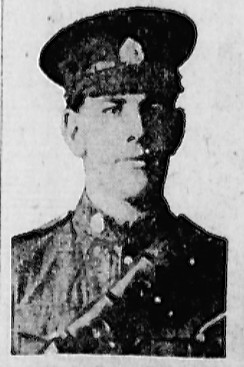
Information about birth
|
Date of birth: 10/04/1889 |
|
Place of birth: Asby, Westmorland, England, United Kingdom |
General information
|
Last known residence: 1629 Ross Avenue, Winnipeg, Manitoba, Canada |
|
Profession: Gardener |
|
Religion: Presbyterian |
Army information
|
Country: England, United Kingdom |
|
Force: Canadian Expeditionary Force |
|
Rank: Private |
|
Service number: 542465 |
|
Enlistment date: 06/02/1917 |
|
Enlistment place: Winnipeg, Manitoba, Canada |
|
Units: — Canadian Infantry, 27th Bn. (City of Winnipeg) (Last known unit) |
Information about death
|
Date of death: 06/11/1917 |
|
Place of death: Tyne Cottage, Passchendaele, Belgium |
|
Cause of death: Killed in action (K.I.A.) |
|
Age: 28 |
Cemetery
|
Tyne Cot Cemetery Plot: XXXIV Row: J Grave: 22 |
Points of interest 5
| #1 | Place of birth | ||
| #2 | Last known residence | ||
| #3 | Enlistment place | ||
| #4 | Place of death (approximate) | ||
| #5 | Place of death or original burial place |
My story
Jonathan Horn was born on 10 April 1889 in Asby, Cumberland, England, United Kingdom. He was the son of Agnes Horn and the husband of Hilda Horn. Before enlisting, he emigrated to Canada where he worked as a gardener. On 6 February 1917, at the age of 27, he enlisted in Winnipeg, Manitoba. He was initially assigned to the Divisional Cyclist Depot of the Canadian Corps Cyclist Battalion. After his arrival in the United Kingdom, he was transferred to the 27th Battalion (City of Winnipeg), 6th Canadian Infantry Brigade, 2nd Canadian Division.
Jonathan was killed in action on 6 November 1917 during the capture of Passchendaele, part of the Battle of Passchendaele. On 4 November, the 27th Battalion (City of Winnipeg) was positioned in the hamlet of Potijze. The following day at 1 a.m., the battalion moved towards Hill 37, northwest of Zonnebeke, where they relieved the 20th Battalion (Central Ontario). Later that day at 5 p.m., the battalion moved to the front line, from where the attack on Passchendaele would be launched. On 6 November at around 3 a.m., the attacking troops gathered at their starting positions just outside Passchendaele, stretching from what is now Passendalestraat to the present-day Canadalaan, just east of Crest Farm. Their objective was to capture the centre of Passchendaele and the lines just northeast of what is now Doornkouterstraat. The attack was to be carried out by “B”, “C”, and “D” Company. Between 4 a.m. and 6 a.m., the men in their starting positions were repeatedly shelled by artillery fire.
The attack commenced at 6 a.m., when the Allied artillery laid down a barrage. The artillery partially neutralised the foremost German position at about 45 metres from the starting line, after which the remaining German troops were overpowered. The Canadians then advanced towards the centre of Passchendaele, where they came under rifle and machine-gun fire. Upon reaching the ruins of the village, the German troops were killed with bayonets. After securing the village centre, the Canadians advanced towards the final objective line. During this final phase, they came under sniper fire. A machine-gun post attempted to hold the left flank but was destroyed by rifle grenades. The final objective line was secured at around 7:30 a.m. The newly captured positions were immediately consolidated. Between 4 p.m. and 5 p.m., the beginning of a German counterattack was observed, but it was broken up by Allied artillery. Due to heavy shelling in the following days, the fallen soldiers, except those near the starting positions, could not be buried. During the night of 7 to 8 November, the battalion was relieved by the 22nd Battalion (French Canadian). It then returned to Erie Camp near Brandhoek. During their three days on the front line, the battalion suffered 45 killed, 187 wounded, and 10 missing.
Jonathan was hit by artillery fire and was killed in action at the age of 28, barely 9 months after his enlistment. His body was initially buried at the forward dressing station near Tyne Cottage and was reburied after the war at Tyne Cot Cemetery, plot XXXIV, row J, grave 22.
Sources 5
|
5th Canadian Infantry Brigade. (Library and Archives Canada, Ottawa (LAC), RG9-III-D-3, 4886, T-10682, 253). https://library-archives.canada.ca Sources used |
|
McCarthy, Chris. Passchendaele: The Day by Day Account (Londen: Arms & Armour Press, 1995), p. 162-3. Sources used |
|
Personnel Records of the First World War (Library and Archives Canada, Ottawa (LAC) RG 150, Accession 1992-93/166, Box 4499 - 21). https://library-archives.canada.ca/ Sources used |
|
War diaries: 27th Canadian Infantry Battalion (Library and Archives Canada, Ottawa (LAC), RG9-III-D-3, Volume number: 4935, Microfilm reel number: T-10738--T-10739, File number: 423). https://library-archives.canada.ca/eng Sources used |
|
War Graves Registers: Circumstances of Death (Library and Archives Canada, Ottawa (LAC), RG150, 1992-93/314; Volume Number: 194). https://library-archives.canada.ca/eng Sources used |
More information 4
|
Namenlijst (In Flanders Fields Museum) https://namenlijst.org/publicsearch/#/person/_id=27be8194-a705-47f5-9ce5-2b2d34c0b6fc |
|
Commonwealth War Graves Commission Database https://www.cwgc.org/find-records/find-war-dead/casualty-details/463237 |
|
The Canadian Virtual War Memorial https://www.veterans.gc.ca/en/remembrance/memorials/canadian-virtual-war-memorial/detail/463237?Jonathan%20Horn |
|
Lives of the First World War (Imperial War Museum) https://livesofthefirstworldwar.iwm.org.uk/lifestory/5949733 |