L/Cpl
William Henry Hawkins
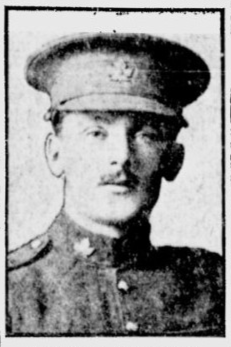
Information about birth
|
Date of birth: 17/07/1879 |
|
Place of birth: Wolverhampton, Staffordshire, England, United Kingdom |
General information
|
Last known residence: Calgary, Alberta, Canada |
|
Profession: Fitter |
|
Religion: Methodist |
Army information
|
Country: England, United Kingdom |
|
Force: Canadian Expeditionary Force |
|
Rank: Lance Corporal |
|
Service number: 446697 |
|
Enlistment date: 08/05/1915 |
|
Enlistment place: Calgary, Alberta, Canada |
|
Units: — Canadian Infantry, 31st Bn. (Alberta) (Last known unit) |
Information about death
|
Date of death: 06/11/1917 |
|
Place of death: Passchendaele, Belgium |
|
Cause of death: Killed in action (K.I.A.) |
|
Age: 38 |
Cemetery
|
Tyne Cot Cemetery Plot: II Row: CC Grave: 3 |
Distinctions and medals 2
|
British War Medal Medal |
|
Victory Medal Medal |
Points of interest 4
| #1 | Place of birth | ||
| #2 | Last known residence | ||
| #3 | Enlistment place | ||
| #4 | Place of death (approximate) |
My story
William Henry Hawkins, a former Fitter, was born on the 17th of July 1879 in Wolverhampton, Staffordshire in England, The United Kingdom. He was the son of Henry and Sarah Ann Hawkins. On the 10th of May 1903, William Henry arrived in Montreal, Quebec in Canada, starting a life Overseas. Later on in life, William Henry married Hilda Sarah Harvey. They had a daughter and son named Hilda Irene and William Harold.
William Henry enlisted on the 8th of May 1915 in Calgary, Alberta in Canada. He would later on serve as a Lance Corporal in the 31st Canadian Infantry (Alberta), Part of the 6th Canadian Brigade, of the 2nd Canadian Division.
On the 2nd of November 1917 the 6th Canadian Infantry Brigade ordered an attack on the village of Passchendaele, together with the 1st and 5th Canadian Infantry Brigade on their left and right. The 6th Canadian Infantry Brigade would attack with the 28th, 31st and 27th Canadian Infantry Battalions on the left, centre and right respectively. The 29th Canadian Infantry Battalion was held in reserve.
On the night of November 5th/6th the 31st Canadian Infantry Battalion relieved the 90th Canadian Infantry Battalion holding the frontline, northeast of the Grenadiersstraat-Canadalaan Crossroads. The battalion planned to attack the village in a northeasterly direction, passing the Passchendaele church on their right. “A” Company was tasked with capturing the first objective, the Vierde Regiment Karabiniersstraat and the houses along this street. “B” and “D” Companies were to take the second objective. This was a line starting along the Westrozebekestraat, about 300 metres south of Vindictive Crossroads, running to point 100 metres east of the five-pointed crossroads due north of Passchendaele. The final objective was a line running about 100 metres in front of the second objective. This line had to be captured by “C” Company. After all objectives had been captured, a new main resistance line would be constructed running north-south between the Osselstraat and Molenstraat. Two platoons of “B” and “D” Companies were held in reserve behind this line, at a farm east of Graf Wood.
At 6. a.m. on November 6th, 1917, “A” Company attacked, capturing the ruined houses along the first objective. “B” and “D” Companies passed through “A” Company and attacked the second objective. They encountered fortified cellars, dug outs and pillboxes, but were able to capture the objective. In doing so, they passed the crest of Passchendaele ridge and came under heavy sniper fire as they consolidated the line. This, along with concrete pillboxes on the front left flank, caused heavy casualties and delayed the attack of “C” Company on the final objective. They were able to take out these strongpoints and established posts in front of the second objective. These positions were shelled throughout the day. On the 7th of November the battalion established a defensive outpost at Vindictive Crossroads and cleared wounded off the battlefield. In the night between November 7th/8th the 22nd Canadian Infantry Battalion relieved the 31st Canadian Infantry Battalion.
Lance Corporal Hawkings, aged 38, was Killed In Action on the 6th of November 1917. It is believed that he got wounded in the arms and legs and wanted to make his way to a dressing station. During that move he was killed by enemy fire. His body would initially have been buried near the front in Passchendaele. The remains were later exhumed and interred at The Tyne Cot Cemetery, Plot II, Row CC, Grave 3.
Sources 8
|
Census of Canada, 1916 (Library and Archives Canada, Ottawa (LAC), RG31-C-1). https://library-archives.canada.ca/ Sources used |
|
Census Returns of England and Wales, 1901 (The National Archives, Kew (TNA), RG14). https://www.nationalarchives.gov.uk/ Sources used |
|
Commonwealth War Graves Registers, First World War (Library and Archives Canada, Ottawa (LAC), RG150, 1992-93/314, 77). https://library-archives.canada.ca/ Sources used |
|
McCarthy, Chris. Passchendaele: The Day by Day Account (Londen: Arms & Armour Press, 1995), p 160-161 Sources used |
|
Personnel Records of the First World War (Library and Archives Canada, Ottawa (LAC), RG 150, Accession 1992-93/166, Box 4170 - 13). https://library-archives.canada.ca/ Sources used |
|
War diaries - 31st Canadian Infantry Battalion - Library and Archives Canada - RG9-III-D-3, Volume number: 4937, Microfilm reel number: T-10742, File number: 430. https://library-archives.canada.ca/ Sources used |
|
War diaries - 6th Canadian Infantry Brigade - Library and Archives Canada - RG9-III-D-3, Volume number: 4890, Microfilm reel number: T-10686--T-10687, File number: 269. https://library-archives.canada.ca/ Sources used |
|
War Graves Registers: Circumstances of Death (Library and Archives Canada, Ottawa (LAC), RG 150, 1992-93/314; Volume Number: 190). https://library-archives.canada.ca/ Sources used |
More information 3
|
Commonwealth War Graves Commission Database https://www.cwgc.org/find-records/find-war-dead/casualty-details/463117 |
|
Namenlijst (In Flanders Fields Museum) https://namenlijst.org/publicsearch/#/person/_id=60bee8d7-0445-450a-bcd6-8d43a3c88cfb |
|
The Canadian Virtual War Memorial https://www.veterans.gc.ca/en/remembrance/memorials/canadian-virtual-war-memorial/detail/463117 |