Lt
Frederick Charles Morrison
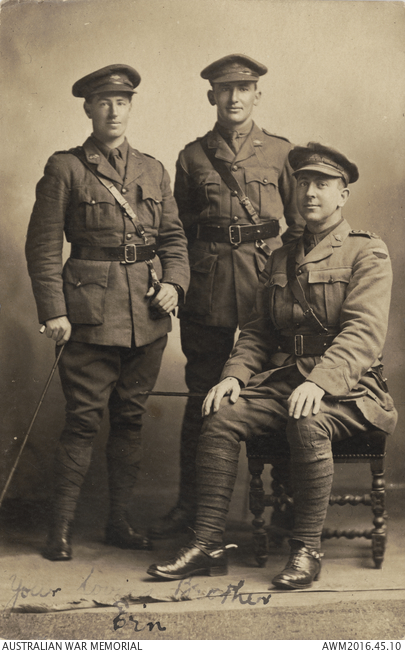
Information about birth
|
Year of birth: 1891 |
|
Place of birth: Bendigo, Victoria, Australia |
General information
|
Last known residence: 51 Gladstone Street, Bendigo, Victoria, Australia |
|
Profession: Shoemaker |
|
Religion: Presbyterian |
Army information
|
Country: Australia |
|
Force: Australian Imperial Force |
|
Rank: Lieutenant |
|
Enlistment date: 11/05/1916 |
|
Enlistment place: Bendigo, Victoria, Australia |
|
Units: — Australian Infantry, 38th Bn. (Last known unit) |
Information about death
|
Date of death: 13/10/1917 |
|
Place of death: Laamkeek, Zonnebeke, Belgium |
|
Cause of death: Killed in action (K.I.A.) |
|
Age: 26 |
Cemetery
|
Tyne Cot Cemetery Plot: XXIII Row: D Grave: 3 |
Points of interest 4
| #1 | Place of birth | ||
| #2 | Last known residence | ||
| #3 | Enlistment place | ||
| #4 | Place of death (approximate) |
My story
Frederick Charles Morrison was the son of Annie Eliza and Joseph Morrison. He was born around 1891 in Bendigo, Victoria, where he also continued to live. Before the war, he worked as a bootmaker. Frederick enlisted in the Australian Army and served in the 38th Battalion Australian Infantry (10th Brigade, 3rd Division).
Frederick was killed on 13 October 1917 in the aftermath of the First Battle of Passchendaele, part of the Battle of Passchendaele. The starting lines of the 38th Battalion were located just in front of Augustus Wood. On 12 and 13 October, the unit launched an attack on Passchendaele. Even on the way to the start lines and after taking up position, the battalion came under fire. During the advance, machine-gun fire from the Bellevue area also caused delays. A part of the battalion managed to cross the Ravebeek and disable three pillboxes, but they too were forced to withdraw due to heavy shelling. They rejoined the unit, which was by then near Haalen.
The New Zealand troops on their left flank had failed to advance. Because of this, and due to the high number of casualties in the 38th Battalion, the unit was forced to retreat to near their original positions. The battalion held this line until it was relieved during the night of 13 to 14 October. Initially, they fell back to Hussar Farm before being transported by bus to Senlecques. After the attack, the 38th Battalion had suffered 11 killed, 270 wounded, and 101 missing.
Frederick was killed in action at the age of 26. According to a testimony, he was hit in the head, and his body was found around 14 October in Berlin Wood. After the war, his body was recovered near Laamkeek. He was reburied at Tyne Cot Cemetery, where he found his final resting place.
Sources 6
|
10th Australian Infantry Brigade, (Australian War Memorial, Campbell (AWM), AWM4 23/10/12). https://www.awm.gov.au/ Sources used |
|
38th Australian Infantry Battalion, (Australian War Memorial, Campbell (AWM), AWM4 23/55/17). https://www.awm.gov.au/collection/C1338583 https://www.awm.gov.au/ Sources used |
|
Australian Red Cross Wounded and Missing Enquiry Bureau (Australian War Memorial, Campbell (AWM), RCDIG1053587). https://www.awm.gov.au/ Sources used |
|
First Australian Imperial Force Personnel Dossiers, 1914-1920, (National Archives of Australia, Canberra (NAA), B2455, MORRISON F C). https://www.naa.gov.au/ Sources used |
|
McCarthy, Chris. Passchendaele: The Day by Day Account (Londen: Arms & Armour Press, 1995), 129-130. Sources used |
|
Unit embarkation nominal rolls, 1914-18 War (Australian War Memorial, Campbell (AWM), AWM8 23/55/1). https://www.awm.gov.au/ Sources used |
More information 4
|
Commonwealth War Graves Commission Database https://www.cwgc.org/find-records/find-war-dead/casualty-details/464013 |
|
Namenlijst (In Flanders Fields Museum) https://namenlijst.org/publicsearch/#/person/_id=7c268d56-0bb5-4054-8a23-182b308500b6 |
|
Lives of the First World War (Imperial War Museum) https://livesofthefirstworldwar.iwm.org.uk/lifestory/7517774 |
|
The AIF Project (UNSW Canberra) https://aif.adfa.edu.au/showPerson?pid=215170 |