Pte
Patrick Joseph Fitzgerald

Information about birth
|
Date of birth: 14/04/1893 |
|
Place of birth: Douro, Peterborough County, Ontario, Canada |
General information
|
Last known residence: Asquith, Saskatchewan, Canada |
|
Profession: Teacher |
|
Religion: Roman Catholic |
Army information
|
Country: Canada |
|
Force: Canadian Expeditionary Force |
|
Rank: Private |
|
Service number: 911049 |
|
Enlistment date: 03/07/1916 |
|
Enlistment place: Asquith, Saskatchewan, Canada |
|
Units: — Canadian Infantry, 46th Bn. (South Saskatchewan) (Last known unit) |
Information about death
|
Date of death: 26/10/1917 |
|
Place of death: Windmill Cabaret - Kleynmolen, Zonnebeke, Belgium |
|
Cause of death: Killed in action (K.I.A.) |
|
Age: 24 |
Cemetery
|
Tyne Cot Cemetery Plot: XVII Row: D Grave: 7 |
Distinctions and medals 2
|
British War Medal Medal |
|
Victory Medal Medal |
Points of interest 3
| #1 | Place of birth | ||
| #2 | Place of death (approximate) | ||
| #3 | Cemetery |
My story
Patrick Joseph Fitzgerald, son of farmer Patrick Fitzgerald (b. 1848, Ireland) and Mary Fitzgerald (née Leah) (b. 1857, Ontario), was born on 14 April 1893 in Douro, Peterborough County, Ontario, Canada.
He lived for some time in Asquith, Saskatchewan, approximately 55 kilometers west of the city of Saskatoon. Patrick attended the Saskatoon Normal School (now the Saskatoon Teachers’ College) and successfully completed his studies in February 1916. He then worked as a public school teacher for a few months before enlisting for military service.
On 3 July 1916, Patrick joined the 196th (Western Universities) Battalion, CEF, a unit recruiting from universities across western Canada. After sailing to England in November 1916, the 196th Battalion was absorbed into the 19th Reserve Battalion on 1 January 1917.
In June 1917, Private Fitzgerald was transferred to the 46th Infantry Battalion, joining his new unit on 21 June in the Lievin region of France, where the battalion was resting and training for its next major engagement—the Battle of Hill 70 (15–25 August 1917).
Private Fitzgerald was wounded (gassed) on 22 August 1917 and admitted to No. 13 Canadian Field Hospital, but he returned to duty with his regiment just two days later, on 24 August 1917. After the Battle of the battalion was removed from the frontline for rest and training in preparation of new action in the Ypres Salient.
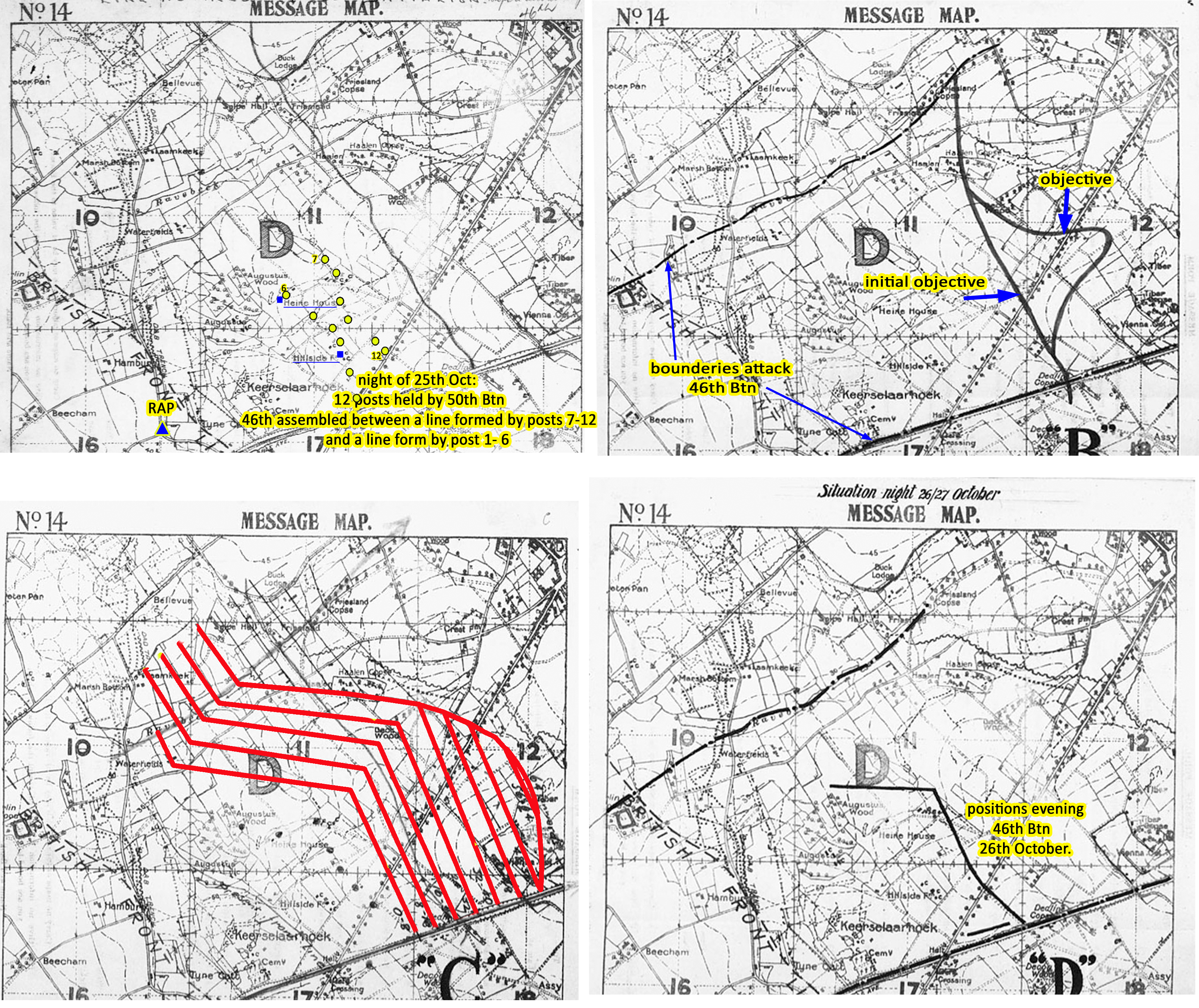
On 21 October 1917, the Canadian 10th Infantry Brigade (including the 46th Battalion) arrived in the Ypres sector and took over the front line south of Passchendaele on the 22nd, with the 50th Battalion in the front and the 46th Battalion in immediate support. While waiting for the attack (planned for the 26th), the men lived in shell holes with only their ground sheets for cover. Rain and cold made conditions extremely difficult. Enemy shelling caused many casualties. In preparation for the attack, in the evening of the 25th, the 46th Battalion moved up to the jumping-off line near Heine House and Hillside Farm. The barrage opened at 5:40 a.m., but fell short, causing many casualties in the ranks before they could advance. During the assault, the Canadians suffered heavy casualties inflicted by both friendly and enemy artillery fire, as well as by intense German machine-gun fire.
With the support of the 50th Battalion, all objectives were captured and consolidated before noon. Around 4 p.m., the enemy laid down a very severe barrage and launched several counter-attacks. In view of the high casualty rate, a weak defensive line, and lack of artillery support, the 46th Battalion withdrew along the Passchendaele Road. After some reorganization, the 46th held a line near the positions from which they had advanced earlier that day. In the evening, the 46th was relieved and retired to Levis Corner. The enemy shelled that area with gas and other shells, causing more casualties. According to the report of Commanding Officer Lt/Col Dawson, the battalion suffered 402 casualties (53 KIA, 287 WIA, 62 MIA), which was 70%. The CWGC.org lists 98 men who died on 26 October, of whom 75 are listed on the Menin Gate Memorial and 11 are buried in Tyne Cot Cemetery. Within a few days after the attack, another 16 men of the 46th Battalion died of wounds in field hospitals.
On 21 October 1917, the Canadian 10th Infantry Brigade (including the 46th Battalion) arrived in the Ypres front area. On the 22nd, the brigade took over the front line south of Passchendaele, with the 50th Battalion in the front line and the 46th Battalion directly behind it in support. While waiting for the attack (scheduled for the 26th), the men took shelter in shell holes, with their groundsheets as their only protection. Rain and cold made conditions particularly harsh. German shelling caused heavy casualties. In preparation for the attack, on the evening of the 25th, the 46th Battalion moved to positions in the front line near Heine House and Hillside Farm.
The artillery bombardment began at 5.40 a.m., but fell short, causing many casualties among their own ranks even before the troops could advance. During the attack, the 46th Battalion suffered heavy losses from both friendly and German artillery fire, as well as intense German machine gun fire. With the support of the 50th Battalion, all objectives were captured and reinforced before noon.
Around 4 p.m., the enemy launched a heavy artillery bombardment on the lines and launched several counterattacks. Due to the high number of casualties, the weak defensive line and the lack of artillery support, the 46th Battalion withdrew towards Zonnebeke, mainly using the Zonnebeke-Passendale road. After some regrouping, the battalion held its ground in a line close to the positions from which they had departed that morning.
In the evening, the 46th Battalion was relieved and withdrew to Levis Corner, near the center of Zonnebeke. The Germans fired gas grenades and other ammunition at that area, resulting in further casualties.
According to the report by Lt. Col. Dawson, who commanded the 46th, the battalion suffered 402 casualties (53 killed, 287 wounded, 62 missing), which amounts to 70%. The website CWGC.org lists 94 men from the 46th who were killed on 26 October, 71 of whom are commemorated on the Ypres (Menin Gate) Memorial and 11 buried at Tyne Cot Cemetery. Within days of the attack, another 16 men from the 46th Battalion died of their wounds in field hospitals. The very high losses during this and other operations in the First World War earned the battalion the nickname “The Suicide Battalion”.
Private Fitzgerald died on October 26 and was initially buried near the relay posts close to Windmill Cabaret (Zonnebeke). These relay posts were the gathering place for casualties who were brought from the forward aid stations to the rear for further medical treatment or evacuation. After the war, his body was exhumed and reburied at Tyne Cot Cemetery, plot 17, row D, grave 7.
Sources 5
|
46th Canadian Infantry Battalion (Library and Archives Canada, Ottawa (LAC), RG9-III-D-3, Volume number: 4939, Microfilm reel number: T-10745--T-10746, File number: 437). https://library-archives.canada.ca/ Sources used |
|
Circumstance of Death (Library and Archives Canada, Ottawa (LAC), RG150, 1992-93/314, 178) https://library-archives.canada.ca/ Sources used |
|
Commonwealth War Graves Registers, First World War (Library and Archives Canada, Ottawa (LAC), RG150, 1992-93/314, 68) https://library-archives.canada.ca/ Sources used |
|
Personnel Records of the First World War (Library and Archives Canada, Ottawa (LAC), RG 150, Accession 1992-93/166, Box 3119 - 37) https://library-archives.canada.ca/ Sources used |
|
War Diaries 10th Canadian Infantry Brigade, October 1917. (Library and Archives Canada, RG9-III-D-3, Volume number: 4902, Microfilm reel number: T-10694, File number: 308) https://library-archives.canada.ca/ Sources used |
More information 5
|
The Canadian Virtual War Memorial https://www.veterans.gc.ca/en/remembrance/memorials/canadian-virtual-war-memorial/detail/462758 |
|
Lives of the First World War (Imperial War Museum) https://livesofthefirstworldwar.iwm.org.uk/lifestory/7437559 |
|
Namenlijst (In Flanders Fields Museum) https://namenlijst.org/publicsearch/#/person/_id=2cc34b04-c8f9-4c42-9c6c-b047620dda23 |
|
Commonwealth War Graves Commission Database https://www.cwgc.org/find-records/find-war-dead/casualty-details/462758 |
|
A Street Near You https://astreetnearyou.org/person/462758/ |