Gfr
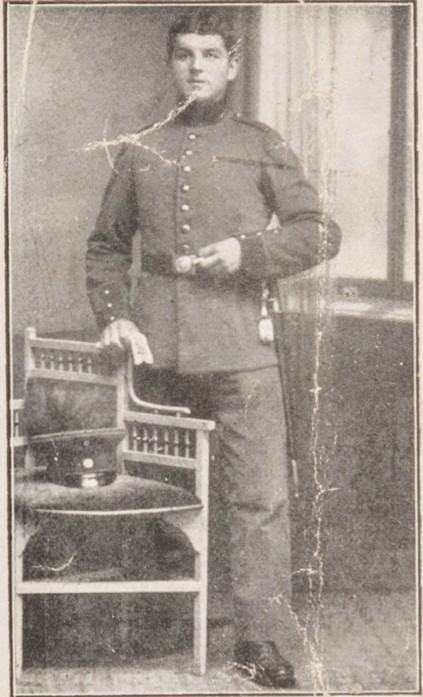
Ludwig Buchecker
Information about birth
|
Date of birth: 24/06/1892 |
|
Place of birth: Regen, Niederbayern, Bayern, Kingdom of Bavaria, German Empire |
General information
|
Last known residence: Regensburg, Oberpfalz, Bayern, Kingdom of Bavaria, German Empire |
|
Profession: Labourer |
Army information
|
Country: German Empire |
|
Force: Imperial German Army |
|
Rank: Gefreiter |
|
Units: — Kgl. Bayer. Infanterie-Regiment Nr. 11 (Last known unit) |
Information about death
|
Date of death: 20/09/1917 |
|
Place of death: Polderhoek, Belgium |
|
Cause of death: Killed in action (K.I.A.) |
|
Age: 25 |
Cemetery
|
Deutscher Soldatenfriedhof Langemark (Kameradengrab) Plot: Unknown Row: Unknown Grave: Unknown |
Points of interest 3
| #1 | Place of birth | ||
| #2 | Last known residence | ||
| #3 | Place of death (approximate) |
My story
Ludwig Buchecker was the son of Michael and Maria Buchecker. He was born in Regen, Niederbayern. Before the war, Ludwig lived in Regensburg, Oberpfalz, and worked as a laborer. He joined the German army and was part of the Königliches Bayerisches Infanterie-Regiment Nr. 11.
Ludwig fell on 20 September 1917 during the Battle of the Menin Road, part of the Battle of Passchendaele. On 20 September, the regiment had to prepare south of Beselare for an attack. The first battalion was tasked with taking both sides of Polderhoek Chateau, while the second battalion had to try to advance up to the original front line between the forest and the Menin Road. The third battalion was to attack the southern edge of the Polygon Wood.
At the start of the attack, the third battalion came under heavy fire, resulting in severe losses and an impossible advance. The unit remained entrenched in the same position near Polygon Wood until the evening. The first battalion advanced westward, only reaching south of Polderhoek Chateau under heavy shelling at 16:00. Two companies, south and north of the chateau, took positions next to the third battalion. Further advance was impossible. The second battalion advanced along the Menin Road with its left wing under heavy fire. Around 16:00, the troops reached Hill 64, west of Polderhoek Chateau, and held that position.
At 19:00, the order to attack followed. It became another slow advance under heavy shelling. By evening, the front line had moved only 150 m west of the chateau park, and the troops spent most of the night in shell holes. The second battalion maintained their positions on Hill 64. Throughout the night, the shelling with machine guns continued. Around 04:00, an allied barrage followed around Polderhoek.
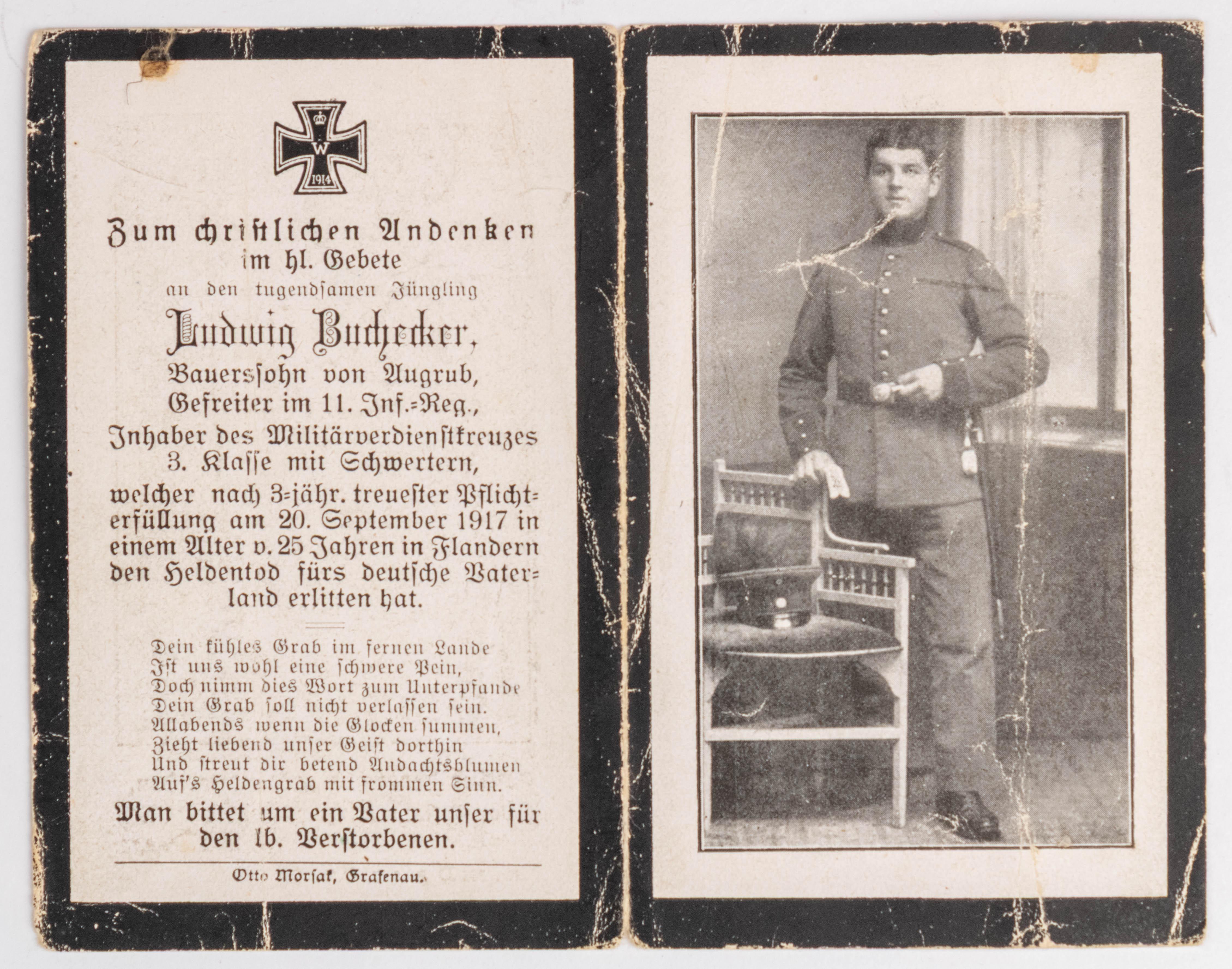
The Battle of the Menin Road ended on both sides with heavy losses: as many as 4,000 Germans and twice as many Allies were casualties. Among them was the 25-year-old Ludwig Buchecker. He fell near Polderhoek. The young German found his final resting place at the German Military Cemetery in Langemark. According to his memorial card, he had already been in service for three years at the time of the Battle of the Menin Road.
Sources 2
|
Dunzinger, Albert. Das K.B. 11. Infanterie-Regiment von der Tann (München: Bayerisches Kriegsarchiv, 1921), 55-56. Sources used |
|
Kriegstammrollen, 1914-1918 (Bayerisches Hauptstaatsarchiv, München (BHA), Abteilung IV Kriegsarchiv. Kriegstammrollen, 1914-1918; Volume: 1235. Kriegstammrolle: Bd. 1). https://www.stmwk.bayern.de/art-and-culture/archives.html Sources used |
More information 2
|
Namenlijst (In Flanders Fields Museum) https://namenlijst.org/publicsearch/#/person/_id=c19d4c6b-948b-44be-9d71-94edd417d6e4 |
|
Volksbund Deutsche Kriegsgräberfürsorge https://www.volksbund.de/erinnern-gedenken/graebersuche-online/detail/a3TJy00000036t1MAA |