Pte
Archie Lloyd Taylor

Information about birth
|
Date of birth: 27/07/1897 |
|
Place of birth: Boissevain, Manitoba, Canada |
General information
|
Last known residence: Morton, Manitoba, R0K 0E0 Municipality of Boissevain, Canada |
|
Profession: Student |
|
Religion: Presbyterian |
Army information
|
Country: Canada |
|
Force: Canadian Expeditionary Force |
|
Rank: Private |
|
Service number: 292446 |
|
Enlistment date: 13/08/1916 |
|
Enlistment place: Camp Hughes, Manitoba, Canada |
Information about death
|
Date of death: 26/10/1917 |
|
Place of death: Windmill Cabaret - Kleynmolen, Zonnebeke, Belgium |
|
Cause of death: Killed in action (K.I.A.) |
|
Age: 20 |
Cemetery
|
Tyne Cot Cemetery Plot: XVII Row: D Grave: 5 |
Distinctions and medals 2
|
British War Medal Medal |
|
Victory Medal Medal |
Points of interest 4
| #1 | Place of birth | ||
| #2 | Last known residence | ||
| #3 | Place of death (approximate) | ||
| #4 | Cemetery |
My story
Archie Lloyd Taylor was born on 27 July 1897, the seventh child of Dugald Taylor (1860–1929) and Eliza Caldbick (1863–1947). Dugald and Eliza raised a total of 11 children (3 boys and 8 girls) in Morton, Manitoba, five miles south of Boissevain, near the border between Canada and North Dakota (USA).
By 1916, Archie had already left home and was working and living in Morton on the farm of his eldest brother and sister-in-law. Archie was also a member of the 106th Regiment, Winnipeg Light Infantry, Non-Permanent Active Militia (NPAM). This was a part-time volunteer army, a civil guard consisting of local men who, in addition to their civilian jobs, underwent military training in the evenings, at weekends or during short summer camps.
When the First World War broke out, the 106th Regiment, Winnipeg Light Infantry was deployed locally, mainly for guard duties. However, Archie wanted to go to the front in Europe, and since the 106th Regiment was not mobilised, he chose to volunteer for the 222nd Regiment, which would participate in the fighting in Europe. He signed his attestation paper on 13 August 1916. At that time, he stated that he was a student, while the 1916 census tells us that he worked as a labourer on his brother's farm.
In November 1916, the 222nd Regiment left for England. Archie was temporarily assigned to the 19th Reserve Battalion before being transferred in June 1917 to the 46th Battalion, which was on the front line in northern France. In August 1917, the 46th took part in the Battle of Hill 70 (15-25 August 1917). After the battle, the battalion was withdrawn from the front line for rest and training in preparation for new combat operations in the Ypres Salient.
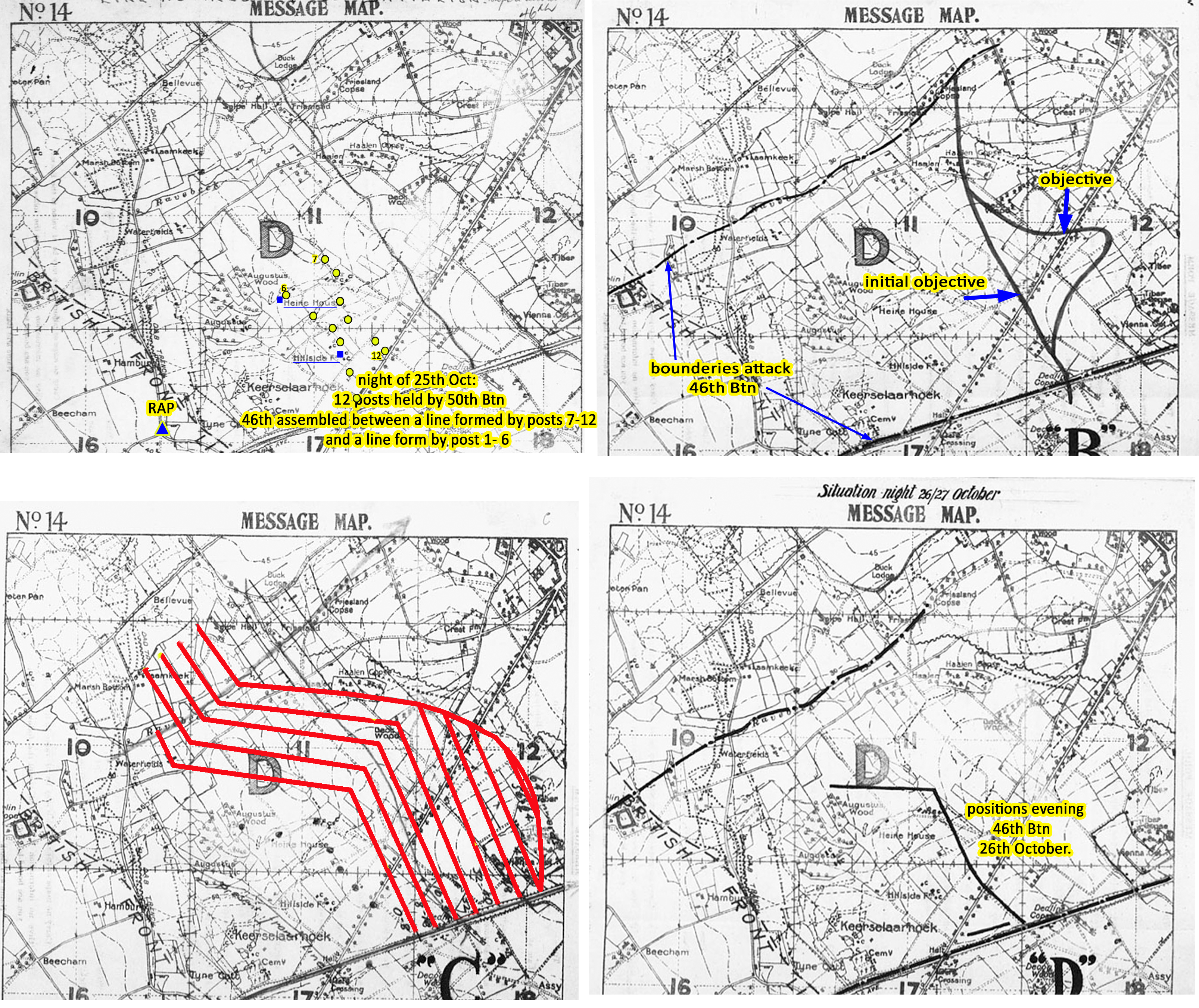
On 21 October 1917, the Canadian 10th Infantry Brigade (including the 46th Battalion) arrived in the Ypres front area. On the 22nd, the brigade took over the front line south of Passchendaele, with the 50th Battalion in the front line and the 46th Battalion directly behind it in support. While waiting for the attack (scheduled for the 26th), the men took shelter in shell holes, with their groundsheets as their only protection. Rain and cold made conditions particularly harsh. German shelling caused heavy casualties. In preparation for the attack, on the evening of the 25th, the 46th Battalion moved to positions in the front line near Heine House and Hillside Farm.
The artillery bombardment began at 5.40 a.m., but fell short, causing many casualties among their own ranks even before the troops could advance. During the attack, the 46th Battalion suffered heavy losses from both friendly and German artillery fire, as well as intense German machine gun fire. With the support of the 50th Battalion, all objectives were captured and reinforced before noon.
Around 4 p.m., the enemy launched a heavy artillery bombardment on the lines and launched several counterattacks. Due to the high number of casualties, the weak defensive line and the lack of artillery support, the 46th Battalion withdrew towards Zonnebeke, mainly using the Zonnebeke-Passendale road. After some regrouping, the battalion held its ground in a line close to the positions from which they had departed that morning.
In the evening, the 46th Battalion was relieved and withdrew to Levis Corner, near the center of Zonnebeke. The Germans fired gas grenades and other ammunition at that area, resulting in further casualties.
According to the report by Lt. Col. Dawson, who commanded the 46th, the battalion suffered 402 casualties (53 killed, 287 wounded, 62 missing), which amounts to 70%. The website CWGC.org lists 98 men from the 46th who were killed on 26 October, 75 of whom are commemorated on the Ypres (Menin Gate) Memorial and 11 buried at Tyne Cot Cemetery. Within days of the attack, another 16 men from the 46th Battalion died of their wounds in field hospitals. The very high losses during this and other operations in the First World War earned the battalion the nickname “The Suicide Battalion”.
Private Taylor died on 26 October and was initially buried near the relay posts close to Windmill Cabaret (Zonnebeke). These relay posts were the gathering place for casualties who were brought from the forward aid stations to the rear for further medical treatment or evacuation. After the war, his body was exhumed and reburied at Tyne Cot Cemetery, plot 17, row D, grave 5.
Sources 6
|
1906 Canada Census of Manitoba, Saskatchewan, and Alberta https://www.ancestry.com/search/collections/8827/ Sources used |
|
1916 Canada Census of Manitoba, Saskatchewan, and Alberta https://www.ancestry.com/search/collections/1556/ Sources used |
|
Commonwealth War Graves Registers, First World War (Library and Archives Canada, Ottawa (LAC), RG150, 1992-93/314, 128) https://library-archives.canada.ca/ Sources used |
|
Personnel Records of the First World War (Library and Archives Canada, Ottawa (LAC), RG 150, Accession 1992-93/166, Box 9515 - 28) https://library-archives.canada.ca/ Sources used |
|
War Diaries 10th Canadian Infantry Brigade, October 1917. (Library and Archives Canada, RG9-III-D-3, Volume number: 4902, Microfilm reel number: T-10694, File number: 308) https://library-archives.canada.ca/ Sources used |
|
war diaries 46th Canadian Infantry Battalion (Library and Archives Canada, Ottawa (LAC), RG9-III-D-3, Volume number: 4939, Microfilm reel number: T-10745--T-10746, File number: 437) https://library-archives.canada.ca/ Sources used |
More information 5
|
Namenlijst (In Flanders Fields Museum) https://namenlijst.org/publicsearch/#/person/_id=fcd8ebfd-664d-40ca-9571-ff859290c45e |
|
Lives of the First World War (Imperial War Museum) https://livesofthefirstworldwar.iwm.org.uk/lifestory/5747235 |
|
The Canadian Virtual War Memorial https://www.veterans.gc.ca/en/remembrance/memorials/canadian-virtual-war-memorial/detail/fcd8ebfd-664d-40ca-9571-ff859290c45e |
|
Commonwealth War Graves Commission Database https://www.cwgc.org/find-records/find-war-dead/casualty-details/464847 |
|
A Street Near You https://astreetnearyou.org/person/464847// |