Pte
Ludwik Zgrzybłowski

Information about birth
|
Date of birth: 06/06/1894 |
|
Place of birth: Berezdov, Ukraine (alternate names: Berezdovo (Yiddish) and Berezdiv (German)), Ukraine |
General information
|
Profession: Blacksmith |
|
Religion: Roman Catholic |
Army information
|
Country: Canada |
|
Force: Canadian Expeditionary Force |
|
Rank: Private |
|
Service number: 887725 |
|
Enlistment date: 24/01/1916 |
|
Enlistment place: Humboldt, Saskatchewan, Canada |
|
Units: — Canadian Infantry, 46th Bn. (South Saskatchewan) (Last known unit) |
Information about death
|
Date of death: 26/10/1917 |
|
Place of death: Tiber, Passchendaele, Belgium |
|
Cause of death: Killed in action (K.I.A.) |
|
Age: 23 |
Cemetery
|
Tyne Cot Cemetery Plot: XVIII Row: F Grave: 1 |
Distinctions and medals 2
|
British War Medal Medal |
|
Victory Medal Medal |
Points of interest 4
| #1 | Place of birth | ||
| #2 | Enlistment place | ||
| #3 | Place of death (approximate) | ||
| #4 | Cemetery |
My story
He was born on June 6, 1894, the son of Ignace and Walerja Zgrzyblowski. Before immigrating to Canada, he lived in Berezdów (also known as Berezdovo or Berezdiv). Berezdów used to belong to the Kingdom of Poland but was assigned to the Russian Empire after the partition of Poland. After World War I, Berezdów became Ukrainian territory.
In mid-1915, Ludwik enlisted as a volunteer with the 65th Infantry Battalion CEF in Saskatoon. However, he was discharged a month later for unknown reasons. “Irregular enlistment” was written on his “attestation.” In early 1916, he re-enlisted, this time in Humboldt with the 188th Battalion. In October 1916, the 188th Battalion boarded the SS Olympic in Halifax and sailed to England. A few weeks after his arrival in England, Pte Zgrzyblowsky was sent to northern France, where he joined the 46th Battalion. The 46th took part in minor actions on the front in France and mainly prepared for the big job in Ypres.
Strangely enough, his military file contains a third ‘attestation’, but with the name Vincent Zgrzyblowky and September 20, 1894 as his date of birth.
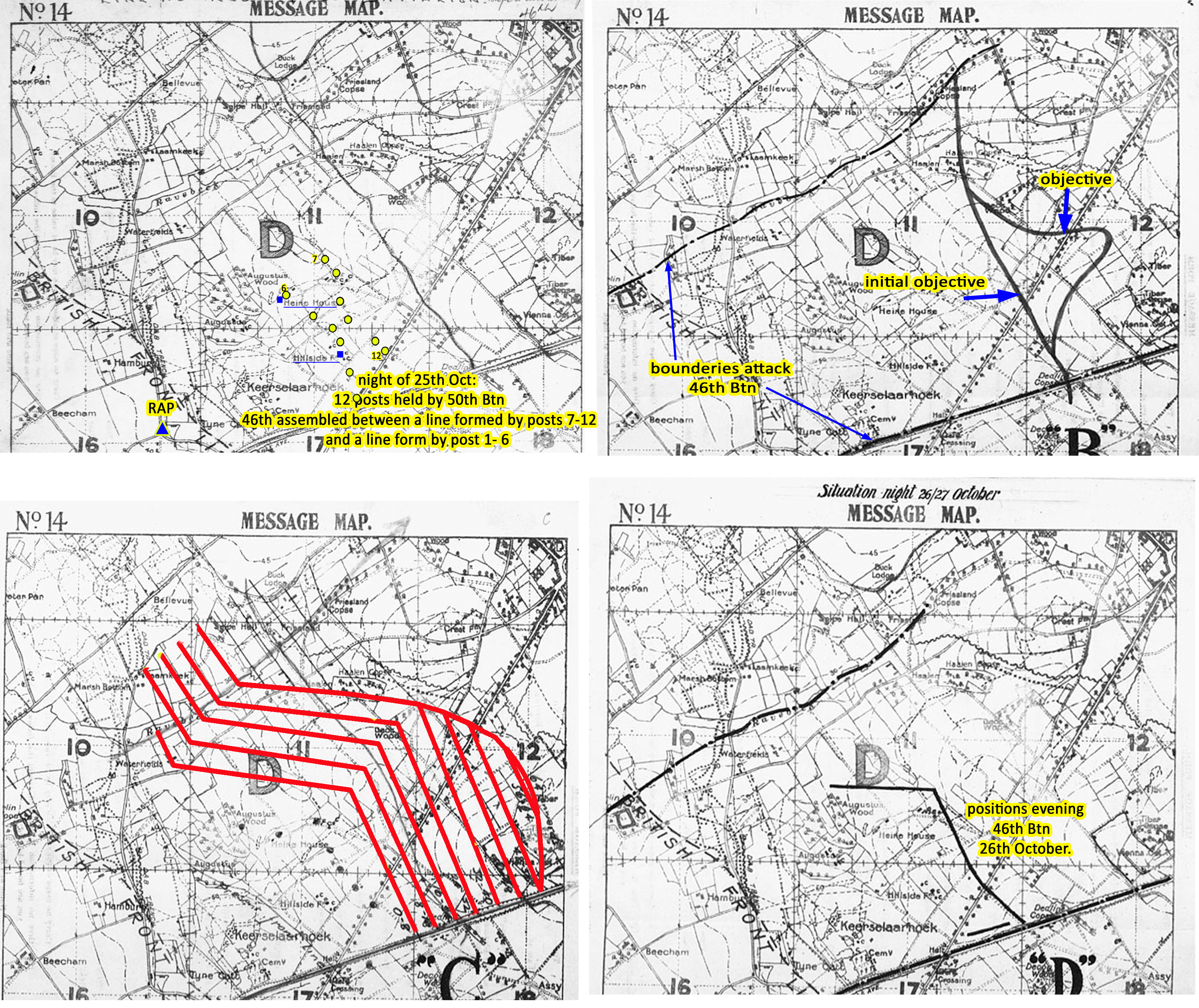
On 21 October 1917, the Canadian 10th Infantry Brigade (including the 46th Battalion) arrived in the Ypres sector and took over the front line south of Passchendaele on the 22nd, with the 50th Battalion in the front and the 46th Battalion in immediate support. While waiting for the attack (planned for the 26th), the men lived in shell holes with only their ground sheets for cover. Rain and cold made conditions extremely difficult. Enemy shelling caused many casualties. In preparation for the attack, in the evening of the 25th, the 46th Battalion moved up to the jumping-off line near Heine House and Hillside Farm. The barrage opened at 5:40 a.m., but fell short, causing many casualties in the ranks before they could advance. During the assault, the Canadians suffered heavy casualties inflicted by both friendly and enemy artillery fire, as well as by intense German machine-gun fire.
With the support of the 50th Battalion, all objectives were captured and consolidated before noon. Around 4 p.m., the enemy laid down a very severe barrage and launched several counter-attacks. In view of the high casualty rate, a weak defensive line, and lack of artillery support, the 46th Battalion withdrew along the Passchendaele Road. After some reorganization, the 46th held a line near the positions from which they had advanced earlier that day. In the evening, the 46th was relieved and retired to Levis Corner. The enemy shelled that area with gas and other shells, causing more casualties. According to the report of Commanding Officer Lt/Col Dawson, the battalion suffered 402 casualties (53 KIA, 287 WIA, 62 MIA), which was 70%. The CWGC.org lists 94 men who died on 26 October, of whom 71 are listed on the Menin Gate Memorial and 11 are buried in Tyne Cot Cemetery. Within a few days after the attack, another 16 men of the 46th Battalion died of wounds in field hospitals.
The very high casualty rates during this and other World War I operations earned the battalion the nickname "The Suicide Battalion."
Le 21 octobre 1917, la 10e Brigade d’Infanterie Canadienne (incluant le 46e Bataillon) est arrivée dans le secteur d’Ypres. Le 22, elle a pris position sur la ligne de front au sud de Passchendaele, avec le 50e Bataillon en première ligne et le 46e en soutien immédiat. En attendant l’attaque (prévue pour le 26), les soldats se sont abrités dans des entonnoirs d’obus, avec seulement leur bâche comme protection. La pluie et le froid ont rendu les conditions extrêmement difficiles. Les bombardements ennemis ont causé de nombreuses pertes.
En préparation de l’attaque, le 46e Bataillon s’est déplacé dans la soirée du 25 vers des positions proches de Heine House et Hillside Farm.
Le barrage d’artillerie a commencé à 5h40 du matin, mais il est tombé trop court, provoquant de nombreuses pertes dans les rangs avant même que l’assaut ne débute. Pendant l’attaque, le 46e Bataillon a subi de lourdes pertes causées tant par l’artillerie amie et ennemie que par les tirs nourris de mitrailleuses allemandes.
Avec le soutien du 50e Bataillon, tous les objectifs ont été atteints et consolidés avant midi. Vers 16h, l’ennemi a déclenché un violent barrage d’artillerie et lancé plusieurs contre-attaques. En raison du nombre élevé de pertes, d’une ligne de défense affaiblie et du manque de soutien d’artillerie, le 46e Bataillon s’est replié le long de la route Zonnebeke–Passchendaele. Après une réorganisation, il a établi une nouvelle ligne défensive proche des positions qu’il avait quittées plus tôt dans la journée. Le soir, le 46e Bataillon a été relevé et s’est retiré vers Levis Corner. L’ennemi a bombardé la zone avec des obus à gaz et d’autres types de munitions, causant à nouveau des pertes.
Selon le rapport du commandant Dawson, le bataillon a subi 402 pertes (53 tués, 287 blessés, 62 disparus), soit environ 70 % de ses effectifs. Le site CWGC.org recense 94 soldats du 46e Bataillon morts le 26 octobre, dont 71 sont commémorés à la Porte de Menin (Ypres) et 11 sont enterrés au cimetière de Tyne Cot. Dans les jours suivant l’attaque, 16 autres soldats du 46e sont morts de leurs blessures dans des hôpitaux de campagne. Les pertes extrêmement élevées subies lors de cette opération et d’autres engagements de la Première Guerre mondiale ont valu au bataillon le surnom de « The Suicide Battalion » (le Bataillon Suicide).
Pte Ludwik Zgrzyblowky was killed in action during the attack on 26 October and was buried along the road to Passchendaele, west of Tiber Farm. The location of the grave was near the furthest line reached during the attack. His body was exhumed after the war and reburied at Tyne Cot Cemetery, in grave XVIII. F. 1.
Sources 1
|
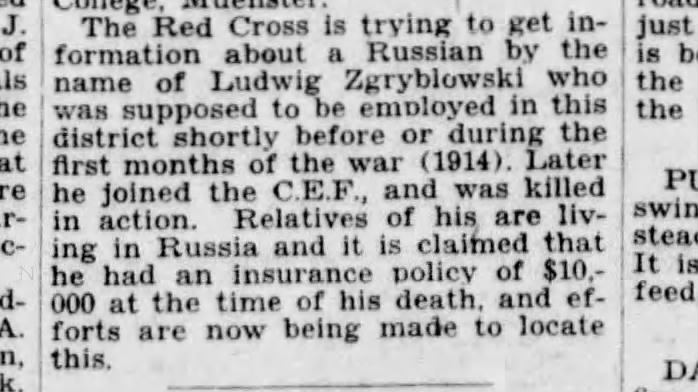
Star-Phoenix Fri, Sep 21, 1928 ·Page 11 http://www.newspapers.com Sources used |
More information 5
|
Namenlijst (In Flanders Fields Museum) https://namenlijst.org/publicsearch/#/person/_id=13bea89a-4347-49e6-8627-efb050dba3c1 |
|
Lives of the First World War (Imperial War Museum) https://livesofthefirstworldwar.iwm.org.uk/lifestory/5804210 |
|
The Canadian Virtual War Memorial https://www.veterans.gc.ca/en/remembrance/memorials/canadian-virtual-war-memorial/detail/465314 |
|
Commonwealth War Graves Commission Database https://www.cwgc.org/find-records/find-war-dead/casualty-details/465314 |
|
A Street Near You https://astreetnearyou.org/person/465314/ |