Pte
Richard Wyndom Sherlock

Information about birth
|
Date of birth: 18/04/1889 |
|
Place of birth: Lodsworth, Petworth, Sussex, England, United Kingdom |
General information
|
Profession: Farmer |
|
Religion: Church of England |
Army information
|
Country: England, United Kingdom |
|
Force: Canadian Expeditionary Force |
|
Rank: Private |
|
Service number: 437998 |
|
Enlistment date: 25/11/1915 |
|
Enlistment place: Edmonton, Alberta, Canada |
|
Units: — Canadian Infantry, 38th Bn. (Ottawa) (Last known unit) |
Information about death
|
Date of death: 30/10/1917 |
|
Place of death: Abraham Heights, Zonnebeke, Belgium |
|
Cause of death: Killed in action (K.I.A.) |
|
Age: 28 |
Cemetery
|
Tyne Cot Cemetery Plot: XV Row: A Grave: 20 |
Distinctions and medals 2
|
British War Medal Medal |
|
Victory Medal Medal |
Points of interest 2
| #1 | Enlistment place | ||
| #2 | Place of death (approximate) |
My story
Richard Windham (not Wyndom) Sherlock was born on 18 April 1889 in the rural village of Lodsworth, Sussex, England. He was the son of Richard Sherlock (1848) and Phoebe Emma Munday (1847).
According to the 1910 England census, at the age of 21 he was still living with his parents and worked as a postman (rural). Richard set off for Canada, most likely in March 1912. He was a gardener and his final destination was Toronto.
We find Richard again in the archives when, in November 1915, he enlisted as a volunteer in the Canadian Army in Edmonton, Alberta. He was then 26 years old, unmarried and a farmer by profession. His middle name, Wyndham, was misspelt on his enlistment form as ‘Wyndom’. He was given service number 437998 and was assigned to the 51st Infantry Battalion, CEF. The battalion recruited mainly in the city of Edmonton.
In April 1916, the battalion, numbering some 1,100 men, set off by train for Halifax, from where they were to sail to England. At Bramshott Camp, he received further training as an infantryman, but also undertook training with the 12th Brigade Machine Gun Corps. In August, he was attached to the 38th Infantry Battalion – on paper, at least – as it was not until November 1916 that he was able to join the 38th in the field.
In November 1916, the 38th took over a section of the front line just north of Thiepval and went ‘over the top’ for the first time on 18 November. All objectives were achieved, but at a high cost in casualties. After the attack, the battalion was relieved.
On Christmas Eve 1916, the battalion took up positions on the line at Vimy Ridge near Souchez. Numerous skirmishes between patrols took place in no man’s land. On 22 February 1917, the 38th launched an attack on the enemy front line, inflicting heavy losses on the enemy.
After a brief period of rest, the battalion took part in the Battle of Vimy Ridge and launched an attack on 9 April 1917. All objectives were achieved, but again at a heavy cost in casualties. Following another brief period of rest, the battalion resumed fighting near Lens (La Coulotte and Avion).
In July 1917, the battalion was withdrawn from the front for three weeks for reorganisation and training. The months of August and September were spent back at the front near Avion.
In October 1917, the 12th Canadian Infantry Brigade (comprising the 38th, 72nd, 78th and 85th Battalions and the 12th MGC) was withdrawn from the front in northern France to be deployed in Flanders (Belgium).
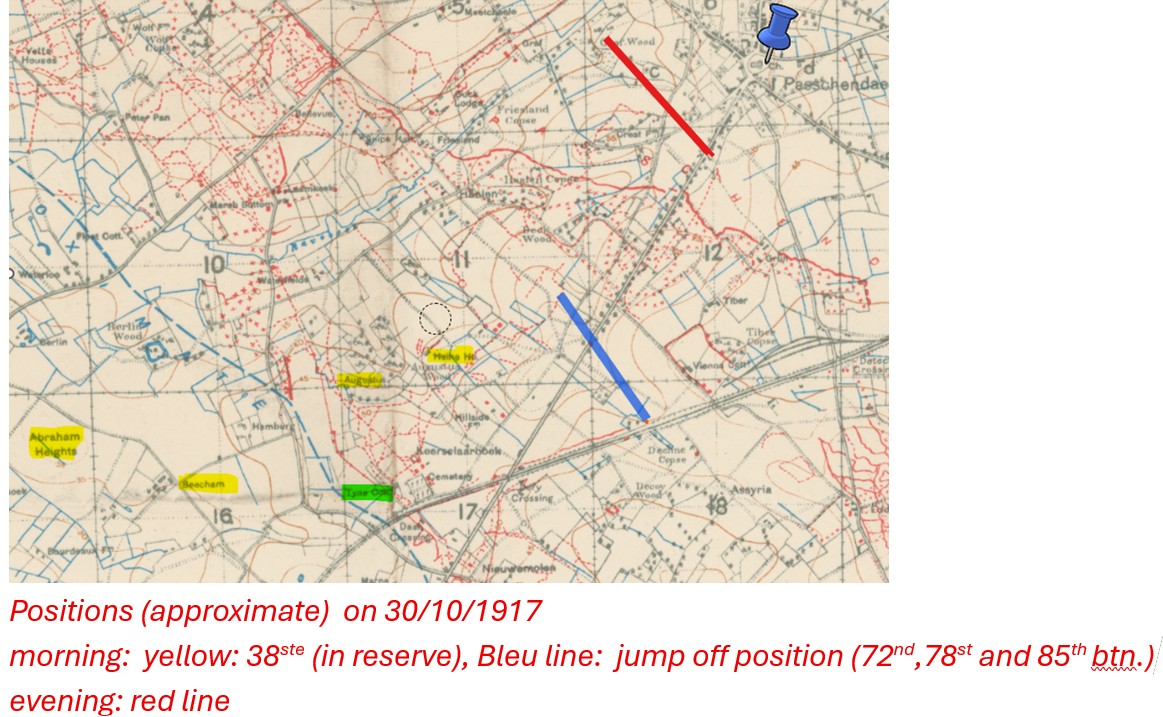
The 38th arrived in the vicinity of Poperinge (Belgium) on 23 October and, five days later, marched via Ypres to a camp in Pottijze, where it prepared for the coming battles. The brigade was to launch an attack on 30 October with three battalions: the 85th, 72nd and 78th. The 38th Battalion was to be held in reserve.
During the night of 29–30 October, the three battalions took up their positions on the front line, with the 38th just behind them in support. The 38th’s positions were as follows: B and D Companies at Augustus and Hillside Farm, and A and C Companies at Beecham and Abraham Heights.
The attack was launched at 05.40 on 30 October 1917. Despite heavy enemy shelling, the three battalions managed to capture their objectives fairly quickly. German artillery also targeted the positions of the 38th, which was being held in reserve. The 38th suffered considerable casualties; B Company, in particular, suffered heavy losses. The heavy German shelling continued for almost the entire day. The Germans appeared to be deliberately sparing the outpost at Tyne Cottage. In the afternoon, B, C and D Companies of the 38th were sent forward to consolidate the newly captured positions.
It was during the fighting on 30 October that Private Sherlock was killed and was most likely buried at or very close to the spot where he fell.
On 31 October and 1 November, the 38th remained on the front line to reinforce and hold the forward positions captured on 30 October. There were no organised German counter-attacks, but German artillery continued to shell the Canadians heavily, causing heavy casualties. Among other things, A Company helped to bring in supplies and evacuate the wounded. Late in the evening of 2 November, the 38th was relieved.
Back at the camp near Pottijze, the battalion (according to the War Diary) recorded its casualties*: 1 officer and 48 men / wounded: 4 officers and 163 men / missing: 22 men. On 3 November, the 38th left the Ypres Salient to return to France.
*According to CWGC.org: The Battle of Passchendaele ultimately claimed the lives of 79 men from the 38th, 14 of whom are buried at Tyne Cot Cemetery. A further 37 have unmarked graves; their names are engraved on Panel 28 of the Menin Gate.
In January 1920, the grave of Private Sherlock was located at coordinates 28.D.16.A.30.40, just east of Abraham Heights. His body was exhumed, identified and reburied at Tyne Cot Cemetery: plot XV, row A, grave 20.
Sources 4
|
Circumstance of Death (Library and Archives Canada, Ottawa (LAC), RG150, 1992-93/314, 238) https://library-archives.canada.ca/ Sources used |
|
Personnel Records of the First World War (Library and Archives Canada, Ottawa (LAC), RG 150, Accession 1992-93/166, Box 8857 - 7) https://library-archives.canada.ca/ Sources used |
|
War diaries: 38th Canadian Infantry Battalion (Library and Archives Canada, Ottawa (LAC), RG9-III-D-3, Volume number: 4938, Microfilm reel number: T-10743, File number: 432, File part: 1=1916/08/13-1917/12/31;2=1918/01/01-1919/05/31) https://library-archives.canada.ca/ Sources used |
|
War Graves Registers, First World War (Library and Archives Canada, Ottawa (LAC), RG150, 1992-93/314, 120) https://library-archives.canada.ca/ Sources used |
More information 5
|
Namenlijst (In Flanders Fields Museum) https://namenlijst.org/publicsearch/#/person/_id=c82a442b-21fe-438b-b9be-ff001837ab90 |
|
Commonwealth War Graves Commission Database https://www.cwgc.org/find-records/find-war-dead/casualty-details/464597 |
|
The Canadian Virtual War Memorial https://www.veterans.gc.ca/en/remembrance/memorials/canadian-virtual-war-memorial/detail/598684 |
|
A Street Near You https://astreetnearyou.org/person/464597/ |
|
Lives of the First World War (Imperial War Museum) https://livesofthefirstworldwar.iwm.org.uk/lifestory/5702521 |