Cpl
Claude Greybrook Schwonberg
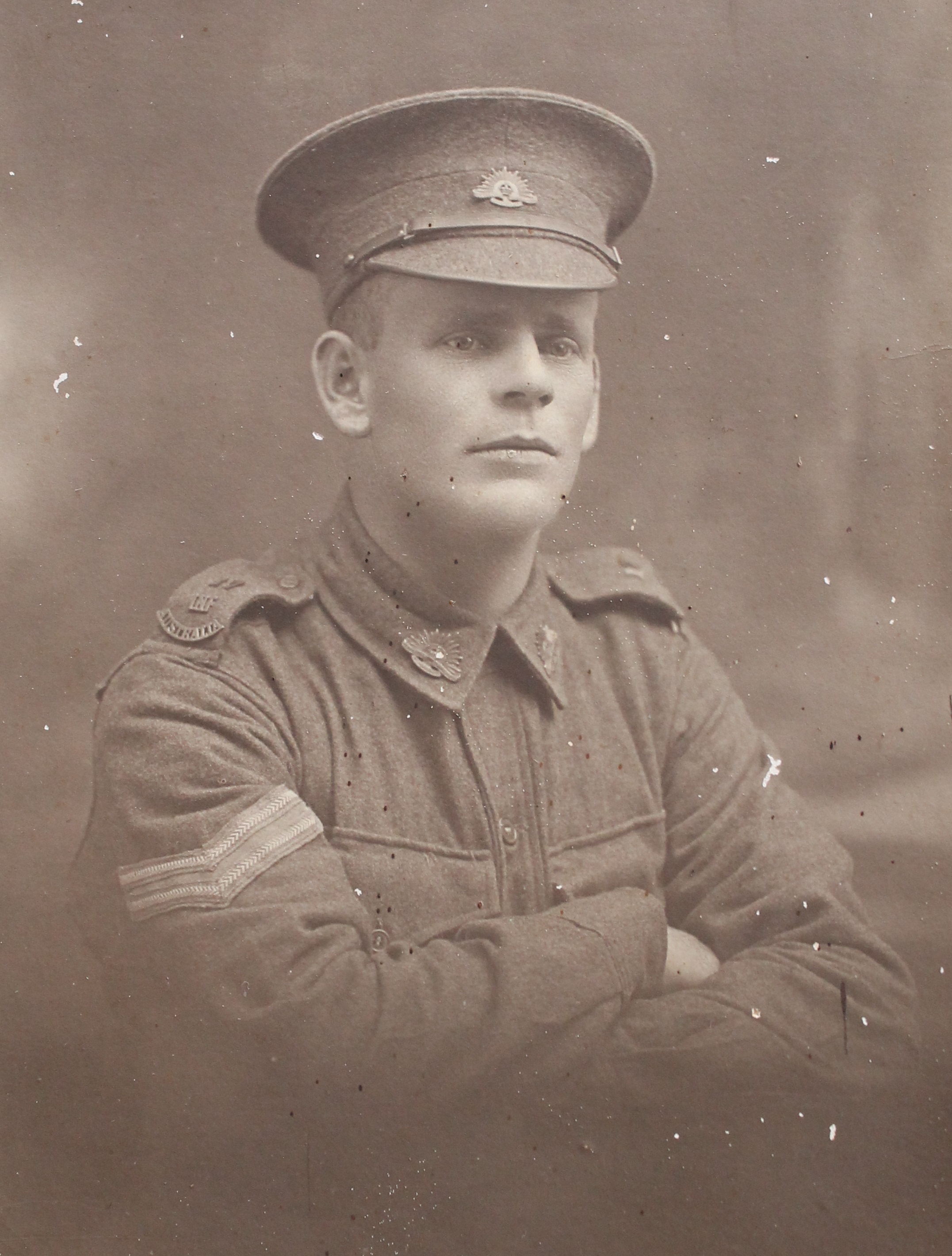
Information about birth
|
Date of birth: 24/04/1889 |
|
Place of birth: MacLean, New South Wales, Australia |
General information
|
Last known residence: Sydney, New South Wales, Australia |
|
Profession: Ship’s Purser |
|
Religion: Presbyterian |
Army information
|
Country: Australia |
|
Force: Australian Imperial Force |
|
Rank: Corporal |
|
Service number: 2782 |
|
Enlistment date: 12/07/1915 |
|
Enlistment place: Sydney, New South Wales, Australia |
|
Units: — Australian Infantry, 17th Bn. (New South Wales) (Last known unit) |
Information about death
|
Date of death: 09/10/1917 |
|
Place of death: Decline Copse, Passchendaele, Belgium |
|
Cause of death: Missing in action |
|
Age: 28 |
Memorial
|
Ypres (Menin Gate) Memorial Panel: 17 |
Distinctions and medals 3
|
1914-15 Star Medal |
|
British War Medal Medal |
|
Victory Medal Medal |
Points of interest 4
| #1 | Place of birth | ||
| #2 | Last known residence | ||
| #3 | Enlistment place | ||
| #4 | Place of death (approximate) |
My story
Claude Greybrook Schwonberg was born on 24 April 1889 in Maclean, New South Wales. He served for five years with the Maclean Scottish Rifles, a militia unit that was later disbanded. He worked as a ship's purser and was unmarried.
On 12 July 1915, he enlisted in the Australian Army. He departed from Sydney on 1 November 1915 and arrived in Marseilles on 27 March 1916 after a stopover in Alexandria, Egypt. Two days later, on 29 March 1916, he arrived at Étaples, where he received further training at the Base Depot of the 2nd Australian Division. On 3 May, he was transferred to the 17th Australian Infantry Battalion, 5th Brigade, 2nd Australian Division. He was promoted to Lance Corporal on 1 July 1916 and to Corporal on 1 August 1917.
On 6 October 1917, the 17th Australian Infantry Battalion was in reserve near Zonnebeke. On 8 October, the battalion moved to Broodseinde Ridge in preparation for the attack that was to take place the following day. At 4:30 a.m. on 9 October, the battalion was ready for the assault, which began at 5:20 a.m. It overcame German resistance in the area of Defy Crossing and advanced as far as Decline Copse. However, communication with the units on both flanks had been lost and all of the battalion's officers had by then become casualties. The battalion was therefore compelled to withdraw to the vicinity of Defy Crossing, where it was relieved by the 45th Australian Infantry Battalion at about 3:00 a.m. on 10 October 1917.
Private Lynch of the 17th Australian Infantry Battalion stated on 15 December 1917 that he had been part of the advance guard that had penetrated far along the Ypres-Roulers railway line. When German troops launched a counterattack, the unit was forced to withdraw. The wounded could not be evacuated and were left behind. Among them was Corporal Schwonberg, who had suffered a gunshot wound to the chest. As no further information concerning his fate could be obtained, including through the Red Cross, Claude Schwonberg was officially declared dead in 1918. He is commemorated on the Ypres (Menin Gate) Memorial, Panel 17.
His older brother, Dugald Schwonberg, was killed in action at the Somme on 15 March 1917 while serving under the name Sidney Stanbury.
Sources 5
|
17th Australian Infantry Battalion, (Australian War Memorial, Campbell (AWM), AWM4 23/34/27). https://www.awm.gov.au/collection/C1343930 Sources used |
|
2782 Corporal Claude Greybrook Schwonberg (Australian Red Cross Society Wounded and Missing Enquiry Bureau files, 1914-18 War 1DRL/0428). https://www.awm.gov.au/collection/C1406449 Sources used |
|
Mackenzie K.W., The Story of the Seventeenth Battalion A.I.F. in the Great War 1914-1918, (Sydney, Shipping Newspapers, 1946). Sources used |
|
NAA: B2455, SCHWONBERG CLAUDE GREYBROOK https://recordsearch.naa.gov.au/SearchNRetrieve/Interface/DetailsReports/ItemDetail.aspx?Barcode=8076592 Sources used |
|
Studio portrait of 2782 Corporal (Cpl) Claude Greybrook Schwonberg, 17th Battalion, of Maclean, NSW (Australian War Memorial, P06513.001). https://www.awm.gov.au/collection/C1219916 Sources used |
More information 4
|
Commonwealth War Graves Commission Database https://www.cwgc.org/find-records/find-war-dead/casualty-details/1600948 |
|
Namenlijst (In Flanders Fields Museum) https://namenlijst.org/publicsearch/#/person/_id=49aa1fa9-8732-4e28-8c36-fad9c2e892e9 |
|
The AIF Project (UNSW Canberra) https://aif.adfa.edu.au/showPerson?pid=268350 |
|
Virtual War Memorial Australia https://vwma.org.au/explore/people/266120 |