Pte
Edward Bingham

Information about birth
|
Date of birth: 03/04/1892 |
|
Place of birth: Lye, Worcestershire, England, United Kingdom |
General information
|
Last known residence: Highley, Shropshire, England, United Kingdom |
|
Profession: Coal miner / Collier |
Army information
|
Country: England, United Kingdom |
|
Force: British Expeditionary Force |
|
Rank: Private |
|
Service number: 200220 |
|
Enlistment place: Bridgnorth, Shropshire, England, United Kingdom |
|
Units: — King's Shropshire Light Infantry, 1/4th Bn. (Last known unit) |
Information about death
|
Date of death: 14/11/1917 |
|
Place of death: Wimereux, Pas-de-Calais, France |
|
Cause of death: Died of wounds (D.O.W.) |
|
Age: 25 |
Cemetery
|
Wimereux Communal Cemetery Plot: VI Row: G Grave: 25 |
Distinctions and medals 2
|
British War Medal Medal |
|
Victory Medal Medal |
Points of interest 5
| #1 | Place of birth | ||
| #2 | Last known residence | ||
| #3 | Enlistment place | ||
| #4 | Place of wounding | ||
| #5 | Place of death (approximate) |
My story
Edward Bingham was born in 1892 in Lye, near Stourbridge, Worcestershire. He was the second son of Samuel Bingham and Rachel Perrins. He married Ethel May Warner in 1912, and they lived in Highley, Shropshire. Ethel and Edward had a daughter in the fall of 1914, Mary Ethel Bingham. Like his father, Edward worked as a coal miner before joining the British Expeditionary Force in the nearby market town of Bridgnorth. During the war, Edward served with the 1/4th Battalion, King's Shropshire Light Infantry, part of the 190th Brigade of the 63rd (Royal Naval) Division.
The Royal Naval Division participated in the final stages of the Battle of Passchendaele (31 July – 10 November 1917), during which the Allies sought to break through the German lines on the heights east of Ypres, Belgium. On 29 October, the 1/4th Battalion, King's Shropshire Light Infantry, moved towards the front line in anticipation of an attack on 30 October, during which the Canadians advanced on the heights of Passchendaele. The 63rd (Royal Naval) Division was in the vicinity of the hamlet of Wallemolen, on the northern flank of the Canadian push, advancing towards the heights around the Goudberg, north of Passchendaele. When the 1/4th Battalion arrived at Albatross Farm, near their jump-off positions, around 9 p.m., it was heavily shelled, suffering around 25 casualties in about an hour.
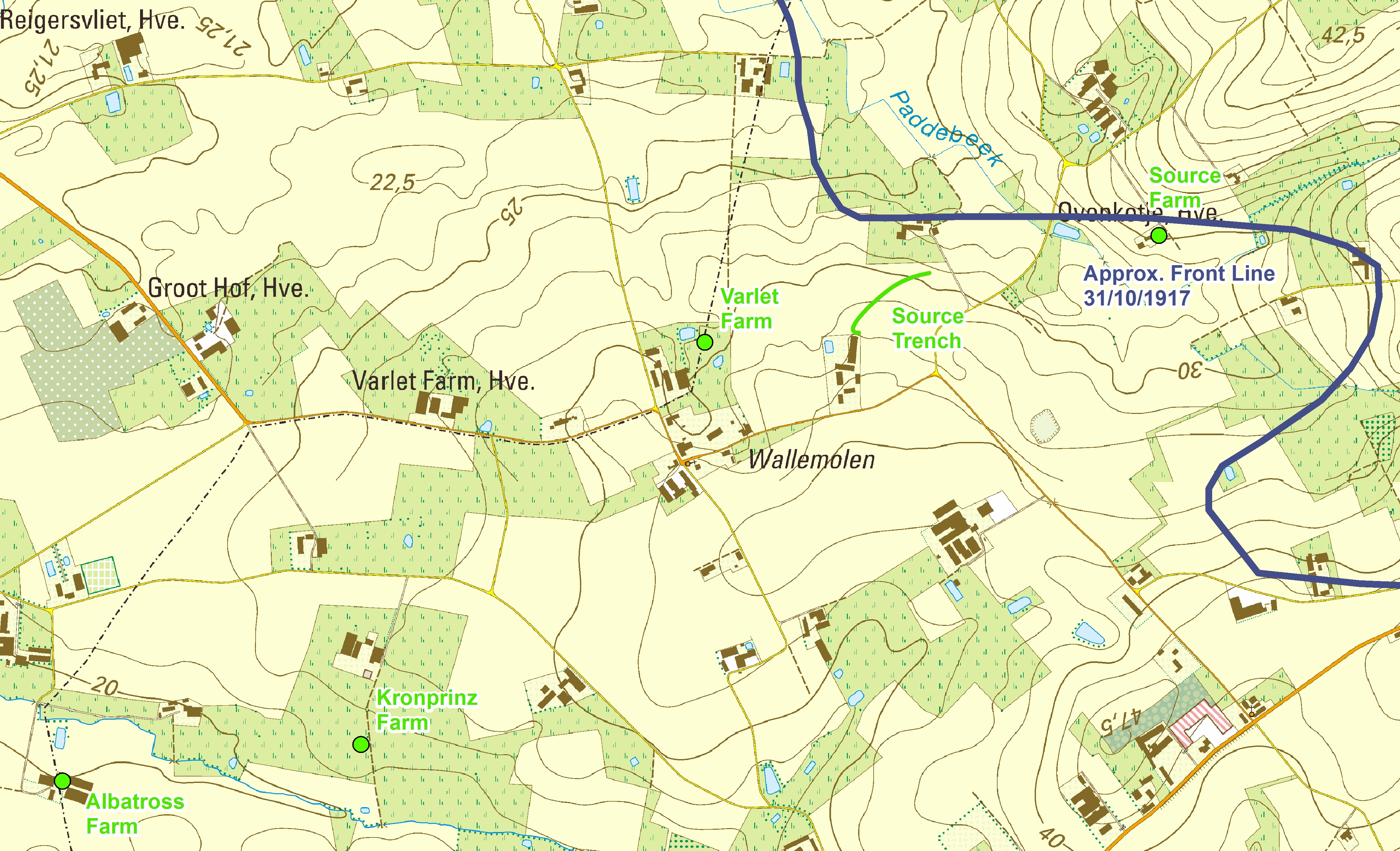
After a dreadful night in the open, at 5:50 a.m. the Royal Naval Division attacked with the 190th Brigade in support of the Canadians. The 1/4th King's Shropshire Light Infantry acted as a counter-attack battalion. At 1:30 p.m., two companies of the battalion were sent up to Varlet Farm, near the hamlet of Wallemolen, while one company moved to Kronprinz Farm. “A” and “D” Companies were to attack Source Trench, between Varlet Farm and Source Farm at the Goudberg, to fill a gap in the line between those positions. In the meantime, “B” Company moved towards Source Farm in support of the Canadians on the right. “B” Company suffered heavy casualties in doing so and only managed to link up with “A” and “D” Companies after dark. During the night, a line of posts was consolidated between Source Farm and Varlet Farm. The battalion held these positions until they were relieved after dark on 31 October 1917.
The casualties of the 1/4th King's Shropshire Light Infantry attack at Source Trench were: 1 officer killed, 8 officers wounded, 21 other ranks killed, 106 wounded, and 1 man missing. Private Edward Bingham was wounded during the action on 30-31 October 1917. He was evacuated to Wimereux, France, where he succumbed to his wounds on 14 November 1917, aged 25, leaving a young wife and a three-year-old child.
Sources 5
|
4 Battalion King's Shropshire Light Infantry (The National Archives, KEW (TNA), WO 95/3118/3). https://www.nationalarchives.gov.uk/ Sources used |
|
Census Returns of England and Wales, 1901 (The National Archives, Kew (TNA), RG13). https://www.nationalarchives.gov.uk/ Sources used |
|
Census Returns of England and Wales, 1911 (The National Archives, Kew (TNA), RG14). https://www.nationalarchives.gov.uk/ Sources used |
|
McCarthy C., Passchendaele. The Day-by-Day Account, (London, Uniform, 2018), pp. 153-155. Sources used |
|
Wood W., The history of the King's Shropshire Light Infantry in the Great War: 1914-1918, (London, The Medici Society, 1925), pp. 107-108. Sources used |
More information 4
|
Commonwealth War Graves Commission Database https://www.cwgc.org/find-records/find-war-dead/casualty-details/507698 |
|
A Street Near You https://astreetnearyou.org/person/507698/ |
|
Namenlijst (In Flanders Fields Museum) https://namenlijst.org/publicsearch/#/person/_id=589b4a90-2836-405f-9a2f-1851e771afb7 |
|
Lives of the First World War (Imperial War Museum) https://livesofthefirstworldwar.iwm.org.uk/lifestory/344123 |