Lt
John Alexander Catto
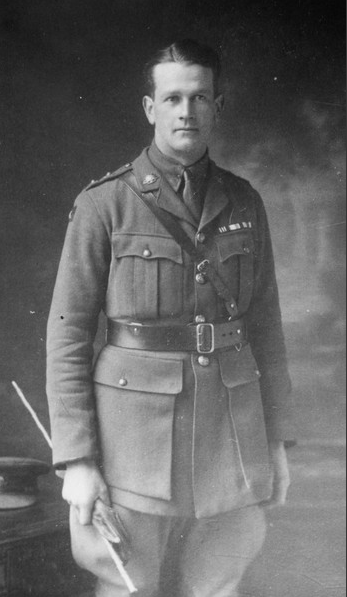
Information about birth
|
Date of birth: 28/06/1890 |
|
Place of birth: Catto’s farm, Rheola, Victoria, Australia |
General information
|
Last known residence: Catto’s farm, Rheola, Victoria, Australia |
|
Profession: Farmer |
|
Religion: Church of England |
Army information
|
Country: Australia |
|
Force: Australian Imperial Force |
|
Rank: Lieutenant |
|
Service number: 357 |
|
Enlistment date: 17/09/1914 |
|
Enlistment place: Inglewood, Victoria, Australia |
|
Units: — Australian Infantry, 5th Bn. (Last known unit) |
Information about death
|
Date of death: 29/05/1972 |
|
Place of death: Catto’s farm, Rheola, Victoria, Australia |
|
Cause of death: Death post-war (unrelated) |
|
Age: 81 |
Distinctions and medals 5
|
1914-15 Star Medal |
|
British War Medal Medal |
|
Mentioned in Despatches Honourable mentioning |
|
Military Medal Medal |
|
Victory Medal Medal |
Points of interest 6
| #1 | Place of birth | ||
| #2 | Last known residence | ||
| #3 | Enlistment place | ||
| #4 | Location of medal-earning event | ||
| #5 | Place of death (approximate) | ||
| #6 | Cemetery |
My story
John (Jock) Alexander Catto was born on 28 June 1890 in Rheola (Victoria, Australia), the son of the Scottish immigrant John Catto and his wife, Mary Ann Catto (née Gorst). He grew up in a family with three sisters and three brothers. Jock worked on the family farm called “Tyrie”, a reference to the hamlet in Aberdeenshire where his father was born. On 17 September 1914, in nearby Inglewood, John Alexander enlisted with the 8th Light Horse Regiment as a trooper. He was the first to enlist, although his three brothers would later follow.
After a brief training, he embarked at Melbourne on 25 February 1915, bound for Egypt. From there the regiment departed on 16 May 1915 for Gallipoli, where it was deployed dismounted as infantry to reinforce the stalled offensive that had begun on 25 April 1915. After nearly three months on the peninsula, John fell seriously ill with dysentery, a consequence of the difficult and unhygienic conditions in the trenches. He was evacuated and, just over a month later, ended up in a hospital in England. It was not until more than ten months later, on 24 July 1916, that he was discharged from hospital. He would not return to Gallipoli, since the Allied evacuation had been completed on 9 January 1916. Nor did he rejoin the 8th Light Horse Regiment: on 1 October 1916 he was assigned as a private to the 5th Battalion, part of the 2nd Infantry Brigade, 1st Australian Division.
Catto wintered on the Somme. On 16 February 1917 his battalion carried out a large trench raid on the German positions south of Ligny-Thilloy, in which more than a hundred men took part. John, by then a lance corporal, was among the participants. When the order to withdraw came after the raid, he noticed that a wounded comrade had been left behind. He brought him back to their own lines and then helped to transport the wounded to medical aid posts. For this he was recommended for a Military Medal, but ultimately did not receive it. His efforts were only recognised on 9 April 1917, when Corporal Catto – he had been promoted again – was formally honoured with a mention in Sir Douglas Haig’s despatches.
Five months later, on 14 September 1917, Lance Sergeant Catto – he had received the appointment in late May – crossed the Belgian border with the 5th Battalion. On 20 September 1917 they took part in the Battle of the Menin Road at Glencorse Wood. The attack succeeded and the front was pushed forward, but not without heavy losses. According to the war diary the unit suffered a total of 271 casualties: 70 killed (3 officers and 67 other ranks), 189 wounded (6 officers and 183 other ranks), and 12 missing (all other ranks). Catto survived the battle and was promoted two days later to temporary sergeant.
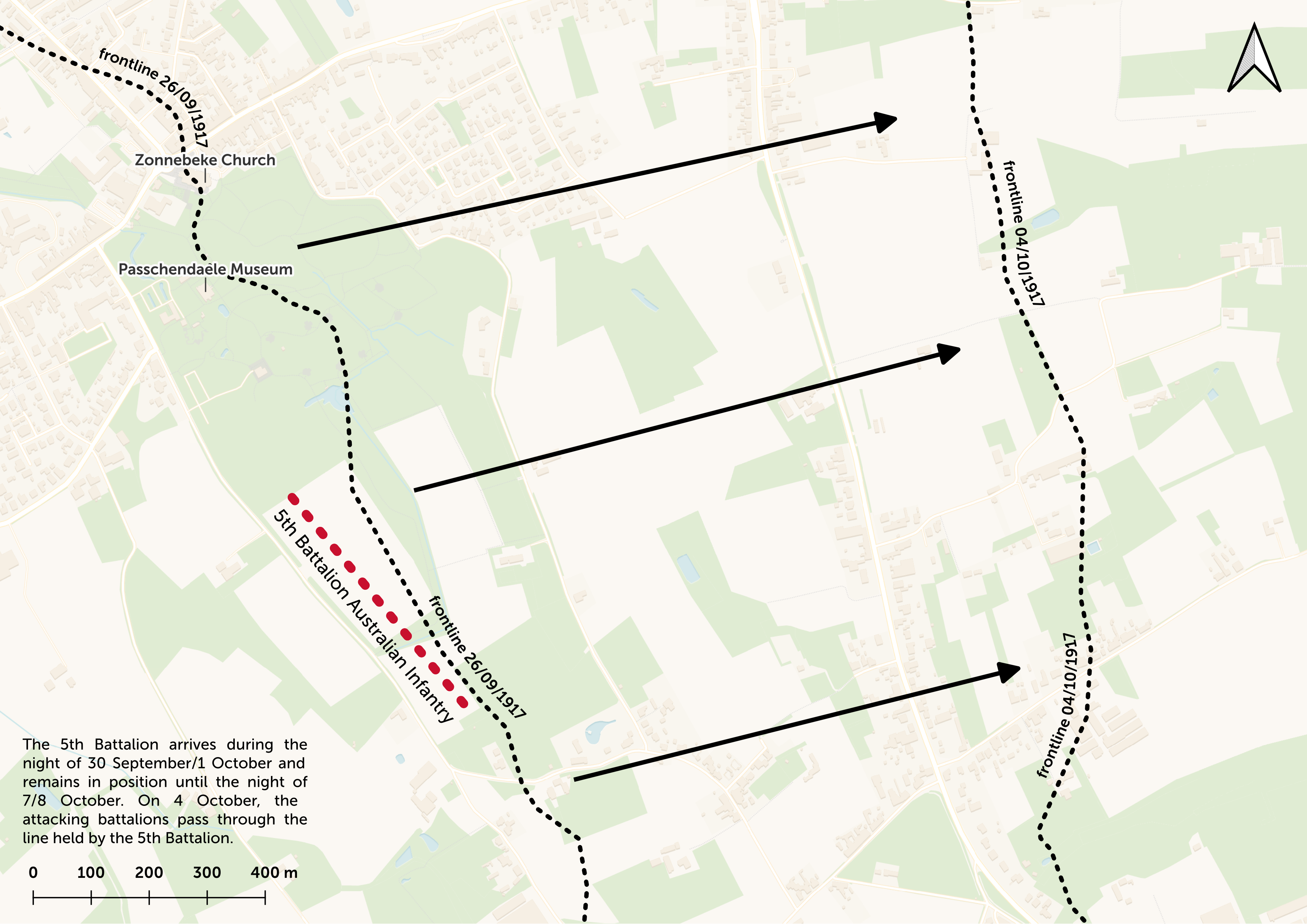
After a period of rest, the 5th Battalion took over the line again on 1 October 1917. The line had by then been advanced to near Zonnebeke. The front they occupied ran parallel to the Berten Pilstraat, on the southern side of the castle park. The German troops opposite them sat on the heights of the Broodseinde ridge. In the early hours of 4 October the German artillery opened up, followed by an infantry attack. The Australians, however, had planned their own attack for that same morning, so the German assault troops were struck in open ground by the Allied artillery preparation. The Australians managed to take the high ground of Broodseinde. This action would later become known as the Battle of Broodseinde.
The 5th Battalion did not take an active part in the attack – which was carried out by the 6th, 7th and 8th Battalion – but had to hold the front line from 1 October until being relieved on the night of 7-8 October. In doing so, they were regularly exposed to heavy artillery fire. The battalion suffered 173 casualties during that period: 54 killed (1 officer and 53 other ranks), 115 wounded (6 officers and 109 other ranks), and 4 missing (all other ranks).
Catto survived the battle. He was once again recommended for a Military Medal, and this time it was awarded. “This non-commissioned officer”, the citation reads, “displayed the greatest courage and devotion to duty during the action near Zonnebeke […]. Despite enemy barrage fire he tended and evacuated the wounded, without regard for his own safety. Towards the end of the seven days at the front, in heavily shelled and waterlogged trenches, it was his cheerfulness and great courage that kept morale high among tired and sorely tried men.”
On 15 October 1917 Catto was promoted to Second Lieutenant and thereby entered the officer ranks. At the end of October the battalion was again deployed in the front line at Nieuwemolen, without taking part in offensive operations. After a rest period in France, the battalion was redeployed in Flanders from mid-December. The Third Battle of Ypres was by then over, and this period at the front was relatively quiet. In addition to front-line duty, the battalion was used for working parties. On 18 March 1918, Second Lieutenant Catto was working with a working party near Vierstraat when they were caught in an artillery bombardment.
John and another soldier were wounded. With a shrapnel wound to his left leg, he was evacuated to England. During his hospital stay he received mixed news. On the one hand he was promoted to lieutenant; on the other, he learned that his eldest brother, Robert Grant Catto, had been killed in action near Corbie (France) on 5 April 1918. Robert served as a private with the 60th Battalion. He survived, among other engagements, the Battle of Polygon Wood on 26 September 1917, but was killed on the last day of Operation Michael, part of the German Spring Offensive. The 29-year-old is commemorated on the Australian National Memorial at Villers-Bretonneux.
Lieutenant Catto set foot in France again on 10 November 1918, one day before the armistice. He reached his unit near Saint-Quentin, France, on 19 November, but his return was short-lived. Exactly one month later he was wounded again. At Walcourt – province of Namur, his unit having moved into Belgium in the meantime – a team of four mules and a wagon bolted in the direction of a platoon. Catto managed to bring it to a halt before it reached the men, but did not get away unscathed. He was again evacuated to a hospital in Wimereux. For his intervention, the Corps Commander had a note of thanks entered into his personal file on 13 January 1919.
At the end of January 1919 Catto was able to rejoin his unit. On 21 March 1919 he left France, but he still had to remain in the United Kingdom for some time. On Anzac Day, 25 April 1919, he was given the honour of leading his men in a parade through the streets of London. During his further stay in the United Kingdom he managed to put the waiting time before his return to good use: he was granted special leave to study animal husbandry and to work on the farm of John Bell near – not a coincidence – Tyrie in Aberdeenshire, Scotland. On 1 November 1919 he embarked and arrived in Melbourne on 15 December 1919, four years, nine months and twenty days after his departure.
Back in Australia he settled again on the family farm in Rheola. In the early 1920s John married Eleanor Florence Gillespie and, together with his brother Stanley, started an apple and pear orchard to the north of the village. The orchard of some 20 hectares was christened “Zonnebeke Orchard”, a reference to the place where he had received his Military Medal. Despite the dry semi-desert climate of the region, the fruit grew well. He won the ‘Colombie Cup’ three years in a row (1934-1936) for growing and selling the best export apples of the state of Victoria. Over time the name “Zonnebeke” gradually displaced “Tyrie” as the designation for the Catto farm.
By around 1950 the Australian Zonnebeke had grown into a diversified mixed enterprise, a deliberate strategy on Catto’s part as an alternative to a poor fruit harvest. The orchard then comprised some 4,000 apple and 1,000 pear trees, accounting for 10,000 to 12,000 cases of apples and more than 2,000 cases of pears each year. In addition he kept about 150 pigs, fourteen to seventeen cows and 800 to 1,000 Merino sheep. In total he managed some 400 acres of his own land and 2,700 acres leased, together equivalent to about 1,250 hectares, roughly 18% of the area of the Belgian municipality of Zonnebeke (6,757 ha). Water remained the greatest challenge, and in the late 1940s John installed an irrigation system and the “Zonnebeke dam”, a water reservoir for the orchard.
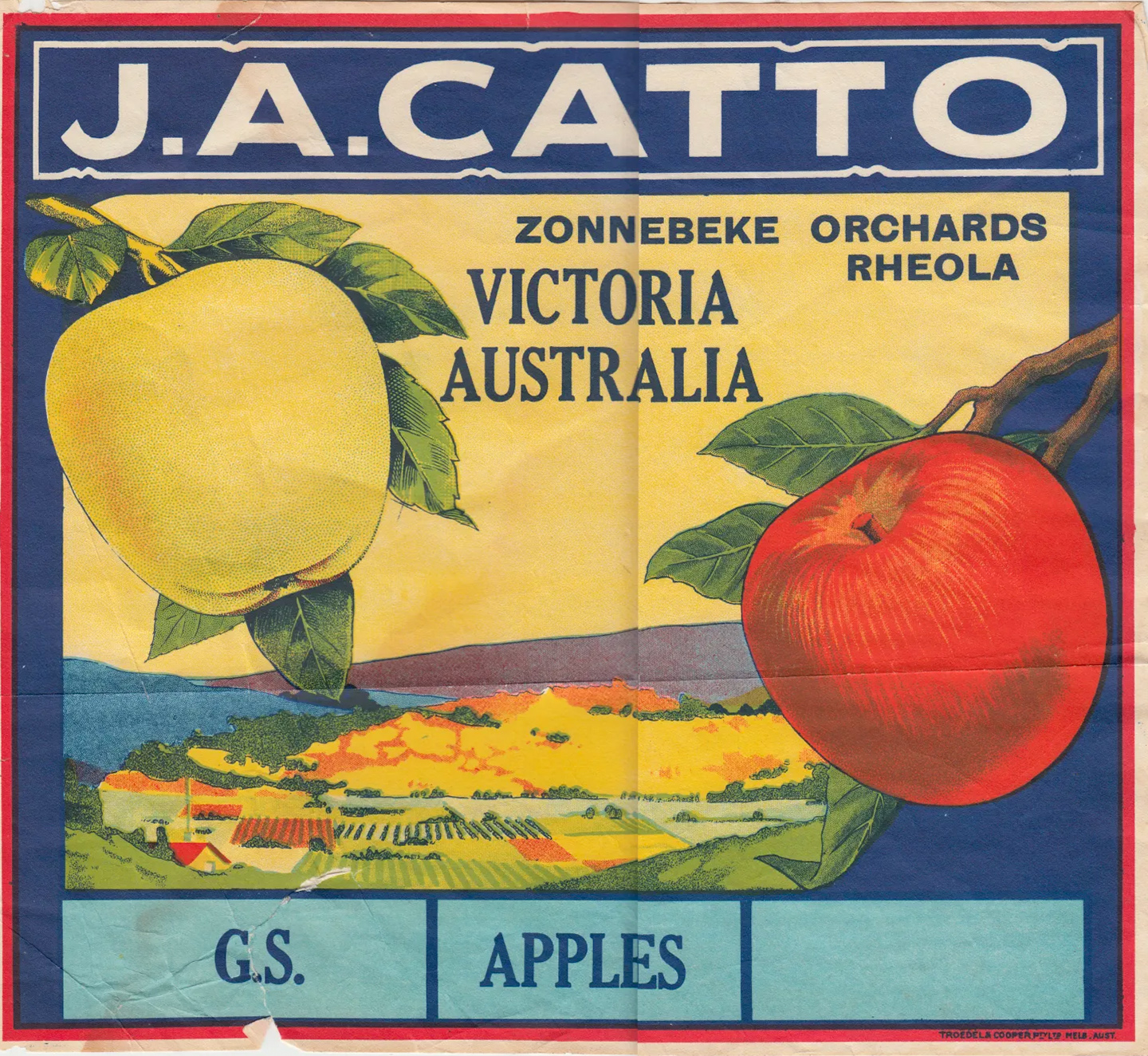
John Alexander Catto died at the age of 81 on 29 May 1972. His farm was sold at public auction a few years later, but exists to this day. Along the Inglewood-Rheola Road, just before the junction with Pipeclay Road, a sign bearing the name “Zonnebeke Orchard” still stands. Despite the fact that the village of Zonnebeke and the farm of the same name lie some 16,500 kilometres apart, they were once again connected on 6 May 2026: on that date, inhabitants of Rheola, during a visit to the Passchendaele Museum, donated an original label from the apple cases of Zonnebeke Orchard to the museum collection.
Sources 8
|
"John Alexander Catto," memorial no. 151866484, Find a Grave, accessed 11 May 2026 https://nl.findagrave.com/memorial/151866484 Sources used |
|
5th Infantry Battalion (Australian War Memorial, Campbell (AWM), AWM4 23/22). https://www.awm.gov.au Sources used |
|
8th Australian Light Horse Regiment (Australian War Memorial, Campbell (AWM), AWM4 10/13). https://www.awm.gov.au Sources used |
|
First Australian Imperial Force Personnel Dossiers, 1914-1920 (National Archives of Australia, Canberra (NAA), B2455). https://www.naa.gov.au/ Sources used |
|
Graeme Brooks, "Orcharding Combined with Dairy Cattle, Pigs and Sheep," Weekly Times (Melbourne), 31 March 1954, 27, accessed via Trove https://trove.nla.gov.au/ Sources used |
|
John Alexander Catto (Australian War Memorial, Campbell (AWM), AWM28 2/279, part 2). https://www.awm.gov.au Sources used |
|
McCarthy Chris., Passchendaele. The Day-by-Day Account (London, Unicorn Publishing Group, 2018). Sources used |
|
Unit embarkation nominal rolls, 1914-18 War (Australian War Memorial, Campbell (AWM), AWM8). https://www.awm.gov.au/ Sources used |
More information 2
|
The AIF Project (UNSW Canberra) https://aif.adfa.edu.au/showPerson?pid=49132 |
|
Virtual War Memorial Australia https://vwma.org.au/explore/people/271476 |