Lt. d. R.
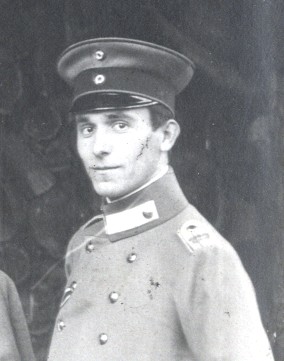
Karl Cramm
Information about birth
|
Date of birth: 24/11/1886 |
|
Place of birth: Gross Lafferde, Hannover, Kingdom of Prussia, German Empire |
General information
|
Last known residence: Groß Berkel, German Empire |
Army information
|
Country: Kingdom of Prussia, German Empire |
|
Force: Imperial German Army |
|
Rank: Leutnant der Reserve |
|
Enlistment place: Hameln, German Empire |
Distinctions and medals 1
|
Eiserne Kreuz II. Klasse Medal |
Points of interest 5
| #1 | Place of birth | ||
| #2 | Last known residence | ||
| #3 | Enlistment place | ||
| #4 | Place of wounding | ||
| #5 | Prisoner-of-war camp |
My story
Karl Cramm was born on 24 November 1886 in Groß Lafferde, Lower Saxony. He worked as a teacher and was married to Hedwig. The couple lived in Groß Berkel, near Hameln.
He was mobilized in 1914 and received his military training in Hameln. He was subsequently assigned to the front with the 12. Kompagnie of Reserve-Infanterie-Regiment 260. While serving with this unit, he was lightly wounded in June 1915 during the fighting along the Dubysa (Dubissa) River in Lithuania. He was later treated in a military hospital in Demmin, Pomerania.
In February and March 1916, Karl attended officer-cadet (Offizier-Aspirant) training at the Munster Lager. He was then transferred to Reserve-Infanterie-Regiment 229, where he was promoted to Leutnant der Reserve and given command of the 1. Zug of the 1. Kompagnie. In mid-September 1916, he was wounded near Eaucourt during the Battle of the Somme. In the organizational chart of Reserve-Infanterie-Regiment 229 dated 1 March 1917, Leutnant Cramm is listed as one of the officers of the 4. Kompagnie.
During the summer of 1917, he completed specialist machine-gun training at Waulsort. From 22 September 1917 onward, the regiment was deployed in Polygon Wood and the area to its south, extending as far as the Reutelbeek. The fighting on 25 and 26 September 1917 resulted in heavy losses for Reserve-Infanterie-Regiment 229. Leutnant Cramm was also severely wounded on 27 September 1917. He was evacuated by a Lazarettzug (hospital train) sponsored by the Cologne-based firm Jean Maria Farina, a manufacturer of eau de cologne. Karl Cramm subsequently received medical treatment in Hameln for several months.
After recovering from his wounds, he attended a training course for Waffenoffizier (ordnance officer) in Stettin from 1 April to 12 May 1918. He was then transferred to Maschinengewehr-Scharfschützen-Abteilung 24. On 4 October 1918, he was captured near Le Catelet. On 11 October 1918, he arrived at the prisoner-of-war camp at Bevois Mount House and Skating Rink in Southampton. He was later transferred to the camp at Ripon.
Sources 2
|
"Verlustlisten Erster Weltkrieg", Verein für Computergenealogie (DES) https://wiki.genealogy.net/Verlustlisten_Erster_Weltkrieg/Projekt Sources used |
|
Alfons Wiedersich. Das Reserve-Infanterie-Regiment Nr. 229. Erinnerungsblätter Preußen Bd. 316 (Verlag Tradition Wilhelm Kolk, Berlin, 1929). Sources used |