Pte
Thomas Colthart

Information about birth
|
Date of birth: 27/06/1892 |
|
Place of birth: Lesmahagow, Lanarkshire, Scotland, United Kingdom |
General information
|
Last known residence: Rosehill Farm, Lesmahagow, Lanarkshire, Scotland, United Kingdom |
|
Profession: Coal miner |
Army information
|
Country: England, United Kingdom |
|
Force: British Expeditionary Force |
|
Rank: Private |
|
Service number: S/10009 |
|
Enlistment place: Hamilton, Lanarkshire, Scotland, United Kingdom |
|
Units: — Gordon Highlanders, 2nd Bn. (Last known unit) |
Information about death
|
Date of death: 04/10/1917 |
|
Place of death: Noordemdhoek, Belgium |
|
Cause of death: Killed in action (K.I.A.) |
|
Age: 25 |
Cemetery
|
Tyne Cot Cemetery Plot: XLIII Row: D Grave: 10 |
Distinctions and medals 4
|
1914-15 Star Medal |
|
British War Medal Medal |
|
Military Medal Medal |
|
Victory Medal Medal |
Points of interest 3
| #1 | Place of birth | ||
| #2 | Enlistment place | ||
| #3 | Place of death or original burial place |
My story
Thomas Colthart, born on 27 June 1892 in Lesmahagow, South Lanarkshire (Scotland), grew up as the eldest son in the large family of farmer James and Janet Colthart. Thomas worked as a miner at the Bellfield Colliery.
In May 1915, he enlisted in the British Army. On 10 November 1915, he arrived on the continent and was posted to the 2nd Battalion Gordon Highlanders, part of the 20th Brigade of the 7th Division. Private Colthart was awarded the Military Medal for his courageous service during the Battle of the Somme in July 1916.
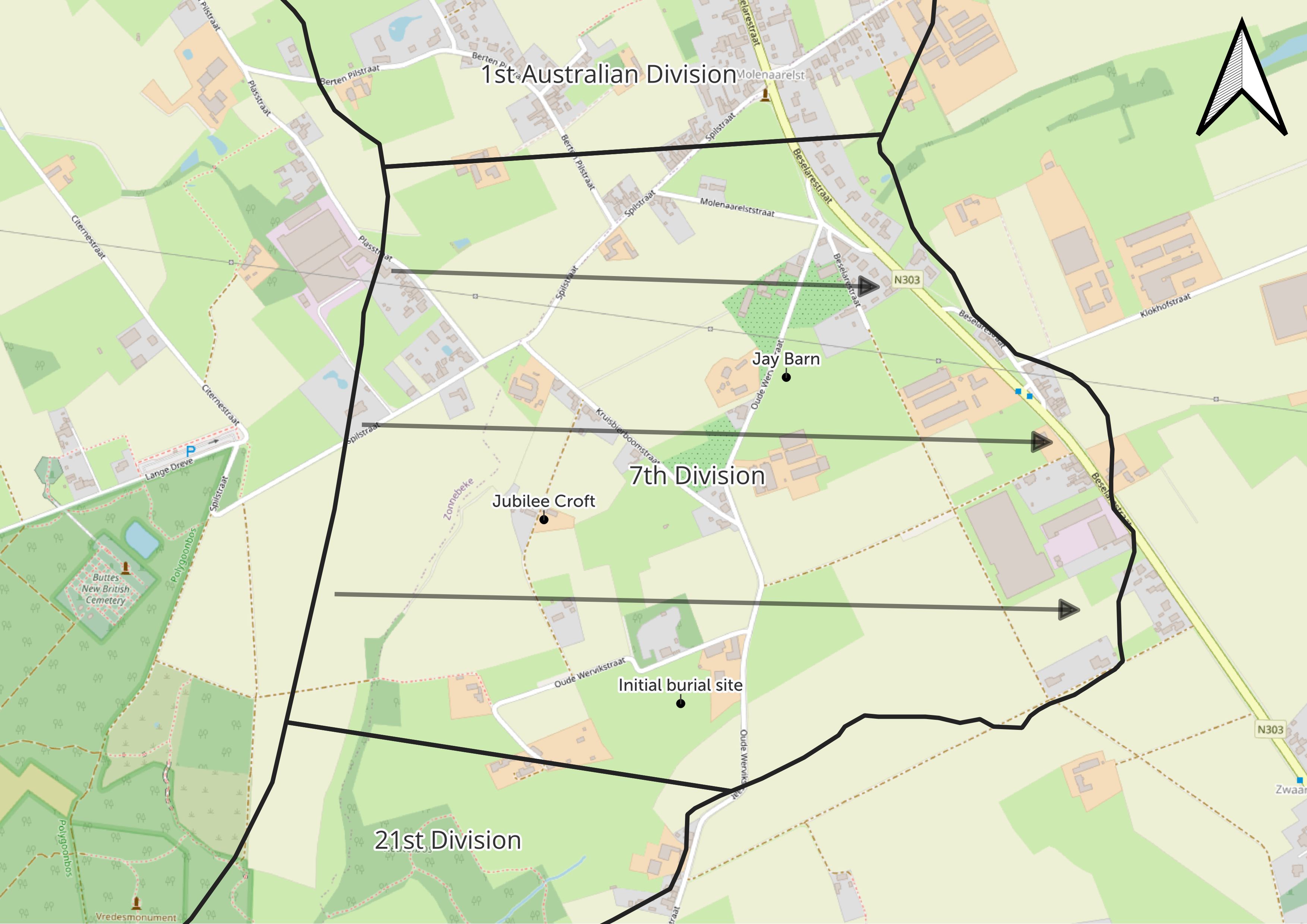
In the autumn of 1917, the 7th Division returned to the area where it had already seen heavy fighting in 1914, namely the Ypres Salient. Whereas in 1914 it had been positioned around the Menin Road near Gheluvelt, it was now assigned the sector north of Polygon Wood.
At the end of September, the 2nd Battalion Gordon Highlanders arrived in Reningelst. Via a camp at Dikkebus, the battalion moved to the front line during the night of 2-3 October, under constant shellfire and attacks by German aircraft, during which several men were wounded.
During the attack of 4 October 1917, the Battle of Broodseinde, the 20th Brigade was flanked by the 91st Brigade (7th Division) on the right and by the Australian 1st Brigade (1st Australian Division) on the left.
The attack began at 9 a.m. with an advance by the 8th Battalion, Devonshire Regiment, which quickly reached its first objective with little opposition. The Gordon Highlanders then took over the attack and stormed the slope of the ridge. Their most difficult task was the capture of the ruined hamlet of Noordemhoek.
Unexpectedly, a large number of German troops were present in the area. Heavy German artillery fire revealed that they had been preparing a counterattack. During the fighting, many prisoners of war were taken.
Only after the 2nd Battalion Gordon Highlanders had reached its final objective did it begin to suffer heavy losses. Enemy shelling was extremely intense and almost continuous. Even the delivery of rations and other supplies proved exceptionally difficult.
The Gordon Highlanders remained in these positions until the night of 7 October, when they were relieved. The battalion's losses were severe: three officers and fifty other ranks were killed, 245 soldiers were wounded, and 26 were reported missing.
Private Thomas Colthart, aged 25, was killed during these battles. His body was buried not far from where he fell. He was later reburied in Tyne Cot Cemetery, Plot XLIII, Row D, Grave 10.
Sources 10
|
1901 Scotland Census (National Records of Scotland). https://www.ancestry.com/ Sources used |
|
2nd Battalion Gordon Highlanders, War Diary, (The National Archives, Kew (TNA), WO 95/1656/2_4). https://www.nationalarchives.gov.uk/ Sources used |
|
British Army World War I Medal Rolls Index Cards, 1914-1920 (The National Archives, Kew (TNA), WO 372). https://www.nationalarchives.gov.uk/ Sources used |
|
Cyril Falls, The Life of a Regiment, Vol IV; "The Gordon Highlanders in the First World War 1914-1914" (The Naval & Military Press, Uckfield, East Sussex, TN22 5QE.) p.161-162. Sources used |
|
McCarthy, Chris. Passchendaele: The Day by Day Account (Londen: Arms & Armour Press, 1995), p.108+111. Sources used |
|
Soldiers' Effects Records (National Army Museum, Chelsea (NAM) 1901-60; NAM Accession Number: 1991-02-333). https://www.nam.ac.uk/ Sources used |
|
Supplement to the London Gazette, 1 September 1916. https://www.thegazette.co.uk/London/issue/29731/supplement/8654 Sources used |
|
Thomas Colthart - Private S/10009, Peasants to Puddles - My Family History - By Nicky Rowberry http://www.peasantstopuddles.org/thomcolt.htm Sources used |
|
UK, British Army Recipients of the Military Medal, 1914-1920. https://www.ancestry.com/ Sources used |
|
War Office and Air Ministry: Service Medal and Award Rolls, First World War (The National Archives, Kew (TNA), WO 329). https://www.nationalarchives.gov.uk/ Sources used |
More information 4
|
Commonwealth War Graves Commission Database https://www.cwgc.org/find-records/find-war-dead/casualty-details/462344 |
|
Namenlijst (In Flanders Fields Museum) https://namenlijst.org/publicsearch/#/person/_id=118617fe-7808-4b0a-ac5e-62cd32b6448c |
|
Lives of the First World War (Imperial War Museum) https://livesofthefirstworldwar.iwm.org.uk/lifestory/911433 |
|
A Street Near You https://astreetnearyou.org/person/462344/ |