Pte
Patrick Francis Fitzpatrick
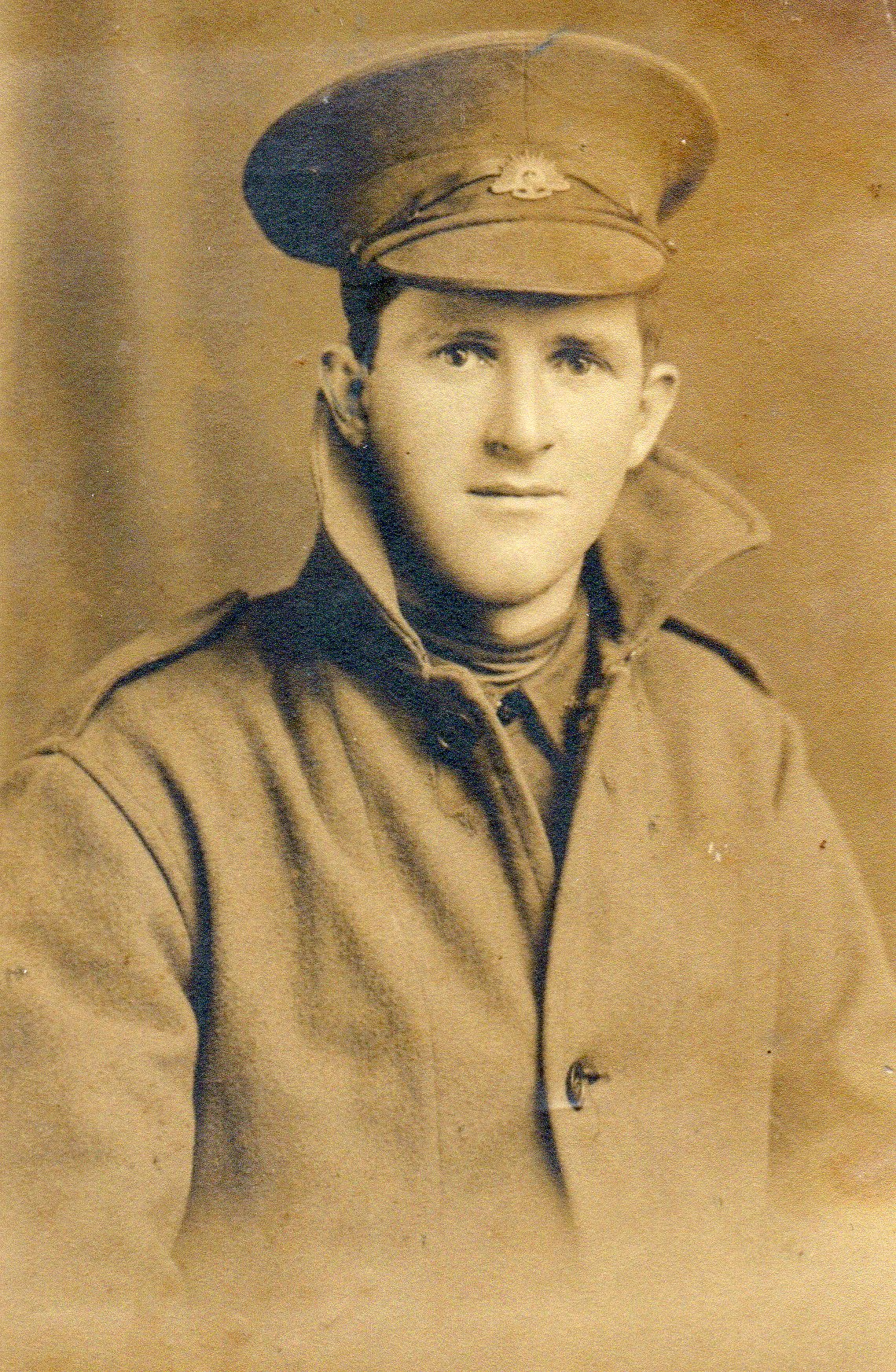
Information about birth
|
Date of birth: 05/12/1893 |
|
Place of birth: Leichhardt, New South Wales, Australia |
General information
|
Last known residence: Leichhardt, New South Wales, Australia |
|
Profession: milk carter |
|
Religion: Roman Catholic |
Army information
|
Country: Australia |
|
Force: Australian Imperial Force |
|
Rank: Private |
|
Service number: 5674 |
|
Enlistment date: 08/11/1915 |
|
Enlistment place: Katoomba, New South Wales, Australia |
|
Units: — Australian Infantry, 17th Bn. (New South Wales) (Last known unit) |
Information about death
|
Date of death: 20/09/1917 |
|
Place of death: Gordon House, Zillebeke, Belgium |
|
Cause of death: Killed in action (K.I.A.) |
|
Age: 23 |
Cemetery
|
Birr Cross Roads Cemetery Plot: III Row: C Grave: 22 |
Distinctions and medals 2
|
British War Medal Medal |
|
Victory Medal Medal |
Points of interest 4
| #1 | Place of birth | ||
| #2 | Last known residence | ||
| #3 | Enlistment place | ||
| #4 | Place of death (approximate) |
My story
Patrick Francis Fitzpatrick was born on 5 December 1893 in Leichhardt, New South Wales (Australia). His parents were Irish Catholic immigrants. Patrick’s father, Michael, died of tuberculosis in 1910. His sister Margaret (born in 1891) also died from the effects of the disease in 1913. Patrick later worked as a milkman and was in a relationship with Ada Elsie Foran. Their son, John Francis, was born on 6 May 1917, and Patrick acknowledged paternity.
Patrick enlisted in the Australian Army on 8 November 1915. He enlisted under the name John Francis and was assigned to the 45th Australian Infantry Battalion on 24 November 1915. He was later transferred to the 17th Australian Infantry Battalion in Lithgow, New South Wales. On 9 September 1916, he embarked at Sydney for Plymouth, where he arrived on 26 October. In December 1916, he was transferred to Étaples in France, and on 24 January 1917 he joined the 17th Australian Infantry Battalion. On 14 March 1917, Patrick was admitted to hospital due to illness, returning to his unit on 8 April. On 15 April 1917, he suffered a gunshot wound to the chest. He was first treated in Boulogne and was then transferred to Great Britain on 1 May, where he was also diagnosed with trench foot. It was not until 9 August that Patrick rejoined the 17th Australian Infantry Battalion. At that time, the unit was stationed near Saint-Omer, where it rested and underwent further training.
On 12 September 1917, the battalion moved to the Ypres Salient. From 13 September onwards, it was housed in a tent camp near Dikkebus in preparation for its participation in the Third Battle of Ypres. During the night of 19-20 September, the 17th Australian Infantry Battalion moved to the front line to support the attack of the 2nd Australian Division as a reserve unit. During this movement along duckboard tracks, a phosphorus shell exploded, killing and wounding several soldiers.
One of the soldiers killed was Private Patrick Francis Fitzpatrick. He was initially buried near the place where he fell. At the end of 1919, his body was exhumed and reburied in Birr Cross Roads Cemetery, where he still lies today in Plot III, Row C, Grave 22.
Sources 4
|
17th Australian Infantry Battalion, (Australian War Memorial, Campbell (AWM), AWM4 23/34/27). https://www.awm.gov.au/collection/C1339175 Sources used |
|
Australian War Memorial, ‘Australian Red Cross Society Wounded and Missing Enquiry Bureau Files, 1914-18 War 1DRL/0428’. https://www.awm.gov.au/collection/R1488697 Sources used |
|
Catherine Nagy, Patrick Francis (AKA John Francis) Fitzpatrick Australian Imperial Force – 17th Battalion Service Number 5674. 2018. Sources used |
|
First Australian Imperial Force Personnel Dossiers, 1914-1920, (National Archives of Australia, Canberra (NAA), B2455, FITZPATRICK J F). https://recordsearch.naa.gov.au/SearchNRetrieve/Interface/DetailsReports/ItemDetail.aspx?Barcode=3910668 Sources used |
More information 4
|
Commonwealth War Graves Commission Database https://www.cwgc.org/find-records/find-war-dead/casualty-details/459949 |
|
Namenlijst (In Flanders Fields Museum) https://namenlijst.org/publicsearch/#/person/_id=6b7d17f0-6c37-424f-8c95-106f1d1f23db |
|
The AIF Project (UNSW Canberra) https://aif.adfa.edu.au/showPerson?pid=98739 |
|
Virtual War Memorial Australia https://vwma.org.au/explore/people/195585 |