Pte
William Whitbread
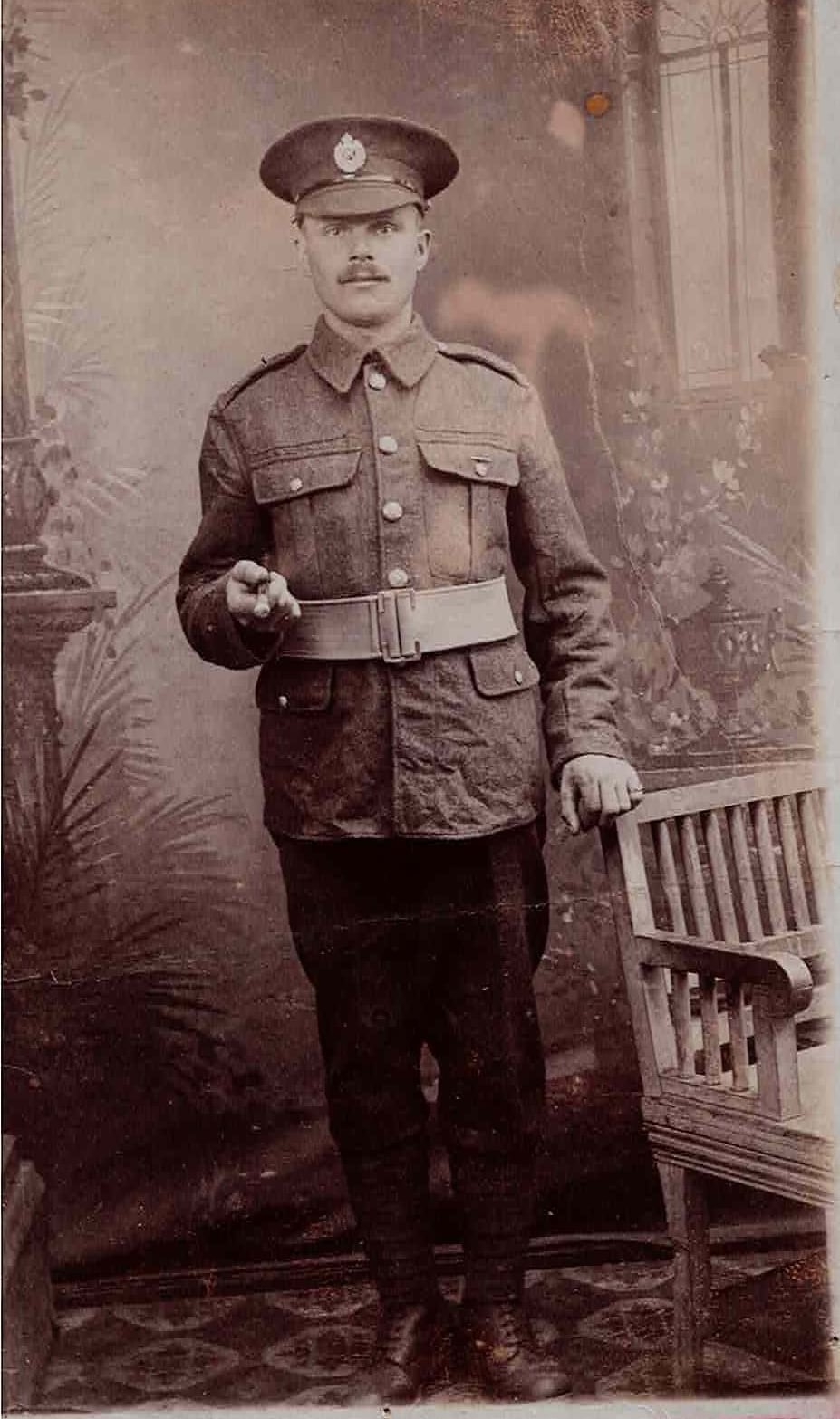
Information about birth
|
Date of birth: 18/07/1887 |
|
Place of birth: Croydon, Surrey, England, United Kingdom |
General information
|
Last known residence: 13 Prussia Place, Nursery Road, Mitcham, Surrey, England, United Kingdom |
|
Profession: Bricklayer |
|
Religion: Church of England |
Army information
|
Country: Wales, United Kingdom |
|
Force: British Expeditionary Force |
|
Rank: Private |
|
Service number: 44351 |
|
Enlistment place: Mitcham, Surrey, England, United Kingdom |
|
Units: — South Wales Borderers, 1st Bn. (Last known unit) |
Information about death
|
Date of death: 10/11/1917 |
|
Place of death: Goudberg, Passchendaele, Belgium |
|
Cause of death: Killed in action (K.I.A.) |
|
Age: 30 |
Memorial
|
Ypres (Menin Gate) Memorial Panel: 65-66 |
Distinctions and medals 2
|
British War Medal Medal |
|
Victory Medal Medal |
Points of interest 4
| #1 | Place of birth | ||
| #2 | Last known residence | ||
| #3 | Enlistment place | ||
| #4 | Place of death (approximate) |
My story
William Whitbread was born on 18 July 1887 in Croydon, Surrey (England). His father was Samuel Whitbread and his mother Jane Stroud. The family had twelve children. William worked as a bricklayer and married Harriet Ellen Hyder on 1 August 1914. The couple had one son, William Charles, born on 7 June 1915.
William enlisted in the British Army at Mitcham and was initially assigned to the Royal Engineers under service number 17117. He was later transferred to the 1st Battalion South Wales Borderers, part of the 3rd Brigade, 1st Division.
On 10 November 1917, an attack by the 3rd Brigade was planned on the Goudberg Ridge, north of Passchendaele. On the left flank, the 2nd Battalion Royal Munster Fusiliers was to attack from Source Farm towards Tournant Farm, Vat Cottages and Veal Cottages. On the right flank, the 1st Battalion South Wales Borderers was to advance from Valour Farm towards a line running from Veal Cottages to Void Farm. Further to the right, the 8th Canadian Infantry Battalion was attacking.
During the night of 9-10 November, the 1st Battalion South Wales Borderers moved from Bellevue Spur to Valour Farm, arriving shortly after 3 a.m. As soon as the attack began, the battalion came under its own British artillery barrage, which was highly irregular. As a result, the attackers drifted to the right, following the much stronger Canadian artillery barrage. This created a gap with the Royal Munster Fusiliers on the left flank, and the attack stalled in the area of Virile Farm and Vocation Farm.
The Germans had meanwhile alerted their artillery, which brought heavy fire down on the attackers. At about 7:15 a.m., a German counter-attack was launched and was largely repulsed. Nevertheless, German troops succeeded in establishing themselves in the gap between the two battalions of the 3rd Brigade. A second counter-attack followed in the afternoon, forcing the 1st Battalion South Wales Borderers to withdraw to a line between Venture Farm and Valour Farm. Reinforcements gradually arrived to close the gap on the left flank.
The battalion was relieved during the night of 11-12 November 1917. Its losses amounted to 10 officers and 372 other ranks.
One of the men killed was Private William Whitbread. His body was never recovered after the war. He is commemorated on the Ypres (Menin Gate) Memorial, Panel 65-66.
Sources 3
|
1 Battalion South Wales Borderers. (The National Archives, KEW (TNA), WO 95/1280/3). https://discovery.nationalarchives.gov.uk/details/r/C7351919 Sources used |
|
3 Infantry Brigade: Headquarters. (The National Archives, KEW (TNA), WO 95/1276/3). https://discovery.nationalarchives.gov.uk/details/r/C14052730 Sources used |
|
William Whitbread, ancestry.com https://www.ancestry.com/family-tree/person/tree/168147407/person/432356122024/facts Sources used |
More information 4
|
Namenlijst (In Flanders Fields Museum) https://namenlijst.org/publicsearch/#/person/_id=5bfcb7c5-788e-4d78-8bc0-59eea32c2bea |
|
Commonwealth War Graves Commission Database https://www.cwgc.org/find-records/find-war-dead/casualty-details/876735 |
|
A Street Near You https://astreetnearyou.org/person/876735/ |
|
Lives of the First World War (Imperial War Museum) https://livesofthefirstworldwar.iwm.org.uk/lifestory/5372798 |