Pte
Eric Bunt
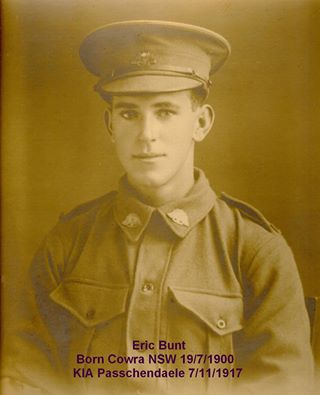
Information about birth
|
Date of birth: 19/07/1900 |
|
Place of birth: Cowra, New South Wales, Australia |
General information
|
Last known residence: Sutton Forest, New South Wales, Australia |
|
Profession: Blacksmith |
|
Religion: Church of England |
Army information
|
Country: Australia |
|
Force: Australian Imperial Force |
|
Rank: Private |
|
Service number: 7219 |
|
Enlistment date: 26/01/1917 |
|
Enlistment place: Moss Vale, New South Wales, Australia |
|
Units: — Australian Infantry, 2nd Bn. (Last known unit) |
Information about death
|
Date of death: 10/11/1917 |
|
Cause of death: Killed in action (K.I.A.) |
|
Age: 17 |
Memorial
|
Ypres (Menin Gate) Memorial Panel: Panel 7 |
Distinctions and medals 2
|
British War Medal Medal — 10/06/1921 |
|
Victory Medal Medal — 10/06/1921 |
Points of interest 3
| #1 | Place of birth | ||
| #2 | Last known residence | ||
| #3 | Enlistment place |
My story
Eric Flint was born in Cowra, New South Wales (Australia), on 19 July 1900 as the illegitimate son of Mary Ellen Flint. His mother married Charles Bunt in 1902, after which Eric took the surname Bunt. By 1917, the family had moved to Sutton Forest, New South Wales, where Eric worked as a labourer.
He enlisted in the Australian Army on 26 January 1917 and stated that he was eighteen years and six months old at the time. He also reported having served for two years as a Senior Cadet in the Citizen Forces. On 10 February 1917, he departed Sydney for Plymouth, where he arrived on 11 April. In Great Britain he underwent military training until he was sent to France on 15 October 1917. There, on 20 October 1917, he was posted to the 2nd Australian Infantry Battalion, part of the 1st (New South Wales) Australian Brigade, 1st Australian Division.
During the night of 5-6 November 1917, the 2nd Australian Infantry Battalion relieved the 9th Australian Infantry Battalion in a sector extending from Tiber (south of Passchendaele) to the vicinity of Decoy Wood, south of the Ypres-Roulers railway line. The battalion was tasked with further developing the sector by laying duckboard tracks, constructing shelters and connecting frontline positions.
On 6 November, the artillery of the 1st Australian Division supported the Canadian attack at Passchendaele by bombarding German positions. The German artillery responded and inflicted casualties on the 2nd Australian Infantry Battalion.
On 7 November 1917, German artillery fire was less intense than on the previous day, but German aircraft repeatedly strafed the sector with machine-gun fire without causing casualties. Five men of the battalion were wounded or killed that day.
Private Eric Bunt, aged seventeen, was killed in action on 7 November 1917. His body was never recovered. He is therefore commemorated on the Ypres (Menin Gate) Memorial, Panel 7.
Sources 4
|
2nd Australian Infantry Battalion, (Australian War Memorial, Campbell (AWM), AWM4 23/19). https://www.awm.gov.au/collection/C1339132 Sources used |
|
Eric Bunt, ancestry.com. https://www.ancestry.com/family-tree/person/tree/156892934/person/122153148727/facts Sources used |
|
Eric Flint/Bunt, ancestry.com. https://www.ancestry.com/family-tree/person/tree/162725006/person/302503754086/facts Sources used |
|
First Australian Imperial Force Personnel Dossiers, 1914-1920 (National Archives of Australia, Canberra (NAA), B2455, BUNT E). https://recordsearch.naa.gov.au/SearchNRetrieve/Interface/ViewImage.aspx?B=3166602 Sources used |
More information 5
|
Commonwealth War Graves Commission Database https://www.cwgc.org/find-records/find-war-dead/casualty-details/1598016 |
|
A Street Near You https://astreetnearyou.org/person/1598016/ |
|
Namenlijst (In Flanders Fields Museum) https://namenlijst.org/publicsearch/#/person/_id=ec190012-f691-45ce-8e54-4fcddb934140 |
|
The AIF Project (UNSW Canberra) https://aif.adfa.edu.au/showPerson?pid=38808 |
|
Virtual War Memorial Australia https://vwma.org.au/explore/people/171375 |