Krgsfr
Franz Daugs
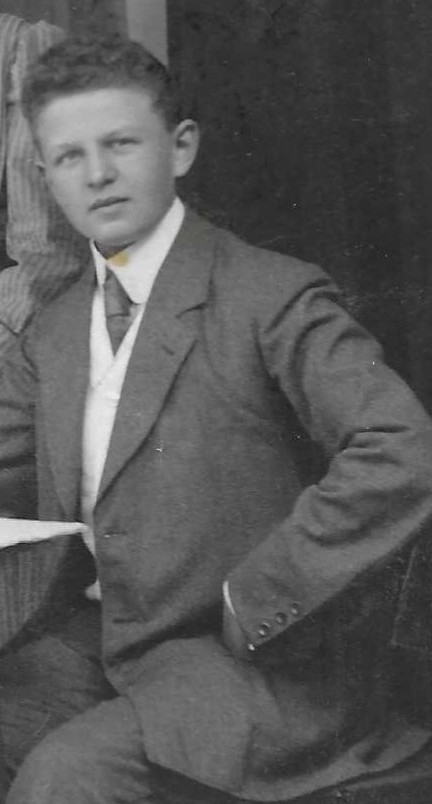
Information about birth
|
Date of birth: 18/05/1894 |
|
Place of birth: Ludwigsburg, Kingdom of Württemberg, German Empire |
General information
|
Last known residence: Ludwigsburg, Kingdom of Württemberg, German Empire |
|
Profession: Merchant |
|
Religion: Protestant |
Army information
|
Country: Kingdom of Württemberg, German Empire |
|
Force: Imperial German Army |
|
Rank: War volunteer |
|
Service number: 62 |
|
Enlistment date: 08/08/1914 |
|
Enlistment place: Ludwigsburg, Kingdom of Württemberg, German Empire |
|
Units: — 2. Kompagnie, I. Bataillon, Reserve-Infanterie-Regiment Nr. 248 (Last known unit) |
Information about death
|
Date of death: 23/12/1914 |
|
Place of death: Polderhoek Château, Belgium |
|
Cause of death: Killed in action (K.I.A.) |
|
Age: 20 |
Memorial
|
Deutscher Soldatenfriedhof Langemark (Kameradengrab) Panel: Unknown |
Points of interest 4
| #1 | Place of birth | ||
| #2 | Last known residence | ||
| #3 | Enlistment place | ||
| #4 | Place of death (approximate) |
My story
Franz Daugs was born on 18 May 1894 in Ludwigsburg, the son of Franz Daugs, a music teacher. He worked as a merchant in Ludwigsburg. On 8 August 1914, he volunteered for military service and was assigned to the 2nd Recruit Depot of the Ersatz Battalion of Infantry Regiment 121. From 5 September 1914 onwards, he served with the 2nd Company of the newly formed Reserve Infantry Regiment No. 248.
With this unit, Franz came to Flanders, where he fought at Beselare and Gheluvelt. On 29 October 1914, he was wounded and was probably treated in a hospital on the Ypres Front until he was able to return to his unit on 17 December 1914.
From mid-November 1914 onwards, Reserve Infantry Regiment No. 248 occupied trenches south of Polygon Wood, in the vicinity of Polderhoek Château. Franz Daugs was killed in action there on 23 December 1914.
He was probably buried nearby in a field grave that was later lost. Today, he is commemorated at the Kameradengrab in Langemark.
Sources 5
|
"Verlustlisten Erster Weltkrieg", Verein für Computergenealogie (DES). https://des.genealogy.net/search/show/506750 Sources used |
|
"Verlustlisten Erster Weltkrieg", Verein für Computergenealogie (DES). https://des.genealogy.net/search/show/734021 Sources used |
|
"Verlustlisten Erster Weltkrieg", Verein für Computergenealogie (DES). https://des.genealogy.net/search/show/1544227 Sources used |
|
Ernst Reinhardt, Das Württembergische Reserve-Inf.-Regiment Nr. 248 im Weltkrieg 1914-1918 (Stuttgart: Chr. Belser A.G. Verlagsbuchhandlung, 1924). http://digital.wlb-stuttgart.de/purl/bsz40801265X Sources used |
|
Landesarchiv Baden-Württemberg, Hauptstaatsarchiv Stuttgart M 482 Bd. 7 Bild 29. http://www.landesarchiv-bw.de/plink/?f=1-1077611-29 Sources used |
More information 2
|
Namenlijst (In Flanders Fields Museum) https://namenlijst.org/publicsearch/#/person/_id=c2ed5f2f-2241-4c44-acb0-38e8a49fcb7a |
|
Volksbund Deutsche Kriegsgräberfürsorge https://www.volksbund.de/erinnern-gedenken/graebersuche-online/detail/a3TJy00000079vQMAQ |