Pte
Joseph Peter Belleville
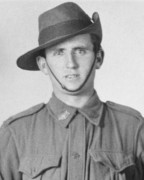
Information about birth
|
Year of birth: 1894 |
|
Place of birth: Watchem, Victoria, Australia |
General information
|
Last known residence: Watchem, Victoria, Australia |
|
Profession: Farmer |
|
Religion: Roman Catholic |
Army information
|
Country: Australia |
|
Force: Australian Imperial Force |
|
Rank: Private |
|
Service number: 3754 |
|
Enlistment date: 20/06/1916 |
|
Enlistment place: Melbourne, Victoria, Australia |
|
Units: — Australian Infantry, 29th Bn. (Last known unit) |
Information about death
|
Date of death: 26/09/1917 |
|
Place of death: Polygon Wood, Zonnebeke, Belgium |
|
Cause of death: Killed in action (K.I.A.) |
|
Age: 23 |
Cemetery
|
Buttes New British Cemetery, Polygon Wood Plot: XI Row: A Grave: 11 |
Distinctions and medals 2
|
British War Medal Medal |
|
Victory Medal Medal |
Points of interest 4
| #1 | Place of birth | ||
| #2 | Last known residence | ||
| #3 | Enlistment place | ||
| #4 | Place of death (approximate) |
My story
Joseph Peter Belleville was born in 1894 in Watchem, Victoria (Australia). He was unmarried and worked as a farmer. On 20 June 1916, he enlisted in the Australian Army. On 19 September 1916, he departed from Sydney for Plymouth, arriving there on 14 November. In mid-December 1916, he crossed to France, where he was assigned to the 29th Australian Infantry Battalion. From 3 to 17 January 1917, Joseph was treated in hospital for influenza. He subsequently spent some time in a convalescent unit before rejoining his battalion on 2 March 1917.
From mid-September 1917, the 29th Australian Infantry Battalion took part in the Battle of Passchendaele. Their first action in Flanders was the Battle of Polygon Wood on 26 September 1917, during which the 5th Australian Division launched its attack.
The attack plan was as follows. First, the 59th Battalion was to capture and secure the first objective. Once this line had been consolidated, the 29th and 31st Battalions would advance to seize the second objective. At 5:50 a.m., the troops advanced behind a creeping barrage. The battalions soon became intermixed, and the advance came to a halt when the attacking units came under fire from German machine guns positioned in the direction of Jerk House on their right flank.
During their advance through the remnants of Polygon Wood, the 5th Australian Division lost contact with the British 33rd Division on its right flank. As a result, the men in Polygon Wood became easy targets for German pillboxes located in the sector of the 33rd Division. After the capture of Jerk House on the right, the Australian troops came under fire once again, this time from Cameron House.
It was then decided to halt the attack until contact with the 33rd Division had been restored. The 29th and 31st Battalions had no choice but to dig in and hold the line.
Once contact with the 33rd Division was finally re-established, the 29th and 31st Australian Infantry Battalions succeeded in securing and consolidating the second objective by 11:00 a.m.
During the following night, attempts were made to locate and bury the dead in and around Polygon Wood. Most were buried close to where they had fallen. However, the constant artillery shelling and relentless machine-gun fire made this task almost impossible.
Joseph Peter Belleville was killed in action on 26 September 1917. In January 1920, his body was exhumed from the area between Polygon Wood and Jetty Wood and reburied in Buttes New British Cemetery.
Sources 3
|
29th Australian Infantry Battalion, (Australian War Memorial, Campbell (AWM), AWM4 23/46/26). https://www.awm.gov.au/collection/C1338583 Sources used |
|
First Australian Imperial Force Personnel Dossiers, 1914-1920, (National Archives of Australia, Canberra (NAA), B2455, BELLEVILLE J P). https://recordsearch.naa.gov.au/SearchNRetrieve/Interface/SearchScreens/NameSearch.aspx. Sources used |
|
Group portrait of men from the Watchem-Massey-Corack area of North Central Victoria, Australian War Memorial https://www.awm.gov.au/collection/C1240290 Sources used |
More information 4
|
Commonwealth War Graves Commission Database https://www.cwgc.org/find-records/find-war-dead/casualty-details/480116 |
|
Namenlijst (In Flanders Fields Museum) https://namenlijst.org/publicsearch/#/person/_id=659f4e18-1ba8-4b14-9c86-24923cda6cc4 |
|
Lives of the First World War (Imperial War Museum) https://livesofthefirstworldwar.iwm.org.uk/lifestory/7355913 |
|
The AIF Project (UNSW Canberra) https://aif.adfa.edu.au/showPerson?pid=19597 |