Rfn
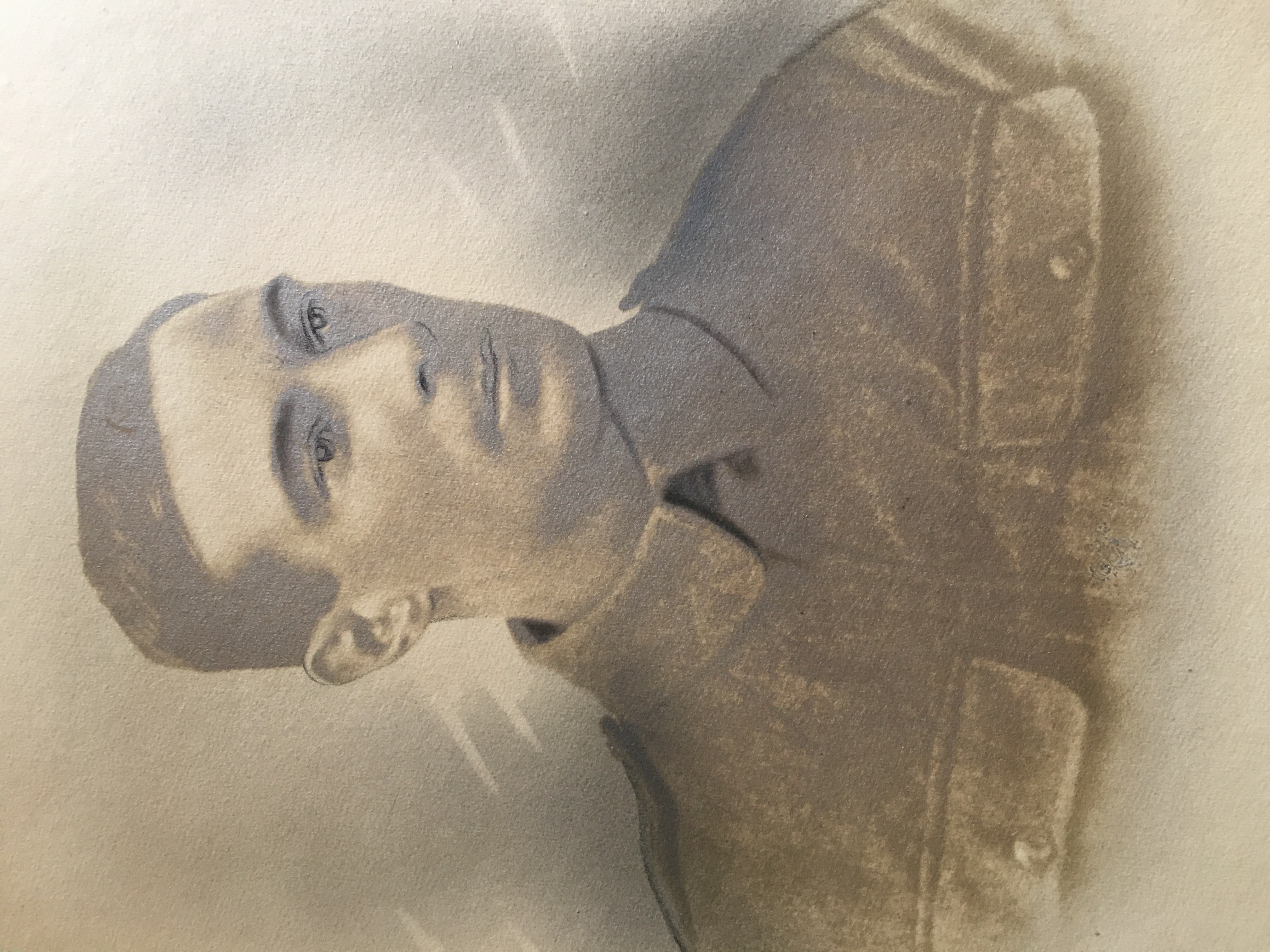
William Walter Dunn

Information about birth
|
Date of birth: 01/11/1888 |
|
Place of birth: Epsom, Surrey, England, United Kingdom |
General information
|
Last known residence: 1, Railway Cottages Woodlands Road, Epsom, Surrey, England, United Kingdom |
|
Profession: Greengrocer |
|
Religion: Church of England |
Army information
|
Country: England, United Kingdom |
|
Force: British Expeditionary Force |
|
Rank: Rifleman |
|
Service number: S/5282 |
|
Enlistment date: 01/11/1914 |
|
Enlistment place: Kingston upon Thames, Surrey, England, United Kingdom |
|
Units: — The Rifle Brigade, 2nd Bn. (Last known unit) |
Information about death
|
Date of death: 16/08/1917 |
|
Place of death: Westhoek, Zonnebeke, Belgium |
|
Cause of death: Died of wounds (D.O.W.) |
|
Age: 28 |
Memorial
|
Tyne Cot Memorial Panel: 146 A |
Distinctions and medals 3
|
1914-15 Star Medal |
|
British War Medal Medal |
|
Victory Medal Medal |
Points of interest 3
| #1 | Place of birth | ||
| #2 | Enlistment place | ||
| #3 | Place of death (approximate) |
My story
William Walter Dunn was born on 1 November 1888 in Epsom, Surrey (England), the son of William and Sarah Dunn. He grew up as the eldest son alongside his two brothers, James and John, and his sister Alice Maud. His father was a fruit dealer and William worked as a greengrocer. His father died in 1911 and his brother James in 1914. William Walter remained unmarried and enlisted in the British Army on his 26th birthday. He was assigned to the 9th Battalion, The Rifle Brigade. As a Rifleman, he embarked for France on 21 May 1915.
On 22 June 1915, he was wounded in the chest by a rifle bullet during the fighting around Railway Wood. Following his recovery, he was probably transferred to the 2nd Battalion, The Rifle Brigade, part of the 25th Brigade of the 8th Division.
In the summer of 1917, the division was stationed in Flanders and took part in the Battle of Passchendaele, including the Battle of Pilckem Ridge (31 July - 2 August) and the Battle of Langemarck (16-18 August). On 10 August 1917, the 2nd Battalion, The Rifle Brigade, was stationed at Halifax Camp in Vlamertinge. On 12 August, the battalion moved to the casemates in Ypres, and on the evening of 13 August it marched on via a muddy track, strewn with shell craters, to Westhoek Ridge. There, Jaffa Trench was used as a support trench. On 14 and 15 August, extensive work was carried out to make the trenches habitable despite sometimes heavy German shelling.
At 4.45 a.m. on 16 August 1917, an attack was launched in which the battalion was required to support two attacking battalions of the brigade. The start line was moved forward to a position 300 yards west of the Hanebeek. The 8th Division was flanked by the 56th Division on the right and the 16th Division on the left.
The 25th Brigade was able to cross the Hanebeek quickly and, despite heavy rifle fire from Nonne Bosschen and Polygon Wood, succeeded in capturing Iron Cross Redoubt. The objective was achieved and the position consolidated. However, because the 8th Division had advanced approximately 1,000 yards farther than the divisions on either flank, the position became untenable and the division had to withdraw behind the Hanebeek. Soldiers from different battalions became intermixed, but despite this, a limited territorial gain was retained. That same evening, the relief of the 2nd Battalion, The Rifle Brigade, by the Sherwood Foresters began.
During these battles, twelve soldiers of the 2nd Battalion, The Rifle Brigade, lost their lives, among them Rifleman William Walter Dunn, who was almost 29 years old. William has no known grave and is therefore commemorated on the Tyne Cot Memorial, Panel 146A.
Sources 9
|
1891 England Census (The National Archives, Kew (TNA), RG12). https://www.nationalarchives.gov.uk/ Sources used |
|
1901 England Census (The National Archives, Kew (TNA), RG13). https://www.nationalarchives.gov.uk/ Sources used |
|
1911 England Census (The National Archives, Kew (TNA), RG14). http://https//www.nationalarchives.gov.uk/ Sources used |
|
2 Battalion Rifle Brigade. (The National Archives, KEW (TNA), WO 95/1731/3). https://discovery.nationalarchives.gov.uk/details/r/C14303 Sources used |
|
British Army World War I Medal Rolls Index Cards, 1914-1920 (The National Archives, Kew (TNA), WO372). https://www.nationalarchives.gov.uk/ Sources used |
|
McCarthy, Chris. Passchendaele: The Day by Day Account (Londen: Arms & Armour Press, 1995), p. 50-53. Sources used |
|
Soldier's Effects records (National Army Museum, Chelsea (NAM) 1901-60; NAM Accesion Number: 1991-02-333). https://www.nam.ac.uk/ Sources used |
|
Surrey, England, Church of England Births and Baptisms, 1813-1921. https://www.ancestry.com/ Sources used |
|
War Office and Air Ministry: Service Medal and Award Rolls, First World War (the National Archives, Kew (TNA), WO 329). https://www.nationalarchives.gov.uk/ Sources used |
More information 3
|
Commonwealth War Graves Commission Database https://www.cwgc.org/find-records/find-war-dead/casualty-details/1630589 |
|
Namenlijst (In Flanders Fields Museum) https://namenlijst.org/publicsearch/#/person/_id=c81a0db9-2d74-4b74-b608-9f16de497dfe |
|
Lives of the First World War (Imperial War Museum) https://livesofthefirstworldwar.iwm.org.uk/lifestory/2402808 |