Pte
William Monaghan
Information about birth
|
Date of birth: 16/06/1885 |
|
Place of birth: Newtownhamilton, Armagh, Ireland, United Kingdom |
General information
|
Last known residence: Tullyvallen, Newtownhamilton, Armagh, Ireland, United Kingdom |
|
Profession: Station Hand - Farm Hand |
|
Religion: Church of Ireland |
Army information
|
Country: Ireland, United Kingdom |
|
Force: British Expeditionary Force |
|
Rank: Private |
|
Service number: 23300 |
|
Enlistment place: Newry, County Down, Ireland, United Kingdom |
|
Units: — Royal Irish Fusiliers, 9th Bn. (County Armagh) (Last known unit) |
Information about death
|
Date of death: 16/08/1917 |
|
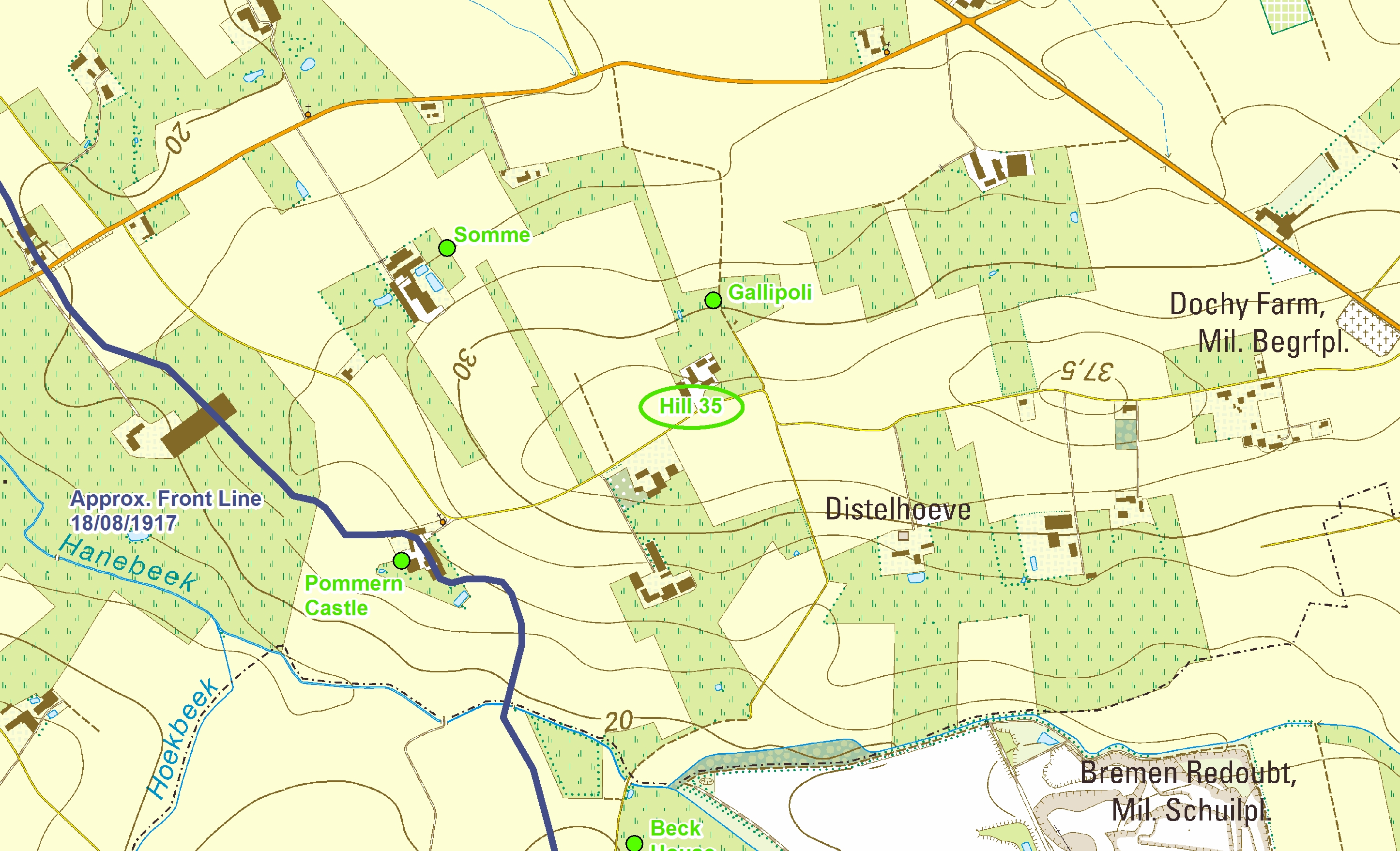
Place of death: Hill 35, Zonnebeke, Belgium |
|
Cause of death: Killed in action (K.I.A.) |
|
Age: 32 |
Memorial
|
Tyne Cot Memorial Panel: 141 |
Distinctions and medals 2
|
British War Medal Medal |
|
Victory Medal Medal |
Points of interest 4
| #1 | Place of birth | ||
| #2 | Last known residence | ||
| #3 | Enlistment place | ||
| #4 | Place of death (approximate) |
My story
William Monaghan was born in 1885 in Newtownhamilton, County Armagh. In 1901 he was employed as a farm servant on the farm of the elderly brothers Robert and Hugh Grimes in Tullyvallen, Newtownhamilton.
By 1916, William — now in his early thirties — was serving with the 9th Battalion (County Armagh) of the Royal Irish Fusiliers, part of the 108th Brigade of the 36th (Ulster) Division.
During the Battle of Passchendaele, on 16 August 1917, the 9th Royal Irish Fusiliers assembled in an old trench running from Pommern Redoubt — the battalion headquarters — to Iberian Farm. Their objective was to advance towards the Zonnebeke–Langemark road, some 1.5 kilometres ahead.
Moments after moving forward behind the creeping barrage, the men were already checked at Hill 35. Despite sustained machine-gun fire from Somme and Gallipoli, the battalion succeeded in capturing Hill 35. Meanwhile, contact was lost with the 7/8th Royal Irish Fusiliers, while the artillery barrage continued to move forward, leaving the advancing troops increasingly exposed to German fire.
One platoon remained behind to consolidate Hill 35, while the attack was pressed on. The Fusiliers advanced until they encountered a double belt of barbed wire at Gallipoli, north of Hill 35. The wire had been cut in only one or two places, forcing the men to struggle through narrow gaps. It was precisely at these bottlenecks that German machine guns concentrated their fire — from dug-outs at Gallipoli, Aisne Farm and Martha House north of Hill 35, and from Hill 37 to the east, along the Zonnebeke–Langemark road. The effect was devastating.
Further advance proved impossible. The battalion was forced to withdraw and consolidated its positions in a trench in front of Hill 35. But even there, continuous machine-gun fire from Hill 37 rendered the position untenable. They withdrew once more, this time to a trench on the southern flank of Hill 35.
This position linked up with the lines of the 16th (Irish) Division to their right. However, when that division was also pushed back by German counter-attacks, the right flank of the Fusiliers was left exposed. From Iberian Farm, south of Hill 35, German machine guns fired into their flank. With no cover remaining on their right, the 9th Royal Irish Fusiliers were ultimately forced to withdraw to their original lines. The attack was a complete failure.
William Monaghan, aged 32, was killed during the attack on Hill 35. He has no known grave and is commemorated on Panel 141 of the Tyne Cot Memorial.
By 1916, William — now in his early thirties — was serving with the 9th Battalion (County Armagh) of the Royal Irish Fusiliers, part of the 108th Brigade of the 36th (Ulster) Division.
During the Battle of Passchendaele, on 16 August 1917, the 9th Royal Irish Fusiliers assembled in an old trench running from Pommern Redoubt — the battalion headquarters — to Iberian Farm. Their objective was to advance towards the Zonnebeke–Langemark road, some 1.5 kilometres ahead.
Moments after moving forward behind the creeping barrage, the men were already checked at Hill 35. Despite sustained machine-gun fire from Somme and Gallipoli, the battalion succeeded in capturing Hill 35. Meanwhile, contact was lost with the 7/8th Royal Irish Fusiliers, while the artillery barrage continued to move forward, leaving the advancing troops increasingly exposed to German fire.
One platoon remained behind to consolidate Hill 35, while the attack was pressed on. The Fusiliers advanced until they encountered a double belt of barbed wire at Gallipoli, north of Hill 35. The wire had been cut in only one or two places, forcing the men to struggle through narrow gaps. It was precisely at these bottlenecks that German machine guns concentrated their fire — from dug-outs at Gallipoli, Aisne Farm and Martha House north of Hill 35, and from Hill 37 to the east, along the Zonnebeke–Langemark road. The effect was devastating.
Further advance proved impossible. The battalion was forced to withdraw and consolidated its positions in a trench in front of Hill 35. But even there, continuous machine-gun fire from Hill 37 rendered the position untenable. They withdrew once more, this time to a trench on the southern flank of Hill 35.
This position linked up with the lines of the 16th (Irish) Division to their right. However, when that division was also pushed back by German counter-attacks, the right flank of the Fusiliers was left exposed. From Iberian Farm, south of Hill 35, German machine guns fired into their flank. With no cover remaining on their right, the 9th Royal Irish Fusiliers were ultimately forced to withdraw to their original lines. The attack was a complete failure.
William Monaghan, aged 32, was killed during the attack on Hill 35. He has no known grave and is commemorated on Panel 141 of the Tyne Cot Memorial.
Sources 5
|
9th Battalion Royal Irish Fusiliers, (The National Archives, Kew (TNA), WO 95/2505/2). Sources used |
|
Census of Ireland 1901/1911 (The National Archives of Ireland, Dublin (NAI)). https://www.nationalarchives.ie/ Sources used |
|
Cunliffe Marcus, The Royal Irish Fusiliers : 1793-1968 (Oxford, Oxford University Press, 1970). Sources used |
|
Harris Henry, The Royal Irish Fusiliers (the 87th and 89th Regiments of Foot) (London, Leo Cooper, 1972). Further reference |
|
McCarthy, Chris, Passchendaele. The Day-by-Day Account (London: Unicorn Publishing Group, 2018). Sources used |
More information 4
|
Namenlijst (In Flanders Fields Museum) https://namenlijst.org/publicsearch/#/person/_id=85c67019-120a-4f0a-a0c5-699f8fe8e574 |
|
Commonwealth War Graves Commission Database https://www.cwgc.org/find-records/find-war-dead/casualty-details/831215 |
|
Lives of the First World War (Imperial War Museum) https://livesofthefirstworldwar.iwm.org.uk/lifestory/2023300 |
|
A Street Near You https://astreetnearyou.org/person/831215/ |