Rfn
William Mangos
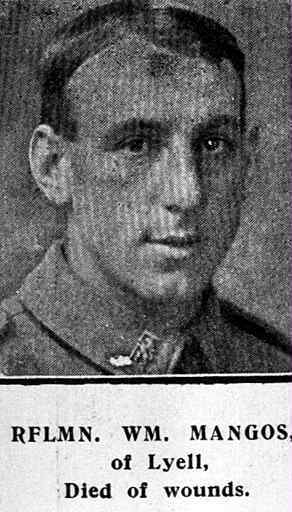
Information about birth
|
Date of birth: 11/03/1886 |
|
Place of birth: Lyell, Westport, West Coast, New Zealand |
General information
|
Last known residence: Murchison, Tasman, New Zealand |
|
Profession: bridge hand |
|
Religion: Roman Catholic |
Army information
|
Country: New Zealand |
|
Force: New Zealand Expeditionary Force |
|
Rank: Rifleman |
|
Service number: 44130 |
|
Enlistment date: 16/06/1916 |
|
Enlistment place: Westport, West Coast, New Zealand |
|
Units: — New Zealand Rifle Brigade, 3rd Bn. (Last known unit) |
Information about death
|
Date of death: 26/08/1917 |
|
Place of death: No. 2 Australian Casualty Clearing Station, Trois Arbres, France |
|
Cause of death: Died of wounds (D.O.W.) |
|
Age: 31 |
Cemetery
|
Trois Arbres Cemetery Plot: I Row: Z Grave: 43 |
Distinctions and medals 2
|
British War Medal Medal |
|
Victory Medal Medal |
Points of interest 5
| #1 | Place of birth | ||
| #2 | Last known residence | ||
| #3 | Enlistment place | ||
| #4 | Place of wounding | ||
| #5 | Place of death (approximate) |
My story
William Mangos was born on 11 March 1886 in Lyell, Tasman (New Zealand). His father, Demetrius Nicholas (“Peter”) Mangos (1833-1901), was of Greek origin and moved to New Zealand in 1844. His mother, Mary Ann Williams (1862-1930), was the daughter of an Irish career soldier who emigrated to New Zealand in 1845. She was a talented pianist. The couple married in 1878 and had fifteen children.
The family lived in Lyell, Buller, on the West Coast. Lyell was a village that grew from one hundred inhabitants in 1863 to more than 2,000 by the end of the 1880s thanks to the gold rush. William’s father also saw opportunities there and built the Post Office Hotel in 1874, which was operated by the family. When the gold mine became exhausted around 1906, the village rapidly declined. After the death of Demetrius Nicholas in 1901, the hotel passed into the hands of a certain Mr Cox. Following a fire, the building was demolished in 1963. Today, only the old cemetery and a few traces in the landscape remain of the village.
Before the war, William worked as a bridge hand, a labourer specializing in the construction and maintenance of bridges. On 16 October 1916, he enlisted in the New Zealand Army. From 4 January 1917, he was assigned to the 24th Reinforcements. On 12 February 1917, he married Ellen Cecilia Chapman. The couple had one son, William John Mangos, born on 2 September 1917.
Following a transfer to the 23rd Reinforcements on 20 February 1917, he departed Wellington for Davenport in Great Britain on 2 April 1917. He arrived there on 10 June 1917 and underwent further training with the 43rd Reinforcements. On 6 July 1917, he arrived in France. From 11 August 1917, he was assigned to the 3rd Battalion, New Zealand Rifle Brigade, part of the 3rd New Zealand (Rifle) Brigade of the New Zealand Division.
At that time, the battalion was stationed at Kortepyp Camp, south of Nieuwkerke. On 14 August, several men were ordered to carry out work on the railway lines at Duke of Connaught’s Siding, southwest of the camp. When the work had been completed and the group of fourteen soldiers was boarding a lorry at about 9:30 p.m., a British Mills grenade suddenly exploded. The origin of the grenade and how it came to explode were later investigated but remained a mystery. The wounded were evacuated to the 2nd Australian Casualty Clearing Station at Trois Arbres near Bailleul.
William Mangos was seriously wounded. He was struck by shrapnel in the abdomen and left thigh. He died of his wounds on 26 August 1917 and was buried in Trois Arbres Cemetery in Steenwerck, Plot I, Row Z, Grave 43.
William’s brother, Demetrius Mangos (born 1895), served with the Canterbury Regiment. During the First World War, he was hospitalized after being exposed to mustard gas. In March 1919, he was discharged from the army because of persistent lung problems caused by the gas attack. He eventually died from its effects in 1927.
Sources 4
|
MANGOS, William - WW1 44130 - Army, New Zealand Archives. https://collections.archives.govt.nz/en/web/arena/search#/entity/aims-archive/R10928115/mangos%2C-william---ww1-44130---army Sources used |
|
MANGOS, William (Service number 44130), South Canterbury Roll of Honour. https://museum.timaru.govt.nz/explore/scroll_kiosk/scroll/profile?id=3736 Sources used |
|
New Zealand, World War 1 Army Casualty Lists, 1914-1919, W.Mangos. https://www.ancestry.com/ Sources used |
|
Rfn. William Mangos, findagrave.com https://www.findagrave.com/memorial/55906108/william-mangos Sources used |
More information 6
|
Commonwealth War Graves Commission Database https://www.cwgc.org/find-records/find-war-dead/casualty-details/203772 |
|
Namenlijst (In Flanders Fields Museum) https://namenlijst.org/publicsearch/#/person/_id=5e277f11-a90c-4d76-af43-e3593063f595 |
|
Lives of the First World War (Imperial War Museum) https://livesofthefirstworldwar.iwm.org.uk/lifestory/7179453 |
|
The NZEF Project (UNSW Canberra) https://nzef.adfa.edu.au/showPerson?pid=156524 |
|
Online Cenotaph (Auckland Museum) https://www.aucklandmuseum.com/war-memorial/online-cenotaph/record/c10282 |
|
A Street Near You https://astreetnearyou.org/person/203772/ |