Pte
Albert Moores
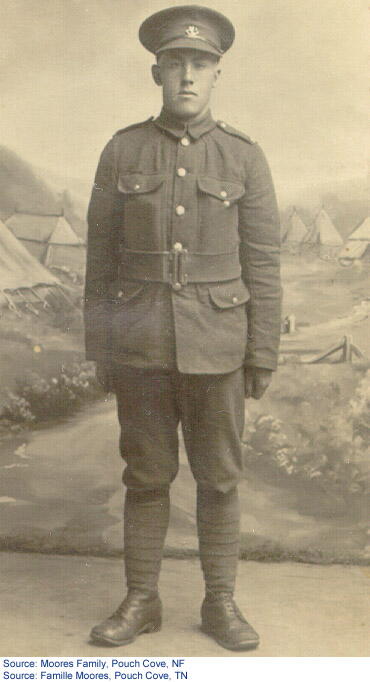
Information about birth
|
Date of birth: 12/10/1896 |
|
Place of birth: Pouch Cove, Newfoundland, Canada |
General information
|
Last known residence: Pouch Cove, Newfoundland, Canada |
|
Profession: Fisherman |
|
Religion: Methodist |
Army information
|
Country: Canada |
|
Force: Canadian Expeditionary Force |
|
Rank: Private |
|
Service number: 2219 |
|
Enlistment date: 03/03/1916 |
|
Enlistment place: St John's, Newfoundland & Labrador, Canada |
|
Units: — Royal Newfoundland Regiment, 1st Bn. (Last known unit) |
Information about death
|
Date of death: 28/09/1917 |
|
Place of death: North-West of Langemark - Broenbeek, Belgium |
|
Age: 20 |
Cemetery
|
Artillery Wood Cemetery Plot: VII Row: D Grave: 20 |
Distinctions and medals 2
|
British War Medal Medal |
|
Victory Medal Medal |
Points of interest 3
| #1 | Place of birth | ||
| #2 | Last known residence | ||
| #3 | Enlistment place |
My story
Albert Moores was born on October 12, 1896, in Pouch Cove, Newfoundland. He worked as a fisherman and enlisted for military service on March 3, 1916.
He embarked from St. John’s for the United Kingdom on July 19, 1916. On October 3, 1916, he sailed to France, where he joined the 1st Battalion, Royal Newfoundland Regiment, on October 14, 1916. On December 28, 1916, he was admitted to the 2nd Stationary Hospital in Abbeville suffering from a painful foot. He was transferred to the 2nd Canadian General Hospital in Le Tréport on January 14, 1917, with muscular pain, and then to the 3rd London General Hospital in Wandsworth on January 20, 1917, where myalgia was diagnosed on January 29, 1917. Following a period of leave, he was declared fit for active service again on March 14, 1917. On August 5, 1917, he embarked for France and rejoined his battalion on August 28, 1917. The unit was resting in various camps at Proven and Herzeele before moving towards the front line at Elverdinge on September 20, 1917.
On September 25, 1917, the 1st Battalion, Royal Newfoundland Regiment, relieved the 4th Battalion, Worcestershire Regiment, northwest of Langemark. There, the battalion was regularly subjected to artillery bombardments and gas shelling. During its four days in the front line, the battalion suffered seven fatalities and twenty-seven wounded. Private Albert Moores was killed in action on September 28, 1917, and was initially buried just northwest of the centre of Langemark village. After the war, his remains were exhumed and reinterred at Artillery Wood Cemetery.
Sources 3
|
1 Battalion Newfoundland Regiment . (The National Archives, KEW (TNA), WO 95/2308/1). https://discovery.nationalarchives.gov.uk/details/r/C14303 Sources used |
|
G.W.L. Nicholson. The fighting Newfoundlander : A history of the Royal Newfoundland Regiment (Montreal: McGill-Queen’s University Press). Sources used |
|
Personnel Records of the First World War: Royal Newfoundland Regiment and Forestry Corps, (Library and Archives Canada, Ottawa (LAC), RG38-A-2-e, Finding Aid 38-27, Reel T-18142, Volume 597). https://www.bac-lac.gc.ca/eng/discover/military-heritage/first-world-war/personnel-records/Pages/search.aspx Sources used |
More information 5
|
Commonwealth War Graves Commission Database https://www.cwgc.org/find-records/find-war-dead/casualty-details/101198 |
|
Namenlijst (In Flanders Fields Museum) https://namenlijst.org/publicsearch/#/person/_id=a569247f-1d1b-4a5b-ac23-827beaba0210 |
|
Lives of the First World War (Imperial War Museum) https://livesofthefirstworldwar.iwm.org.uk/lifestory/3108942 |
|
The Canadian Virtual War Memorial https://www.veterans.gc.ca/en/remembrance/memorials/canadian-virtual-war-memorial/detail/101198 |
|
The Rooms https://therooms.ca/collections-records-and-research/military-service-files/moores-albert |