Pte
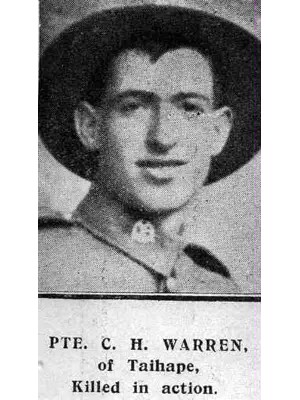
Charles Warren
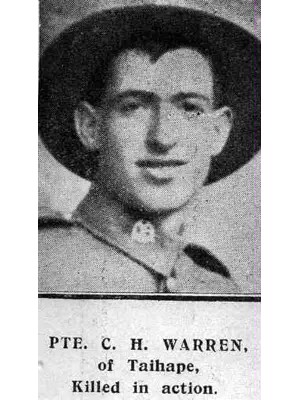
Information about birth
|
Date of birth: 23/06/1895 |
|
Place of birth: Woodville, Manawatu-Wanganui, New Zealand |
General information
|
Last known residence: Wainui, Taihape, New Zealand |
|
Profession: Railway Employee |
|
Religion: Church of England |
Army information
|
Country: New Zealand |
|
Force: New Zealand Expeditionary Force |
|
Rank: Private |
|
Service number: 8/3426 |
|
Enlistment date: 24/08/1915 |
|
Enlistment place: Trentham, Wellington, New Zealand |
|
Units: — Otago Regiment, 1st Bn. (Last known unit) |
Information about death
|
Date of death: 12/10/1917 |
|
Place of death: Bellevue, Passchendaele, Belgium |
|
Cause of death: Killed in action (K.I.A.) |
|
Age: 22 |
Cemetery
|
Poelcapelle British Cemetery Plot: IV Row: A Grave: 27 |
Distinctions and medals 3
|
1914-15 Star Medal |
|
British War Medal Medal |
|
Victory Medal Medal |
Points of interest 5
| #1 | Place of birth | ||
| #2 | Last known residence | ||
| #3 | Enlistment place | ||
| #4 | Place of death (approximate) | ||
| #5 | Place of death or original burial place |
My story
Charles Warren was born on 23 June 1895 in Woodville, New Zealand. He was employed by the New Zealand Railways and was also a member of “D” Company, 7th Territorial Regiment.
On 24 August 1915, he enlisted in the New Zealand Army. On 20 December 1915, Charles sailed with the 8th Reinforcements to Suez, Egypt. From there he proceeded to Moascar, Ismailia (Egypt), where he was posted to the 14th Company of the 1st Battalion, Otago Regiment, part of the 1st Brigade of the New Zealand Division. In April 1916, the division moved to France.
In May and June 1917, he was attached to the 2nd Brigade Demonstration Platoon and the New Zealand Wing, II Anzac Reinforcement Camp, at Rouen. On 19 June 1917, he returned to his unit. At the end of July 1917, he was granted a period of leave in Great Britain.
In October 1917, the New Zealand Division was positioned west of Passchendaele along the ’s Graventafel-Mosselmarkt road. On 12 October 1917, the division attacked with two brigades: the 2nd New Zealand Brigade immediately to the left and right of the road, and the 3rd Brigade to the north of it. The 1st Battalion, Otago Regiment had been temporarily attached to the 2nd Brigade.
Reconnaissance had shown that the attack on Bellevue Spur would be extremely difficult. At least six pillboxes stood directly within the battalion’s sector, while the ground was covered with water-filled shell holes and stretches of barbed wire. To make matters worse, the Ravebeek had to be crossed. An additional artillery bombardment was requested on 11 October, but this weak bombardment achieved little.
At 5.25 a.m. on 12 October 1917, the battalion attacked. Its supporting artillery barrage was weak and some shells fell among the New Zealanders’ own lines. The men quickly became entangled in the barbed wire, sank into the mud around the Ravebeek, and were cut down by machine-gun fire. The only area where the ground was at all passable was along the ’s Graventafel-Mosselmarkt road. However, this proved to be a trap, as the Germans were fully aware of it and had several machine guns covering this gap in the wire.
The reserve battalion, the 2nd Battalion, Canterbury Regiment, was also committed, but this only resulted in further casualties. The battalions became completely intermixed and attempts were made in the afternoon to restore order. By that stage, only about 160 men remained from the 1st Battalion, Otago Regiment.
The remainder of the day and the following day were spent evacuating the wounded from the battlefield to the dressing station at Waterloo Farm. Wounded men from the equally disastrous attack by the 66th Division on 9 October 1917 were still there, and they were now joined by several hundred New Zealand casualties. It was not until midday on 14 October that all the wounded could be evacuated.
The 1st Battalion, Otago Regiment lost seven officers and 98 other ranks killed. Six other ranks died of wounds, while six officers and 230 other ranks were wounded, and 56 other ranks were reported missing.
Private Charles Warren, aged 22, was among the dead. In 1921, his body was exhumed from a battlefield grave and reburied in Poelcapelle British Cemetery, Plot IV, Row A, Grave 27.
Sources 3
|
A. E. Byrne, Official History of the Otago Regiment, N.Z.E.F. in the Great War 1914-1918 (dunedin: Wilkie & Co., Ltd.), 209-225. https://archive.org/details/otagoregimentnzef Sources used |
|
McCarthy, Chris. Passchendaele: The Day by Day Account (Londen: Arms & Armour Press, 1995), p 128-131. Sources used |
|
New Zealand Defence Force Personnel Records (Archives New Zealand, Wellington (ANZ), R22016085). https://collections.archives.govt.nz/en/web/arena/search#/entity/aims-archive/R22016085/warren%2C-charles---ww1-8%2F3426---army Sources used |
More information 6
|
Commonwealth War Graves Commission Database https://www.cwgc.org/find-records/find-war-dead/casualty-details/492259 |
|
Namenlijst (In Flanders Fields Museum) https://namenlijst.org/publicsearch/#/person/_id=93fcd146-5862-4014-a6af-c496a79263e8 |
|
Lives of the First World War (Imperial War Museum) https://livesofthefirstworldwar.iwm.org.uk/lifestory/7184885 |
|
The NZEF Project (UNSW Canberra) https://nzef.adfa.edu.au/showPerson?pid=266850 |
|
Online Cenotaph (Auckland Museum) https://www.aucklandmuseum.com/war-memorial/online-cenotaph/record/c16437 |
|
A Street Near You https://astreetnearyou.org/person/492259/ |