Pte
Archie Stuart Thom
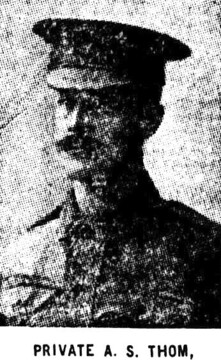
Information about birth
|
Date of birth: 03/04/1884 |
|
Place of birth: Crieff, Kinross, Scotland, United Kingdom |
General information
|
Last known residence: 79 Ferry Street, Kangaroo Point, Brisbane, Queensland, Australia |
|
Profession: Labourer |
|
Religion: Presbyterian |
Army information
|
Country: Australia |
|
Force: Australian Imperial Force |
|
Rank: Private |
|
Service number: 3210 |
|
Enlistment date: 10/11/1916 |
|
Enlistment place: Brisbane, Queensland, Australia |
|
Units: — Australian Infantry, 47th Bn. (Last known unit) |
Information about death
|
Date of death: 12/10/1917 |
|
Place of death: Dash Crossing, Broodseinde, Belgium |
|
Cause of death: Killed in action (K.I.A.) |
|
Age: 33 |
Cemetery
|
Tyne Cot Cemetery Plot: III Row: A Grave: 14 |
Distinctions and medals 2
|
British War Medal Medal |
|
Victory Medal Medal |
Points of interest 5
| #1 | Place of birth | ||
| #2 | Last known residence | ||
| #3 | Enlistment place | ||
| #4 | Place of death (approximate) | ||
| #5 | Sterfteplaats |
My story
Archie Stuart Thom was born April 3, 1884, in Crieff, Scotland, the son of James Callender Thom and Annie Stewar Mcintyre. In 1911 he married Caroline Elizabeth Thom; they resided at St. Marylebone in London. They had one daughter here. By 1915, the family was in Australia, where they welcomed two more daughters. Unfortunately, one of them died before she was a year old. On Nov. 10, 1916, he enlisted and on Dec. 23 left the Australian mainland. On June 20, he arrived in France. Archie was assigned to the 47th Bn. Australian Infantry, part of the 12th Australian Brigade, 4th Australian Division.
On October 12, 1917, the 4th Australian Division took part in the First Battle of Passchendaele, part of the Third Battle of Ypres which had been in progress since July 31, 1917. The objective of the 4th Australian Division was to advance over the Broodseinde Ridge to Keiberg Spur to flank the 3rd Division which was advancing north of the railroad towards Passchendaele. The 47th Battalion was given the task of capturing and holding the red line. This ran roughly from the railroad embankment to Assyria. Then the 48th Battalion would continue the attack.
The attack faced immediate setbacks. The soldiers were tired from marching through the mud. The battalion headquarters, located in a bunker on the Broodseinde ridge, was hit by German artillery shells. Nearly all the signalmen and couriers were casualties, making further communication more difficult during the battle. Archie was one of them.
The Germans retreated, but once the 48th Battalion advanced they faced heavy German fire from Vienna Cottage. This was in the 3rd Division's sector, but heavy resistance had prevented them from advancing. The German position at Vienna Cottage was eliminated, but finally, for lack of support, 47th and 48th Battalions had to retreat to their starting positions. Both battalions lost a total of nearly 1,000 soldiers.
Archie Stuart Thom was temporarily buried in close proximity to the headquarters, between Dash Crossing and Defy Crossing, near the railroad embankment. He currently rests in Tyne Cot Cemetery. He was 33 years old.
On October 12, 1917, the 4th Australian Division took part in the First Battle of Passchendaele, part of the Third Battle of Ypres which had been in progress since July 31, 1917. The objective of the 4th Australian Division was to advance over the Broodseinde Ridge to Keiberg Spur to flank the 3rd Division which was advancing north of the railroad towards Passchendaele. The 47th Battalion was given the task of capturing and holding the red line. This ran roughly from the railroad embankment to Assyria. Then the 48th Battalion would continue the attack.
The attack faced immediate setbacks. The soldiers were tired from marching through the mud. The battalion headquarters, located in a bunker on the Broodseinde ridge, was hit by German artillery shells. Nearly all the signalmen and couriers were casualties, making further communication more difficult during the battle. Archie was one of them.
The Germans retreated, but once the 48th Battalion advanced they faced heavy German fire from Vienna Cottage. This was in the 3rd Division's sector, but heavy resistance had prevented them from advancing. The German position at Vienna Cottage was eliminated, but finally, for lack of support, 47th and 48th Battalions had to retreat to their starting positions. Both battalions lost a total of nearly 1,000 soldiers.
Archie Stuart Thom was temporarily buried in close proximity to the headquarters, between Dash Crossing and Defy Crossing, near the railroad embankment. He currently rests in Tyne Cot Cemetery. He was 33 years old.
Sources 3
|
Deayton Craig , Battle Scarred: the 47th Battalion in the First World War (Newport Big Sky publishing Ltd, 2011).156-188. Sources used |
|
First Australian Imperial Force Personnel Dossiers, 1914-1920 (National Archives of Australia, Canberra (NAA), B2455, Thom, Archie Stuart). https://recordsearch.naa.gov.au/ Sources used |
|
McCarthy, Chris. Passchendaele: The Day by Day Account (Londen: Arms & Armour Press, 2018), 129-132. Sources used |
More information 4
|
Commonwealth War Graves Commission Database https://www.cwgc.org/find-records/find-war-dead/casualty-details/464885 |
|
Lives of the First World War (Imperial War Museum) https://livesofthefirstworldwar.iwm.org.uk/lifestory/7631362 |
|
The AIF Project (UNSW Canberra) https://aif.adfa.edu.au/showPerson?pid=297627 |
|
Namenlijst (In Flanders Fields Museum) https://namenlijst.org/publicsearch/#/person/_id=c4a9cf4e-1c0a-4d28-8c44-00ac8a611be2 |