L/Cpl
Daniel Drennan
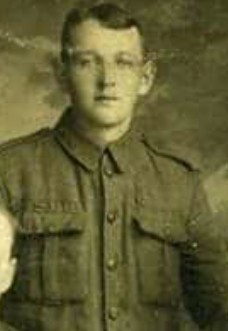
Information about birth
|
Date of birth: 05/02/1897 |
|
Place of birth: Whiteabbey, Newtownabbey, Northern Ireland, Ireland, United Kingdom |
General information
|
Last known residence: 19, Abbey Gardens, Whiteabbey, Newtownabbey, Ireland, United Kingdom |
|
Religion: Congregationalist |
Army information
|
Country: Verenigd Koninkrijk |
|
Force: British Expeditionary Force |
|
Rank: Lance Corporal |
|
Service number: 17590 |
|
Enlistment date: 06/10/1915 |
|
Enlistment place: Whiteabbey, Newtownabbey, Northern Ireland, Ireland, United Kingdom |
|
Units: — Royal Irish Rifles, 12th Bn. (Central Antrim) (Last known unit) |
Information about death
|
Date of death: 16/08/1917 |
|
Place of death: Somme - Wiesengut, Saint-Julien, Belgium |
|
Cause of death: Killed in action (K.I.A.) |
|
Age: 20 |
Cemetery
|
Tyne Cot Cemetery Plot: V Row: G Grave: 3 |
Distinctions and medals 3
|
1914-15 Star Medal |
|
British War Medal Medal |
|
Victory Medal Medal |
Points of interest 5
| #1 | Place of birth | ||
| #2 | Last known residence | ||
| #3 | Enlistment place | ||
| #4 | Place of death (approximate) | ||
| #5 | Place of death or original burial place |
My story
Daniel Drennan was born on 5 February 1897. He grew up as the fifth of eleven children in the family of George and Annie Drennan in Whiteabbey, Newtownabbey (Northern Ireland). On 6 October 1915, he enlisted in the British Army. He was assigned to the 12th Battalion Royal Irish Rifles, part of the 108th Brigade of the 36th (Ulster) Division, and was later promoted to Lance Corporal.
On 16 August 1917, during the Battle of Langemarck, the 12th Battalion Royal Irish Rifles was ordered to support the 9th Battalion Royal Irish Fusiliers and the 13th Battalion Royal Irish Rifles, which carried out the attack of the 108th Brigade in the front line. The first objective of the assault was the Hindu Cotts-Iberian line.
The attackers soon encountered fierce German resistance. All former farmsteads in the area had been reinforced with concrete pillboxes that had not been neutralised by the British artillery. Some attackers were still seen in the vicinity of Gallipoli, but the troops of the 108th Brigade were soon forced to withdraw to a line in front of Somme. Even these limited gains could not be held, and by 10 a.m. the survivors had returned to their starting positions.
During the night of 16 to 17 August, the brigade was relieved and returned to the Brandhoek area (Vlamertinge). For the 12th Battalion Royal Irish Rifles, 16 August 1917 was a black day: the battalion suffered 171 killed, wounded, and missing.
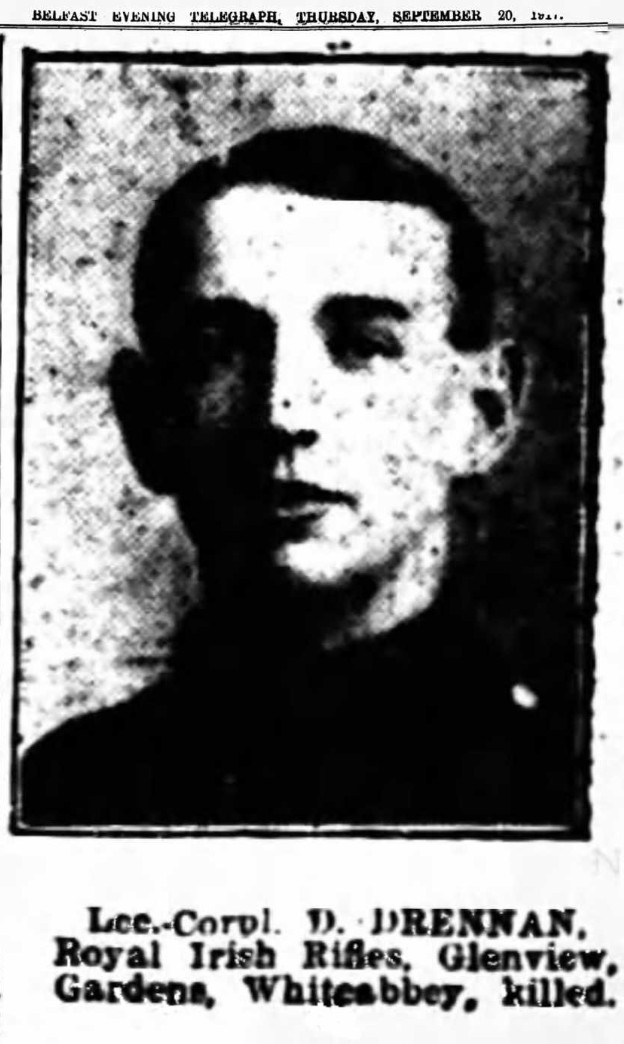
Daniel Drennan was among the fatal casualties. His body was exhumed near Somme in September 1919 and reburied in Tyne Cot Cemetery, Plot V, Row G, Grave 3.
Sources 11
|
12th Battalion Royal Irish Rifles, War Diary, (The National Archives, Kew (TNA), WO 95/2506/2_3). https://www.nationalarchives.gov.uk/ Sources used |
|
British Army World War I Medal Rolls Index Cards, 1914-1920 (The National Archives, Kew (TNA), WO 372). https://www.nationalarchives.gov.uk/ Sources used |
|
Falls Cyril, The History of the 36th (Ulster) Division, (Naval & Military Press Ltd, Uckfield, East Sussex, TN22 5QE, England) p.116-117. Sources used |
|
Find a grave: ID= 11167392 https://nl.findagrave.com Sources used |
|
Ireland, Census 1901. https://www.ancestry.com/ Sources used |
|
Ireland, Census 1911. https://www.ancestry.com/ Sources used |
|
L.Cpl. Daniel Drennan, ancestry. com https://www.ancestry.com/family-tree/person/tree/198617155/person/112685598904/facts Sources used |
|
McCarthy, Chris. Passchendaele: The Day by Day Account (Londen: Arms & Armour Press, 1995), p.52-55. Sources used |
|
Soldiers' Effects Records (National Army Museum, Chelsea (NAM) 1901-60; NAM Accession Number: 1991-02-333). https://www.nam.ac.uk/ Sources used |
|
War Office and Air Ministry: Service Medal and Award Rolls, First World War (The National Archives, Kew (TNA), WO 329), 1914-15 Star. https://www.nationalarchives.gov.uk/ Sources used |
|
War Office and Air Ministry: Service Medal and Award Rolls, First World War (The National Archives, Kew (TNA), WO 329). https://www.nationalarchives.gov.uk/ Sources used |
More information 4
|
CWGC https://www.cwgc.org/find-records/find-war-dead/casualty-details/462614 |
|
Namenlijst (In Flanders Fields Museum) https://namenlijst.org/publicsearch/#/person/_id=8c97b50f-5205-4bf7-993c-a13b6621fad8 |
|
Lives of the First World War (Imperial War Museum) https://livesofthefirstworldwar.iwm.org.uk/lifestory/1693895 |
|
A Street Near You https://astreetnearyou.org/person/462614/ |