Pte
Giles Herbert Alston

Informatie over geboorte
|
Geboortedatum: 21/01/1890 |
|
Geboorteplaats: Edenfield, Rossendale, Lancashire, Engeland, Verenigd Koninkrijk |
Algemene Informatie
|
Beroep: Volder |
Informatie legerdienst
|
Land: Engeland, Verenigd Koninkrijk |
|
Strijdmacht: British Expeditionary Force |
|
Rang: Private |
|
Service nummer: PO/1410(S) |
|
Dienstneming datum: 11/02/1916 |
|
Eenheden: — Royal Marines, 1st Bn. (Laatst gekende eenheid) |
Informatie over overlijden
|
Datum van overlijden: 26/10/1917 |
|
Plaats van overlijden: In the vicinity of Varlet Farm, Bray Farm, Banff House, België |
|
Doodsoorzaak: Killed in action (K.I.A.) |
|
Leeftijd: 27 |
Gedenkplaats
|
Tyne Cot Memorial Paneel: 1 |
Onderscheidingen en medailles 2
|
British War Medal Medaille |
|
Victory Medal Medaille |
Points of interest 1
| #1 | Geboorteplaats |
Mijn verhaal
Private Giles Herbert Alston, a former fulling miller, served in 1st Battalion Royal Marines, which was part of the 188th Infantry Brigade, 63rd (Royal Naval) Division. This Division took part in the Second Battle of Passchendaele on the 26th of October 1917.
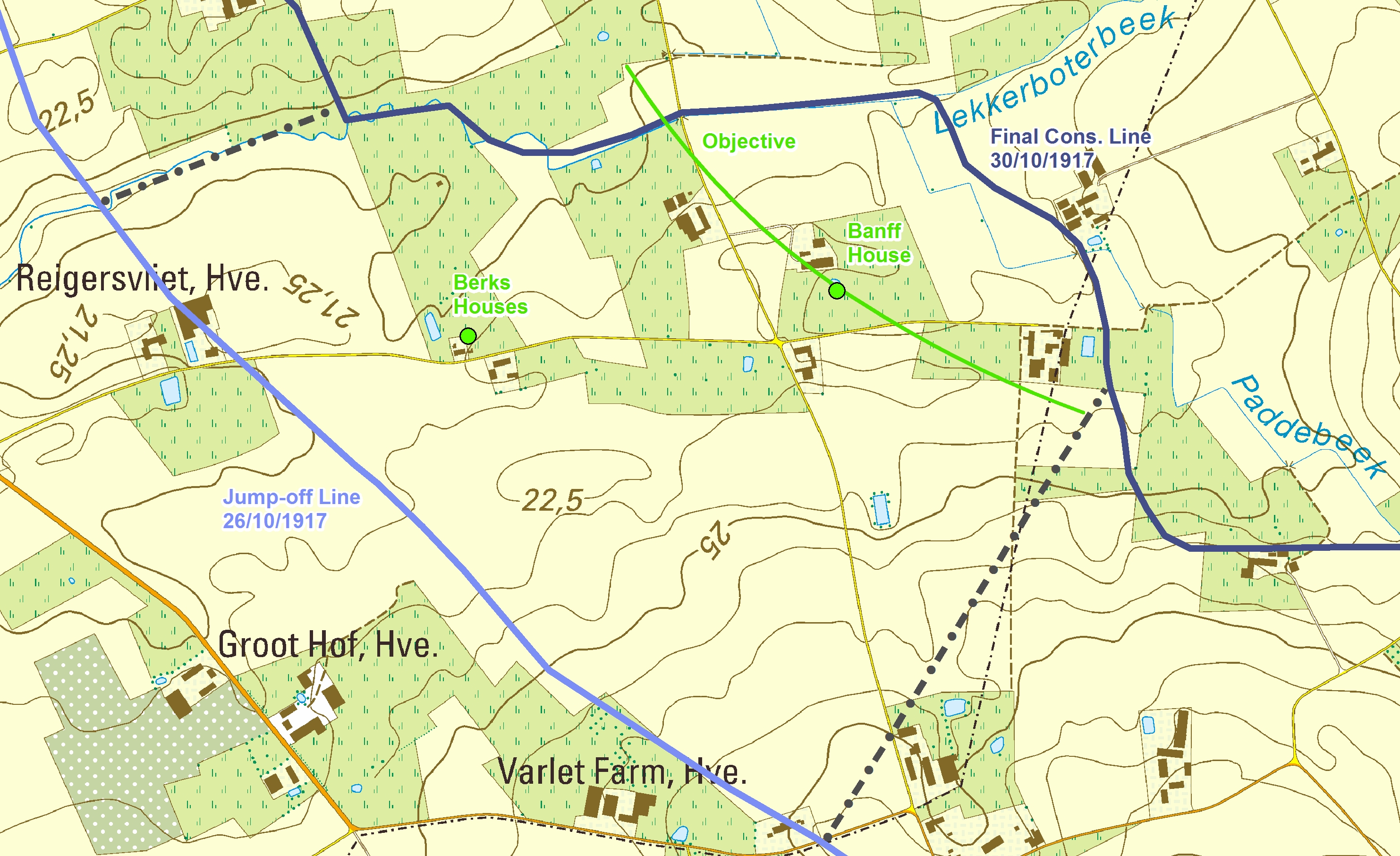
The Division attacked with the 188th Infantry Brigade at 5:40 a.m.. The Anson Battalion and the 1st Royal Marines were to attack the objective with the 2nd Royal Marines were in support, and the Howe Battalion in reserve. The advance took place over a sea of deep mud, the Allied bombardment on German positions over the last 48 hours had turned the terrain into a mass of shell holes, flooded with several feet of water/mud. The 1st Royal Marines, on the left of the divisional front, managed to capture all their objectives, including Berks Houses, Banff House and Bray Farm. Enfilade fire, however, had caused heavy casualties.
Once the 1st Royal Marines had consolidated their gains, the 2nd Royal Marines renewed the attack. This failed, however, due to machine-gun fire from several concrete positions and defended shell holes around Sound Farm, which prevented a major breakthrough. By this time almost all company commanders of the attacking Battalions had become casualties and at 5 p.m. a strong German counter-attack caused the 2nd Royal Marines to retreat back behind the Paddebeek. By nightfall the troops in Banff house were forced to withdraw to Berks Houses. Practically the whole of the first objective had been gained except Source Trench and Banff House, with the four assaulting battalions suffering heavy casualties. The Division held this position until it was relieved on the 27th of October.
The War Diary of the1st Battalion Royal Marines reports that “among the rank and file” 270 casualties were reported. Private Giles Herbert Alston was one of them. He was most likely killed in action during the advance on the objective near Berks Houses, Banff House and Bray Farm. Private Alston has no known grave and is remembered at the Tyne Cot Memorial.
The Division attacked with the 188th Infantry Brigade at 5:40 a.m.. The Anson Battalion and the 1st Royal Marines were to attack the objective with the 2nd Royal Marines were in support, and the Howe Battalion in reserve. The advance took place over a sea of deep mud, the Allied bombardment on German positions over the last 48 hours had turned the terrain into a mass of shell holes, flooded with several feet of water/mud. The 1st Royal Marines, on the left of the divisional front, managed to capture all their objectives, including Berks Houses, Banff House and Bray Farm. Enfilade fire, however, had caused heavy casualties.
Once the 1st Royal Marines had consolidated their gains, the 2nd Royal Marines renewed the attack. This failed, however, due to machine-gun fire from several concrete positions and defended shell holes around Sound Farm, which prevented a major breakthrough. By this time almost all company commanders of the attacking Battalions had become casualties and at 5 p.m. a strong German counter-attack caused the 2nd Royal Marines to retreat back behind the Paddebeek. By nightfall the troops in Banff house were forced to withdraw to Berks Houses. Practically the whole of the first objective had been gained except Source Trench and Banff House, with the four assaulting battalions suffering heavy casualties. The Division held this position until it was relieved on the 27th of October.
The War Diary of the1st Battalion Royal Marines reports that “among the rank and file” 270 casualties were reported. Private Giles Herbert Alston was one of them. He was most likely killed in action during the advance on the objective near Berks Houses, Banff House and Bray Farm. Private Alston has no known grave and is remembered at the Tyne Cot Memorial.
Bronnen 6
|
"Britain's Sea Soldiers : A Record of the Royal Marines during the War 1914-1919", Devonport, Swiss & Co, 1927, pg. 332-336. Gebruikte bronnen |
|
"Passchendaele. The Day-by-Day Account", McCarthy C., London, Uniform, 2018, pg. 146-147. Gebruikte bronnen |
|
Ancestry https://www.ancestry.com/ Gebruikte bronnen |
|
CWGC https://www.cwgc.org/find-war-dead/casualty/846037/alston,-giles-herbert/ Gebruikte bronnen |
|
Naval & Military Archive http://www.nmarchive.com/ Gebruikte bronnen |
|
The Long, Long Trail http://www.longlongtrail.co.uk/army/ Gebruikte bronnen |