Pte
Joseph William Roberts

Information about birth
|
Date of birth: 07/05/1891 |
|
Place of birth: Exeter, Devon, England, United Kingdom |
General information
|
Last known residence: 101 Chandos Street, Toronto, Ontario, Canada |
|
Profession: Labourer |
|
Religion: Church of England |
Army information
|
Country: England, United Kingdom |
|
Force: Canadian Expeditionary Force |
|
Rank: Private |
|
Service number: 775934 |
|
Enlistment date: 03/03/1916 |
|
Enlistment place: Toronto, Ontario, Canada |
|
Units: — Canadian Infantry, 38th Bn. (Ottawa) (Last known unit) |
Information about death
|
Date of death: 30/10/1917 |
|
Place of death: Heine House, Passchendaele, Belgium |
|
Cause of death: Killed in action (K.I.A.) |
|
Age: 26 |
Cemetery
|
Tyne Cot Cemetery Plot: XL Row: D Grave: 22 |
Distinctions and medals 2
|
British War Medal Medal |
|
Victory Medal Medal |
Points of interest 4
| #1 | Place of birth | ||
| #2 | Enlistment place | ||
| #3 | Place of death (approximate) | ||
| #4 | Sterfteplaats |
My story
Very little is known about the young Joseph William Roberts (son of Joseph William and Sarah Jane Roberts). He was born in the English town of Exeter (Devon).
The 1901 England census tells us that he was still living with his parents. Ten years later (the 1911 England census), he had left the family home.
We have not (as yet) been able to find him in the passenger lists or the Canadian census; he has a very common first name and surname, which does not make the search any easier.
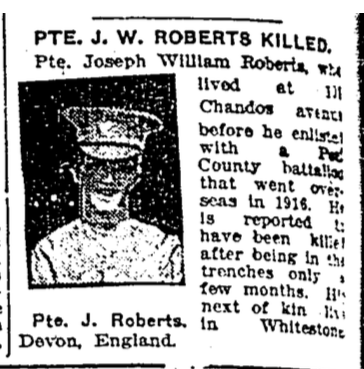
Joseph William ended up in Toronto, Ontario, where he worked as a labourer.
In March 1916, he volunteered for service with the 126th Canadian Infantry Battalion, also known as the ‘Peel Battalion’ because the battalion mainly recruited its men in Peel County (West Toronto and Brampton).
Five months later, the 126th sailed to the UK, where they underwent further training at Bramshot Camp (a Canadian camp in the UK). After a few transfers to other (reserve) units, Pte Roberts ended up with the 38th. He joined his new unit on 16 March 1917 at Camp Château de la Haye (just west of Lens). Was the battalion there at the front under the familiar rotation system of front line – support line – rest/reserve? His baptism of fire was not long in coming: a few days later, the battalion found itself in the front lines.
After a brief rest, the battalion took part in the Battle of Vimy Ridge and attacked on 9 April 1917. All objectives were achieved, but with many casualties. After another short rest, the battalion continued fighting near Lens (La Coulotte and Avion).
In July 1917, the battalion was withdrawn from the front for three weeks of reorganization and training. August and September were spent back in the line at Avion.
In October 1917, the 12th Canadian Infantry Brigade (including the 38th, 72nd, 78th, and 85th Battalions and the 12th MGC) was withdrawn from the front in northern France to be deployed in Flanders (Belgium)
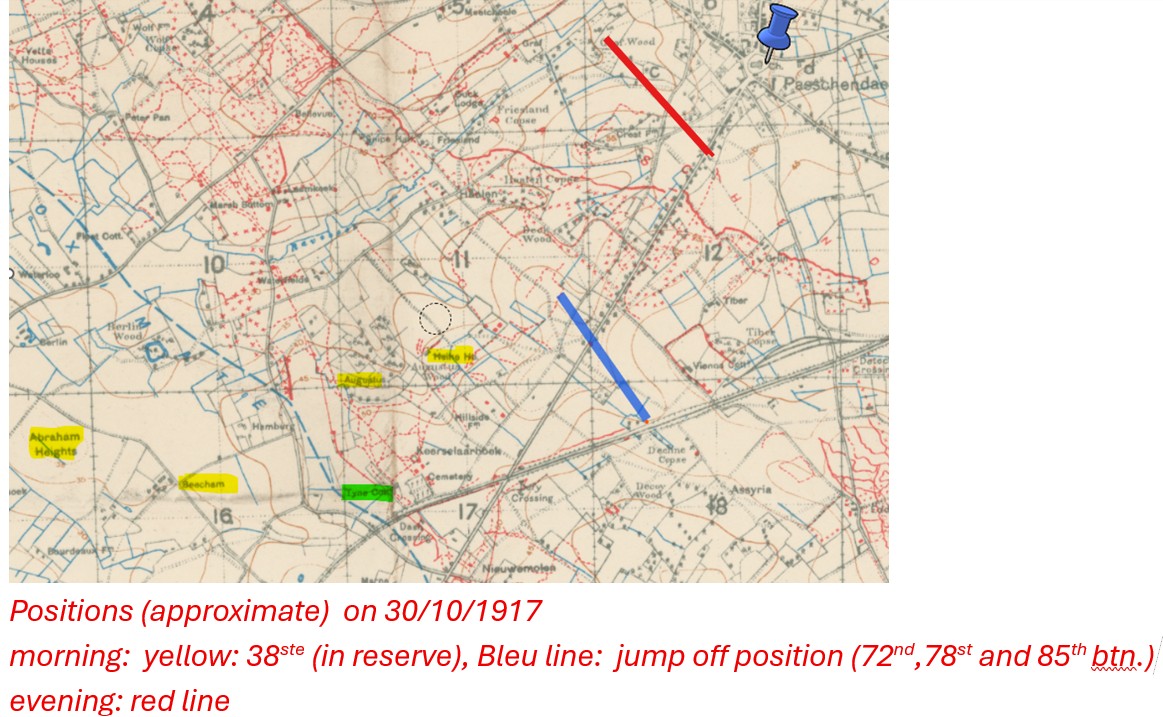
The 38th arrived in the Poperinge area (Belgium) on 23 october and moved five days later via Ypres to a camp in Pottijze where they prepared for the upcoming actions: the Brigade will attack on 30th October with the 55th, 72th and 78th Battalion, while the 38th Battalion will be kept in reserve.
In the night of 29/30 October, the 3 battalions took position in the frontline, the 38th just behind them in support. The positions of the 38th were: A and D coy near Augustus and Hillside Farm and the A and D coy near Beecham and Abraham Heights.
The attack was launched on 30 October, at 5:40 am. Despite the heavy enemy shelling, the three battalions manage fairly quickly to capture the objectives. German artillery also targeted the positions of the 38th. Losses in the 38th are considerable, especially the B company suffered heavily. It was during this action that Pte Roberts, while in a trench, got killed by a German shell.
The heavy German bombardments continued for almost the entire day. The Germans seemed to deliberately spare the aid post at Tyne Cottage. In the afternoon, the B, C, and D companies of the 38th were sent forward to consolidate the newly acquired positions.
On 31 October and 1 November, the 38th remained in the front line to reinforce and hold the advanced positions that were taken on 30 October. There were no organized German counterattacks, but German artillery continued to heavily shell the Canadians, causing many casualties. The A-coy assists, among other things, in bringing up supplies and carrying away the wounded. In the late evening of 2 November, the 38th is relieved.
Back in the camp at Pottijze, the battalion (according to the War Diary) counts its casualties*: 1 officer and 48 OR / wounded: 4 officers and 163 OR / missing 22 OR.
On 3 November, the 38th left Ypres Salient in order to return to France.
*according to CWGC.org: The Battle of Passchendaele ultimately cost 79 men of the 38th their lives, of which 14 of them are buried at Tyne Cot Cemetery. Another 37 have an unknown grave; their names are inscribed on panel 28 of the Menin Gate.
After the war, Private Roberts’s grave was located. The location varies depending on the source (see attachements). His remains were exhumed and reburied at Tyne Cot Cemetery in Plot XL, Row D, Grave 22
Sources 4
|
Circumstance of Death (Library and Archives Canada, Ottawa (LAC), RG150, 1992-93/314, 233) https://library-archives.canada.ca/ Sources used |
|
Commonwealth War Graves Registers, First World War (Library and Archives Canada, Ottawa (LAC), RG150, 1992-93/314, 116) https://library-archives.canada.ca/ Sources used |
|
Personnel Records of the First World War (Library and Archives Canada, Ottawa (LAC), RG 150, Accession 1992-93/166, Box 8339 - 47) https://library-archives.canada.ca/ Sources used |
|
War diaries: 38th Canadian Infantry Battalion (Library and Archives Canada, Ottawa (LAC), RG9-III-D-3, Volume number: 4938, Microfilm reel number: T-10743, File number: 432, File part: 1=1916/08/13-1917/12/31;2=1918/01/01-1919/05/31) https://library-archives.canada.ca/ Sources used |
More information 5
|
CWGC https://www.cwgc.org/find-records/find-war-dead/casualty-details/464450 |
|
Namenlijst (In Flanders Fields Museum) https://namenlijst.org/publicsearch/#/person/_id=3cbe22be-436d-445e-bf49-bd34bc2dc36c |
|
The Canadian Virtual War Memorial https://www.veterans.gc.ca/en/remembrance/memorials/canadian-virtual-war-memorial/detail/598640 |
|
Lives of the First World War (Imperial War Museum) https://livesofthefirstworldwar.iwm.org.uk/lifestory/x |
|
A Street Near You https://astreetnearyou.org/person/464450/ |