L/Cpl
Henry Greer Mills
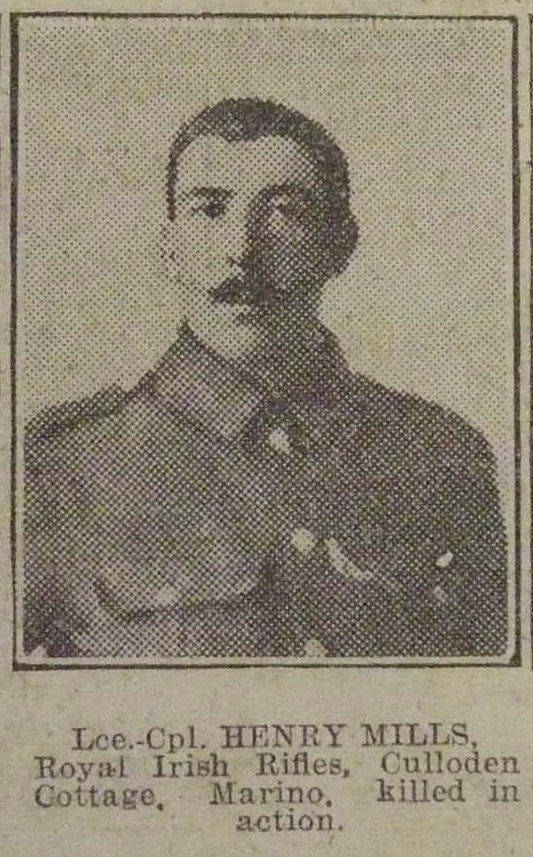
Information about birth
|
Year of birth: 1890 |
|
Place of birth: Holywood, County Down, Ireland, United Kingdom |
General information
|
Last known residence: Culloden Cottage, Marino, Holywood, County Down, Ireland, United Kingdom |
|
Profession: Gardener |
|
Religion: Church of Ireland |
Army information
|
Country: Ireland, United Kingdom |
|
Force: British Expeditionary Force |
|
Rank: Lance Corporal |
|
Service number: 18479 |
|
Enlistment place: Holywood, County Down, Ireland, United Kingdom |
|
Units: — Royal Irish Rifles, 13th Bn. (1st County Down) (Last known unit) |
Information about death
|
Date of death: 16/08/1917 |
|
Place of death: Somme - Wiesengut, Saint-Julien, Belgium |
|
Cause of death: Killed in action (K.I.A.) |
|
Age: 27 |
Cemetery
|
Tyne Cot Cemetery Plot: III Row: D Grave: 3 |
Distinctions and medals 2
|
British War Medal Medal |
|
Victory Medal Medal |
Points of interest 5
| #1 | Place of birth | ||
| #2 | Last known residence | ||
| #3 | Place of work | ||
| #4 | Enlistment place | ||
| #5 | Place of death (approximate) |
My story
Henry Greer Mills was born around 1890 in Holywood, County Down. The Mills family lived in Marino, just north of Holywood, where Henry worked as a gardener alongside his father on the Culloden Estate, then owned by the Church of Ireland and the residence of the Lord Bishop of Down, Connor and Dromore. Henry lived in a cottage on the estate.
The young gardener enlisted with the British Expeditionary Force in Holywood. He served on the Western Front with the 13th Battalion (1st County Down) of the Royal Irish Rifles, part of the 108th Brigade within the 36th (Ulster) Division.
On 16 August 1917, the 36th (Ulster) Division took position just south of the village of Sint-Juliaan. The division advanced with two brigades: the 109th Brigade on the left flank and the 108th Brigade on the right. To their right was the 16th (Irish) Division. The battalions of the 108th Brigade involved in the attack were the 9th Royal Irish Fusiliers and the 13th Royal Irish Rifles; the 12th Royal Irish Rifles provided support, and the 11th Royal Irish Rifles was held in reserve.
The attack began at 4:45 a.m. The 13th Royal Irish Rifles advanced behind a creeping artillery barrage but struggled to maintain the pace due to the swampy terrain. The battlefield was littered with flooded shell craters and waterlogged trenches. In addition to these harsh conditions, the frontline troops came under heavy machine-gun and rifle fire from bunkers near Somme Farm. The men managed to pass Somme but could not capture it, forcing the companies to dig in nearby.
Support and reserves were sent forward to reinforce the attack, but their progress was severely hampered by machine-gun fire from Gallipoli, Hindu Cottage and Aisne Farm on the right, and from Pond Farm and again Hindu Cottage on the left. One hour after the start of the attack, the battalion withdrew to its original positions. There, the survivors were regrouped, and with reinforcements from battalion headquarters, another attempt was made to take Somme — in vain. The attack was quickly broken up by intense German crossfire, and the troops withdrew again. The battalions of the 108th Brigade became scattered and intermixed along their original line. Officers reorganised the men and began fortifying the position. The next day, the 108th Brigade was relieved by the 107th Brigade.
The attack was a complete disaster. The two Irish divisions made virtually no progress. No further attacks were carried out by the 36th (Ulster) Division.
Lance Corporal Henry Greer Mills, aged 27, was killed in action on 16 August 1917. He was initially buried near Somme. After the war, he was laid to rest at Tyne Cot Cemetery, Plot III, Row D, Grave 3.
Sources 4
|
13 Battalion Royal Irish Rifles (The National Archives, KEW (TNA), WO 95/2506/3). https://www.nationalarchives.gov.uk/ Sources used |
|
British Army World War I Medal Rolls Index Cards, 1914-1920 (The National Archives, Kew (TNA), WO372). https://www.nationalarchives.gov.uk/ Sources used |
|
Census of Ireland 1901/1911 (The National Archives of Ireland, Dublin (NAI)). https://www.nationalarchives.ie/ Sources used |
|
McCarthy Chris., Passchendaele. The Day-by-Day Account (London, Unicorn Publishing Group, 2018) 52-55. Sources used |
More information 3
|
Commonwealth War Graves Commission Database https://www.cwgc.org/find-records/find-war-dead/casualty-details/463968 |
|
Namenlijst (In Flanders Fields Museum) https://namenlijst.org/publicsearch/#/person/_id=efbfd1d4-c870-4db6-a17c-78a2b80f200d |
|
Lives of the First World War (Imperial War Museum) https://livesofthefirstworldwar.iwm.org.uk/lifestory/3049832 |