Wehrm.
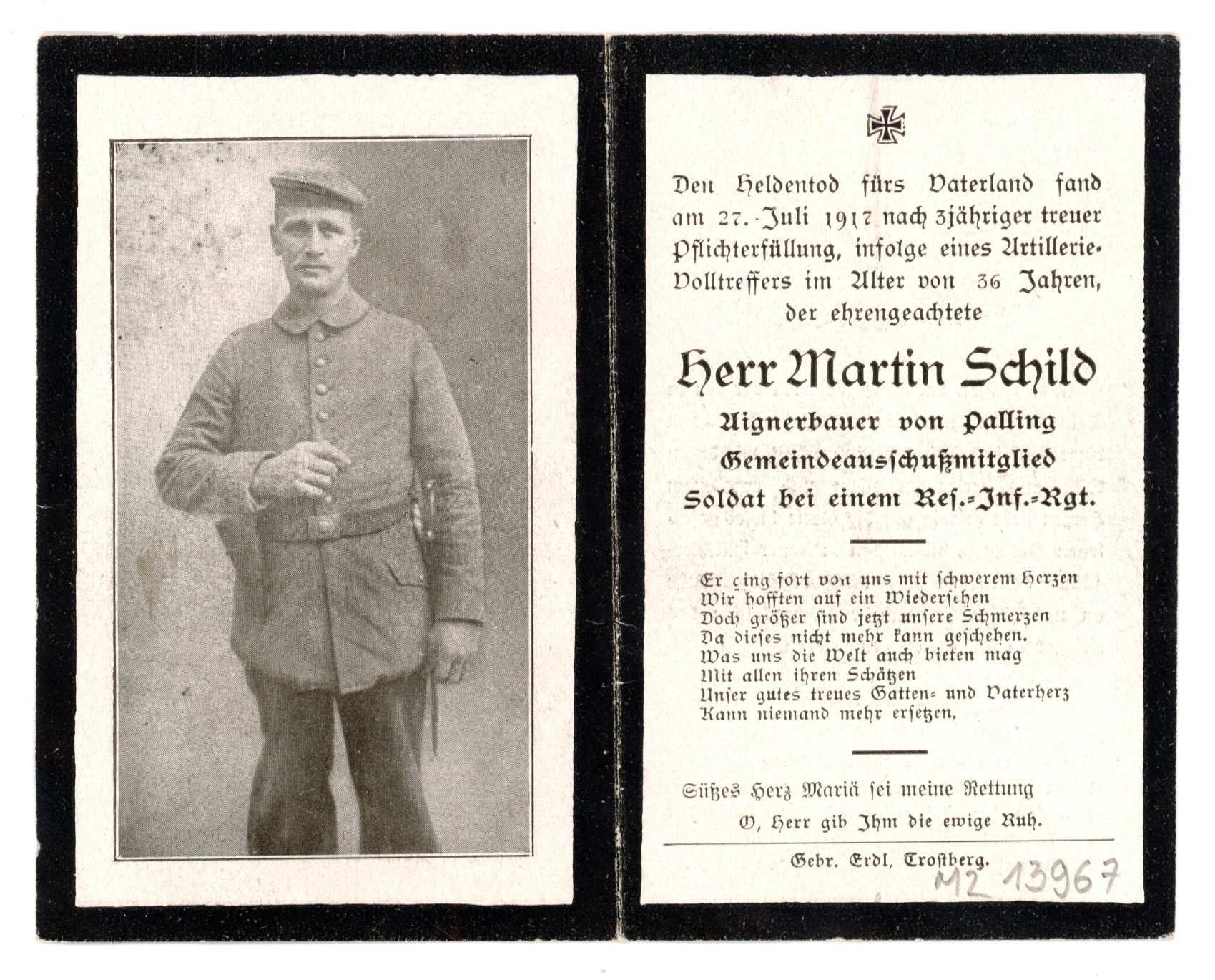
Martin Schild
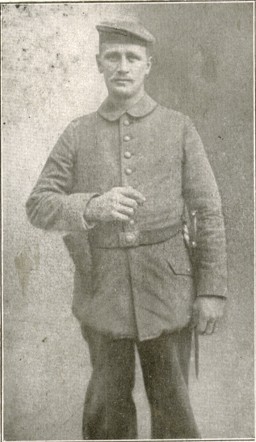
Information about birth
|
Date of birth: 17/10/1882 |
|
Place of birth: Palling, Oberbayern, Kingdom of Bavaria, German Empire |
General information
|
Last known residence: Palling, Oberbayern, Kingdom of Bavaria, German Empire |
|
Profession: Farmer |
|
Religion: Roman Catholic |
Army information
|
Country: Kingdom of Bavaria, German Empire |
|
Force: Imperial German Army |
|
Rank: Wehrmann |
|
Units: — Kgl. Bayer. Reserve-Infanterie-Regiment Nr. 17 (Last known unit) |
Information about death
|
Date of death: 27/07/1917 |
|
Place of death: Becelare, Belgium |
|
Cause of death: Killed in action (K.I.A.) |
|
Age: 34 |
Points of interest 3
| #1 | Place of birth | ||
| #2 | Last known residence | ||
| #3 | Place of death (approximate) |
My story
Martin Schild was the son of Maria and Johann Schild. He was born on 17 October 1917 in Palling, Bavaria, Oberbayern. Before the war, he was a member of the municipal council. He married Theresia Maier. Together they had a son, Johann. After the outbreak of the First World War, Martin joined the German army. At the time of his death, he was serving in the Bayerisches Reserve-Infanterie-Regiment Nr. 17.
Martin was killed on 27 July 1917 during the artillery bombardments that preceded the Battle of Passchendaele. On the night of 26 to 27 July, the regiment occupied a sector near Beselare and was divided into combat battalions, support battalions, and battalions at rest. The plan was to relieve each combat battalion after six days, but due to the heavy shelling, this period had to be shortened to four days: four days in the line, four days as a support unit, followed by four days of rest. Not only the combat units suffered losses, but also the supporting troops and those at rest were affected by the intense artillery fire. They were deployed to repel possible attacks and could only be relieved once the threat seemed unlikely. The danger from explosives was so severe that the front lines were almost completely evacuated during the day. Only at night were supporting companies brought closer.
In addition, part of the combat battalion was located in a tunnel running under the road from Geluveld to Ieper. This passage had to be blown up before the Allied attack began. If not, the troops in the tunnels directly behind the front would not be able to escape in time and would fall into Allied hands. The battalions at rest were stationed near Terhand, but in the last days of July they were brought daily into combat readiness at positions northwest of the Beselare-Geluveld road.
The shelling of the regimental sector continued day and night. Moreover, the Allies also fired gas shells and their air activity was intense. The bombardments caused heavy losses and made the supply of food and ammunition to the troops very difficult.
Martin died at the age of 36. It is unknown where he is buried today.
Sources 2
|
Grossmann, August. Das K.B. Reserve-Infanterie-Regiment nr. 17 (München: J. Lindauersche Universitäts Buchhandlung, 1923), 76-78. Sources used |
|
Kriegstammrollen, 1914-1918 (Bayerisches Hauptstaatsarchiv, München (BHA), Abteilung IV Kriegsarchiv. Kriegstammrollen, 1914-1918; Volume: 3143. Kriegstammrolle: Bd. 4). https://www.ancestry.com/search/collections/1631 Sources used |
More information 1
|
Namenlijst (In Flanders Fields Museum) https://namenlijst.org/publicsearch/#/person/_id=0de95b29-93c8-49a6-8ab7-3638708ba89a |