Lt
Maurice Victor Donald Battenberg
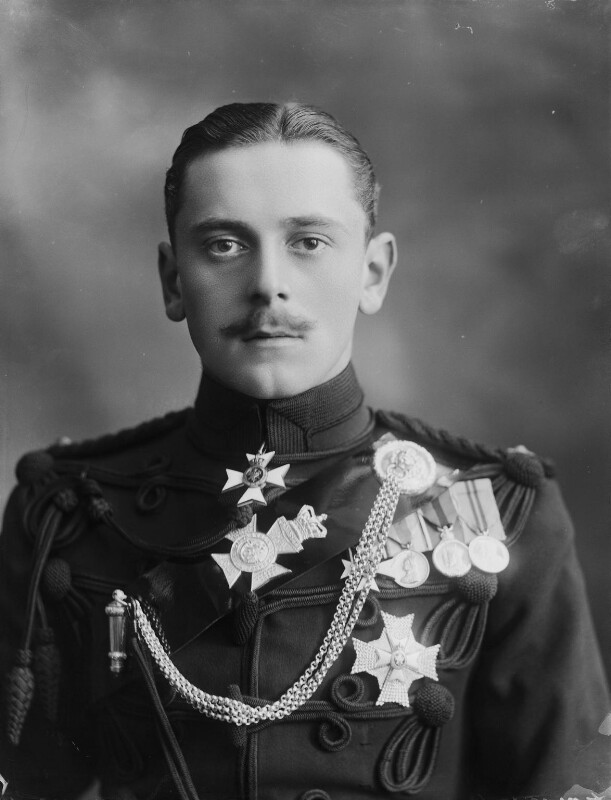
Information about birth
|
Date of birth: 03/10/1891 |
|
Place of birth: Balmoral Castle, Aberdeenshire, Scotland, United Kingdom |
General information
|
Last known residence: Kensington Palace, Kensington, Middlesex, England, United Kingdom |
|
Profession: Professional Soldier |
|
Religion: Church of England |
Army information
|
Country: England, United Kingdom |
|
Force: British Expeditionary Force |
|
Rank: Lieutenant |
|
Enlistment date: 04/03/1911 |
|
Units: — King's Royal Rifle Corps, 1st Bn. (Last known unit) |
Information about death
|
Date of death: 27/10/1914 |
|
Place of death: Broodseinde, Zonnebeke, Belgium |
|
Cause of death: Killed in action (K.I.A.) |
|
Age: 23 |
Cemetery
|
Ypres Town Cemetery Extension Plot: I Row: B Grave: Unknown |
Distinctions and medals 3
|
1914 Star Medal |
|
British War Medal Medal |
|
Victory Medal Medal |
Points of interest 7
| #1 | Place of birth | ||
| #2 | Last known residence | ||
| #3 | Education | ||
| #4 | Education | ||
| #5 | Place of death (approximate) | ||
| #6 | Memorial | ||
| #7 | Memorial |
My story
Maurice Victor Donald Battenberg was born in the autumn of 1891 at Balmoral Castle in Aberdeenshire, Scotland. He was the son of the German nobleman Heinrich Moritz of the House of Battenberg and Princess Beatrice, the youngest child of Queen Victoria and Prince Albert. His father died in early 1896 of illness aboard a warship off the coast of West Africa, where he was to take part in a military expedition against the Ashanti Empire.
His lineage opened doors. As an adolescent, Maurice received a privileged education at the renowned Wellington College in Berkshire. Even there, he showed an interest in military life. He excelled in shooting exercises and became a Lance Corporal in the University Officers’ Training Corps. Like his father, who had served both in the Prussian and later the British army, Maurice ultimately chose a military career. After completing his training at the Royal Military College, Sandhurst, he received his commission in early March 1911 as a second lieutenant in the 1st Battalion King’s Royal Rifle Corps in Gosport, near Portsmouth. In early 1914, he was promoted to lieutenant.
A few days after the outbreak of the war, he departed with his battalion for the continent. The 1st Battalion King’s Royal Rifle Corps, part of the 6th Brigade and the 2nd Division, was under the British I Corps commanded by Lieutenant General Douglas Haig. After deployment at the Marne and the Aisne, Haig’s corps was sent to Flanders. On 19 October 1914, I Corps was ordered to move by train to Ypres and advance from the town towards Torhout, aiming to capture Bruges and drive the Germans back to Ghent.
Haig’s corps arrived at Ypres just in time—not to launch a counterattack, but to relieve the heavily battered British units and prevent a German breakthrough. The 7th Division, already positioned on the heights east of Ypres between the main German force and the town, had suffered heavy losses and was under enormous pressure. German attacks followed relentlessly, so much so that a withdrawal from Ypres was even considered. The enemy’s superiority was great, reserves were small, and the situation critical.
To stabilize the line, the French commander Foch sent reinforcements. French troops took over part of the front, allowing the British to shorten their line.
The Ypres Salient, with Zonnebeke as a hinge point, was thus divided into two sectors. In the north, the French held the line from Zonnebeke via Langemark to the canal at Bikschote; in the south, the British held from Zonnebeke to Reutel and Kruiseke, where the line turned toward Zandvoorde and the Ypres–Comines canal.
On 24 and 25 October, French troops recaptured Zonnebeke and Broodseinde on the strategic heights east of Ypres, which the British had had to relinquish under German pressure. To their right was the British 2nd Division. An attempt to exploit the success and advance further to Poelkapelle, Moorslede, and Passchendaele stalled. The Germans had since entrenched themselves. Franco-British attacks bogged down, leaving countless dead on the field, many of whom would never have a marked grave.
On 26 and 27 October, hardly any ground was gained. Only a few houses and sections of trenches changed hands. To the right of the French sector, the British 2nd Division attempted to storm the Keiberg on 27 October. During this attack, Lieutenant Maurice of Battenberg of the 1st Battalion King’s Royal Rifle Corps was killed. The young nobleman, grandson of Queen Victoria, was instantly killed by a shell while clearly visible to his company on the ridge.
On 25 October, while the French were taking Broodseinde, Maurice’s battalion moved with the 2nd Bn, the South Staffordshire, to the front at the notorious ridge. They bivouacked in a farmhouse at the edge of the Polygon Wood. The next day, 26 October 1914, the battalion was to support an attack by the 1st Battalion, the Irish Guards, and the 1st Battalion, the King’s (Liverpool Regiment), who were on the ridge south of the Broodseinde crossroads. Without knowing the positions of these units, the Rifles left the cover of Polygon Wood at first light, relying on luck. Almost immediately, the first two companies came under fire, probably from houses in Beselare, already in German hands.
An overzealous second lieutenant advanced with his platoon across open ground, assuming the Germans were retreating. The attack reached nearly a German trench before all were cut down.
The battalion soon sought cover in Polygon Wood; companies already on the field occupied abandoned French trenches or hastily dug shallow ditches in the beet and turnip fields. A coordinated counterattack with the Irish Guards never materialized.
New day, new attempt. After an early breakfast at a farmhouse between Zonnebeke and Polygon Wood, the companies were ordered to occupy the front line. The front stretched about 730 meters, from the Broodseinde crossroads to the edge of Molenaarelsthoek. To the left of the Rifles was the 135e régiment d’infanterie advancing toward Droogenbroodhoek; on the right flank were the South Staffords. From the ridge, the terrain sloped gradually to the Heulebeek, then rose steeply toward the Keiberg. Only a few copses, hedges, and scattered farms offered cover in this otherwise open landscape, intersected by seemingly abandoned German and French trenches. The first stretch of about 500 meters had to be crossed entirely in the open, visible to German lines.
From the moment the formations of the 1st Battalion King’s Royal Rifle Corps became visible on the ridge, hell broke loose. Howitzer shells struck the ridge, shrapnel shells exploded in small clouds above the formations, while rifle fire crackled from the positions of East Frisians and Hanoverians of the 38th Landwehr Infantry Brigade.
Lieutenant Maurice Battenberg, just 23 years old, was killed almost immediately along with Captain Walter Wells by a shell. Wells has no known grave. Maurice was shortly afterward buried in the municipal cemetery of Ypres, where he still rests.
The young nobleman had followed in the footsteps of his father—a father he had never known; and, like his father, he would die prematurely during a military campaign.
In Winchester Cathedral, in Hampshire, there is a memorial stone for Maurice and his older brother Leopold, who died in 1922 at the age of 32 during a surgical operation. Both brothers served in the King’s Royal Rifle Corps, which was stationed in Winchester.
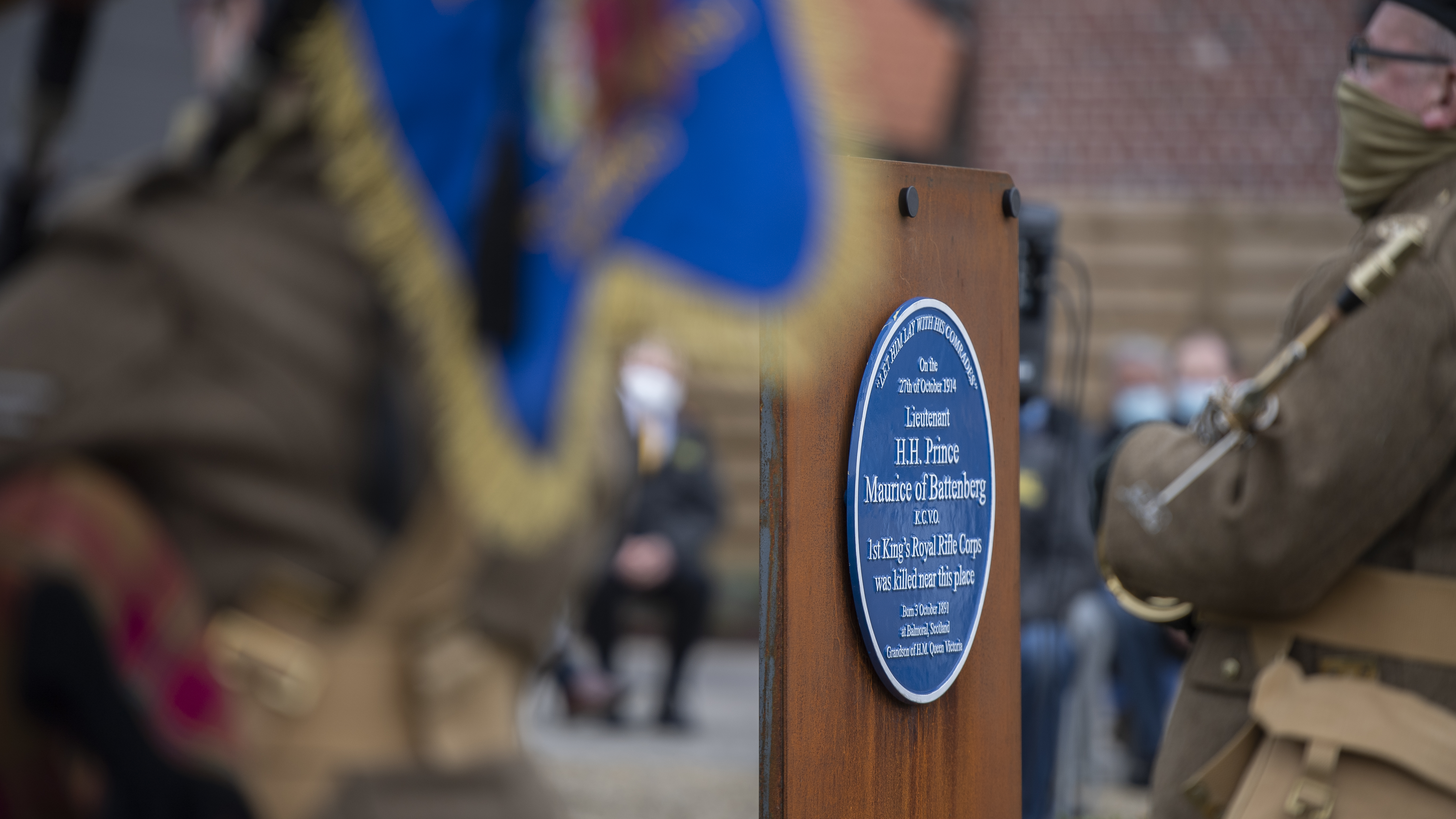
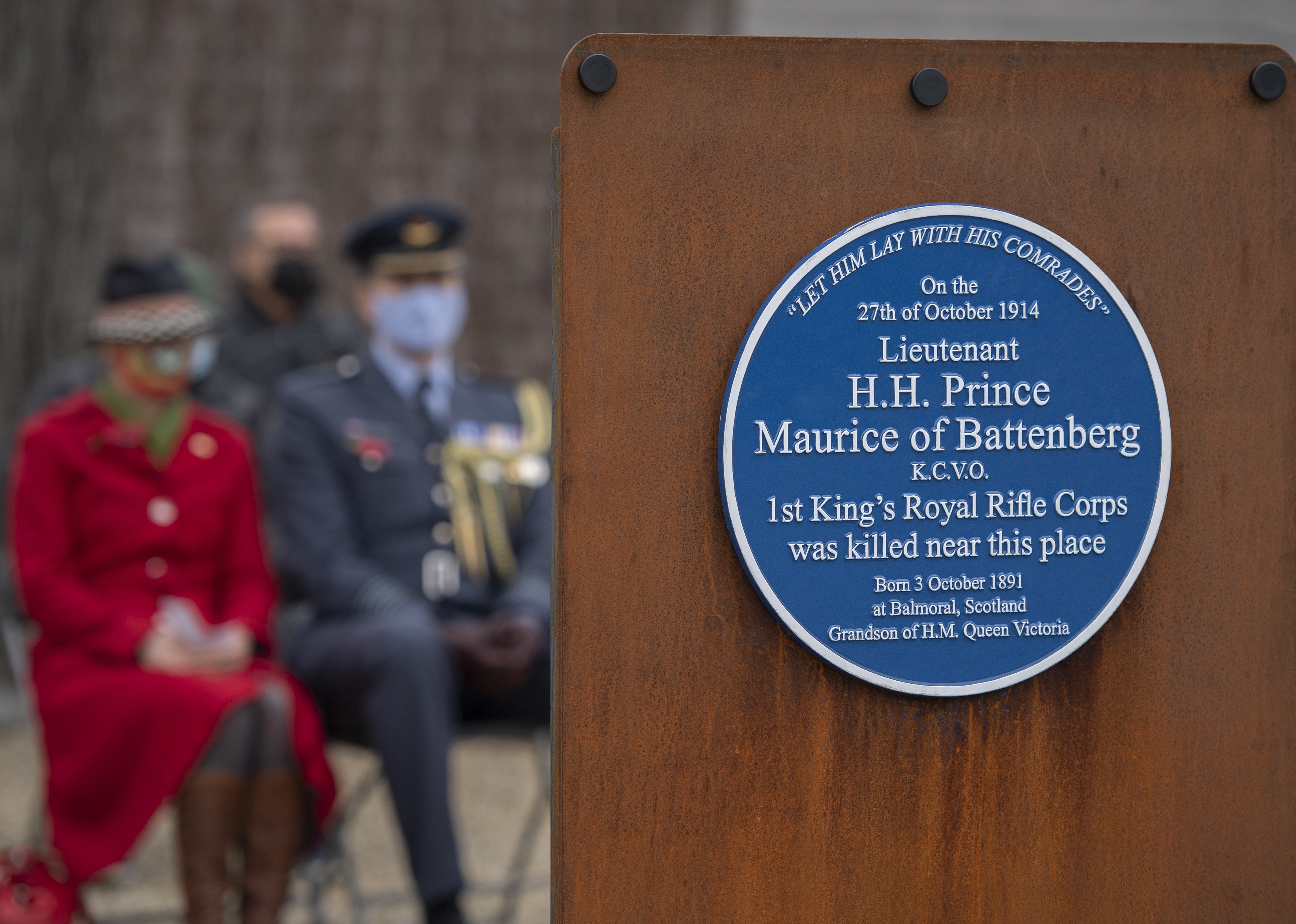
In October 2020, 106 years after Maurice’s death, a blue commemorative plaque was unveiled at Broodseinde, near the location where the young prince lost his life.
Sources 3
|
1 Battalion King's Royal Rifle Corps (The National Archives, Kew (TNA), WO 95/1358/3). https://www.nationalarchives.gov.uk/ Sources used |
|
Byron R., The King's Royal Rifle Corps chronicle, (Winchester, Warren and son, 1915), pp. 126-130. Sources used |
|
De Ruvigny's roll of honour 1914-18 : a biographical record of members of His Majesty's naval and military forces who fell in the Great War 1914-1918 (Uckfield: Naval & Military Press, 2010) vol.1, p. 24. Sources used |
More information 4
|
Commonwealth War Graves Commission Database https://www.cwgc.org/find-records/find-war-dead/casualty-details/446206 |
|
A Street Near You https://astreetnearyou.org/person/446206/ |
|
Lives of the First World War (Imperial War Museum) https://livesofthefirstworldwar.iwm.org.uk/lifestory/243587 |
|
Namenlijst (In Flanders Fields Museum) https://namenlijst.org/publicsearch/#/person/_id=d485a481-28b8-43fb-a740-fe547110a224 |