L/Cpl
Ernest Seaman
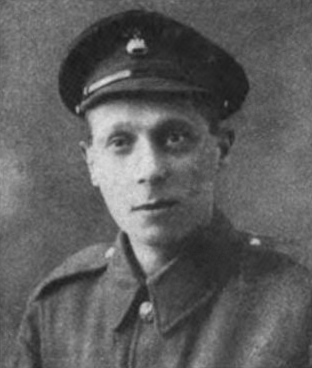
Information about birth
|
Date of birth: 16/08/1893 |
|
Place of birth: Heigham, Norwich, Norfolk, England, United Kingdom |
General information
|
Last known residence: Felixstowe, Suffolk, England, United Kingdom |
|
Profession: Butler - Page |
Army information
|
Country: England, United Kingdom |
|
Force: British Expeditionary Force |
|
Rank: Lance Corporal |
|
Service number: 42364 |
|
Enlistment place: Le Havre, Seine-Maritime, France |
|
Units: — Royal Inniskilling Fusiliers, 2nd Bn. (Last known unit) |
Information about death
|
Date of death: 29/09/1918 |
|
Place of death: Terhand, Geluwe, Belgium |
|
Cause of death: Killed in action (K.I.A.) |
|
Age: 25 |
Memorial
|
Tyne Cot Memorial Panel: 70 |
Distinctions and medals 5
|
1914-15 Star Medal |
|
British War Medal Medal |
|
Military Medal Medal |
|
Victoria Cross Medal |
|
Victory Medal Medal |
Points of interest 5
| #1 | Place of birth | ||
| #2 | Last known residence | ||
| #3 | Enlistment place | ||
| #4 | Location of medal-earning event | ||
| #5 | Place of death (approximate) |
My story
Ernest Seaman was born in August 1893 in Heigham, near Norwich, the son of Henry William and Sarah Seaman. Before the war, he lived in the seaside town of Felixstowe, where he worked as a hotel page.
During the war, Ernest travelled to Le Havre to join the British Expeditionary Force. As he was not considered fully fit for front-line service, he was assigned at the end of 1915 to the supporting Army Service Corps, where he worked in the canteens. However, due to the heavy losses at the front, he was eventually transferred to the infantry. He was posted to the Royal Inniskilling Fusiliers, 2nd Battalion. In the Ypres Salient, he was awarded the Military Medal for tending to wounded comrades under fire.
In 1918, the 2nd Battalion formed part of the 109th (Inniskilling) Brigade, 36th (Ulster) Division, which took part in the Allied final offensive beginning on 28 September. Belgian, British, and French troops attempted to break through the German positions on the heights east of Ypres, advancing towards Roeselare and Menen.
After a cold and rainy night, the offensive resumed on 29 September. The 109th (Inniskilling) Brigade advanced from Beselare with the objective of reaching a line from Dadizele in the north to Molenhoek in the south. The 2nd Battalion advanced around 09:30 on the right flank towards the higher ground at Terhand, where the German Flandern II Stellung ran. The 9th Battalion advanced on the left towards Vijfwegen, while the 1st Battalion provided support. The newly captured ground was churned up; roads were barely usable and under almost constant German fire. Artillery and logistics struggled to keep up over the shattered terrain, limiting artillery support.
The attack itself advanced over relatively undamaged ground, a welcome relief after the sea of mud and shell craters behind them. In the hedgerow landscape, however, the advance was checked by well-concealed German machine guns. After initial progress, “A” Company, to which Ernest belonged, was held up by these positions. Seaman, operating a Lewis gun, attacked the position single-handedly. He knocked out two machine guns, captured twelve prisoners, and killed an officer and two soldiers. Later that day, he again assaulted an enemy machine-gun post, enabling his company to continue the advance. Shortly afterwards, he was killed.
The 25-year-old Ernest Seaman was killed in action on 29 September 1918 during the attack on Terhand. He was posthumously awarded the Victoria Cross. He has no known grave and is commemorated on the Tyne Cot Memorial.
Sources 7
|
2 Battalion Royal Inniskilling Fusiliers (The National Archives, KEW (TNA), WO 95/2510/2). https://www.nationalarchives.gov.uk/ Sources used |
|
British Army World War I Medal Rolls Index Cards, 1914-1920 (The National Archives, Kew (TNA), WO 372). https://www.nationalarchives.gov.uk/ Sources used |
|
Census Returns of England and Wales, 1911 (The National Archives, Kew (TNA), RG14). https://www.nationalarchives.gov.uk/ Sources used |
|
Fox F., The Royal Inniskilling Fusiliers in the World War, ( London, Constable & Company, 1928) pp. 148-153. Sources used |
|
Gliddon G., The Final Days 1918. VCs of the First World War, (Stroud, History Press, 2014), pp. 65-67. Sources used |
|
UK, Soldiers Died in the Great War, 1914-1919, His Majesty's Stationery Office (HMSO), 1921. https://www.ancestry.com/ Sources used |
|
UK, Victoria Cross Medals, 1857-2007. https://www.ancestry.com/ Sources used |
More information 4
|
Commonwealth War Graves Commission Database https://www.cwgc.org/find-records/find-war-dead/casualty-details/828966 |
|
A Street Near You https://astreetnearyou.org/person/828966/ |
|
Namenlijst (In Flanders Fields Museum) https://namenlijst.org/publicsearch/#/person/_id=206f4381-7dc0-47b2-b703-9460c02dd0f7 |
|
Lives of the First World War (Imperial War Museum) https://livesofthefirstworldwar.iwm.org.uk/lifestory/3948114 |