Pte
Frederick (Fred) Dewland

Information about birth
|
Date of birth: 09/04/1882 |
|
Place of birth: Wimborne Minster, Dorset, England, United Kingdom |
General information
|
Profession: Labourer |
|
Religion: Church of England |
Army information
|
Country: Canada |
|
Force: Canadian Expeditionary Force |
|
Rank: Private |
|
Service number: 430601 |
|
Enlistment date: 18/03/1915 |
|
Enlistment place: Victoria, British Columbia, Canada |
|
Units: — Canadian Infantry, 27th Bn. (City of Winnipeg) (Last known unit) |
Information about death
|
Date of death: 06/11/1917 |
|
Place of death: Passchendaele, Belgium |
|
Cause of death: Killed in action (K.I.A.) |
|
Age: 35 |
Cemetery
|
Tyne Cot Cemetery Plot: LVIII Row: B Grave: 31 |
Distinctions and medals 3
|
1914-15 Star Medal |
|
British War Medal Medal |
|
Victory Medal Medal |
Points of interest 3
| #1 | Place of birth | ||
| #2 | Enlistment place | ||
| #3 | Place of death (approximate) |
My story
Fred Dewland was born on 9 April 1882 in Wimborne, Dorset, England, United Kingdom. He was the son of Asenath Weeks. Before enlisting, he emigrated to Canada and worked as a labourer. On 18 March 1915, at the age of 34, he enlisted in Victoria, British Columbia. He was initially assigned to the 48th Battalion (British Columbia). After his arrival in the United Kingdom, he was transferred to the 27th Battalion (City of Winnipeg), 6th Canadian Infantry Brigade, 2nd Canadian Division.
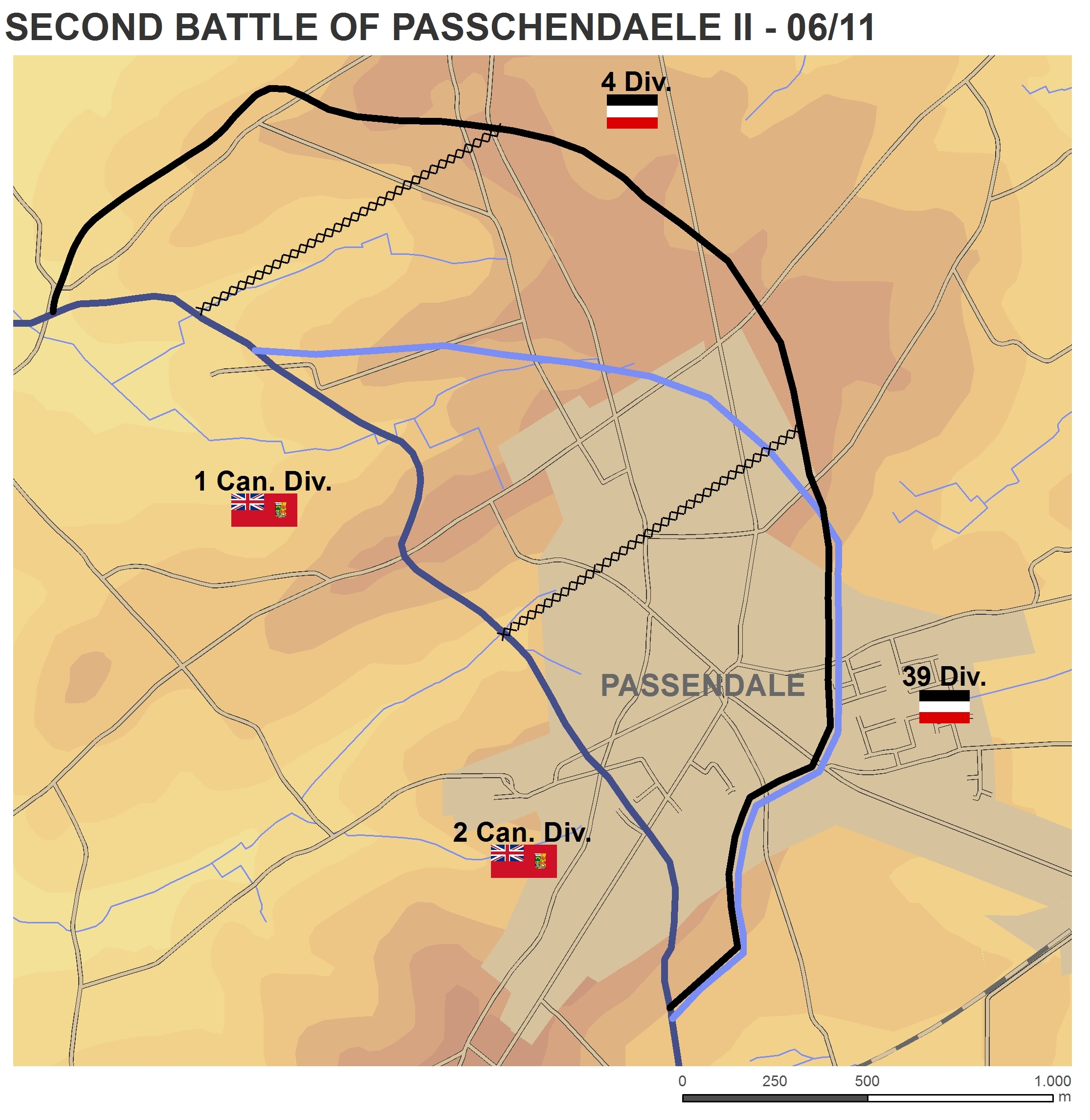
Fred was killed in action on 6 November 1917 during the capture of Passchendaele, part of the Battle of Passchendaele. On 4 November, the 27th Battalion (City of Winnipeg) was stationed in the hamlet of Potijze. The next day, at 1 a.m., the Battalion moved towards Hill 37, northwest of Zonnebeke, where they relieved the 20th Battalion (Central Ontario). That same day, at 5 p.m., the Battalion moved to the frontline, from where the attack on Passchendaele would be launched. On 6 November, around 3 a.m., the attacking troops gathered in their starting positions just outside Passchendaele, stretching from what is now Passendalestraat to what is now Canadalaan, just east of Crest Farm. Their objective was to capture the centre of Passchendaele and the lines just northeast of what is now Doornkouterstraat. The attack was to be carried out by "B", "C", and "D" Company. Between 4 a.m. and 6 a.m., the men in their starting positions were repeatedly shelled by artillery fire.
The attack began at 6 a.m. when Allied artillery laid down a barrage. The artillery partially neutralised the foremost German position about 45 metres from the starting points, after which the remaining German troops were overpowered. The Canadians then advanced towards the centre of Passchendaele, where they came under both rifle and machine-gun fire. Once they reached the ruins of the village, the German troops were killed with bayonets. After securing the village centre, the Canadians continued towards the final objective line. During this final phase, they came under sniper fire. A machine-gun position attempted to hold the left flank but was taken out by rifle grenades. The final objective line was captured around 7.30 a.m., and the newly gained positions were immediately consolidated. Between 4 p.m. and 5 p.m., the start of a German counterattack was observed, but it was repelled by Allied artillery. Due to heavy artillery fire in the following days, the fallen soldiers, except for those near the starting points, could not be buried. During the night of 7 to 8 November, the Battalion was relieved by the 22nd Battalion (French Canadian). It then returned to Erie Camp near Brandhoek. During their three days at the frontline, the Battalion lost 45 killed, 187 wounded, and 10 missing.
Fred was struck by artillery fire and killed at the age of 35. His body was found after the war near what is now Doornkouterstraat and reburied at Tyne Cot Cemetery, Plot LVIII, Row B, Grave 31.
Fred was killed in action on 6 November 1917 during the capture of Passchendaele, part of the Battle of Passchendaele. On 4 November, the 27th Battalion (City of Winnipeg) was stationed in the hamlet of Potijze. The next day, at 1 a.m., the Battalion moved towards Hill 37, northwest of Zonnebeke, where they relieved the 20th Battalion (Central Ontario). That same day, at 5 p.m., the Battalion moved to the frontline, from where the attack on Passchendaele would be launched. On 6 November, around 3 a.m., the attacking troops gathered in their starting positions just outside Passchendaele, stretching from what is now Passendalestraat to what is now Canadalaan, just east of Crest Farm. Their objective was to capture the centre of Passchendaele and the lines just northeast of what is now Doornkouterstraat. The attack was to be carried out by "B", "C", and "D" Company. Between 4 a.m. and 6 a.m., the men in their starting positions were repeatedly shelled by artillery fire.
The attack began at 6 a.m. when Allied artillery laid down a barrage. The artillery partially neutralised the foremost German position about 45 metres from the starting points, after which the remaining German troops were overpowered. The Canadians then advanced towards the centre of Passchendaele, where they came under both rifle and machine-gun fire. Once they reached the ruins of the village, the German troops were killed with bayonets. After securing the village centre, the Canadians continued towards the final objective line. During this final phase, they came under sniper fire. A machine-gun position attempted to hold the left flank but was taken out by rifle grenades. The final objective line was captured around 7.30 a.m., and the newly gained positions were immediately consolidated. Between 4 p.m. and 5 p.m., the start of a German counterattack was observed, but it was repelled by Allied artillery. Due to heavy artillery fire in the following days, the fallen soldiers, except for those near the starting points, could not be buried. During the night of 7 to 8 November, the Battalion was relieved by the 22nd Battalion (French Canadian). It then returned to Erie Camp near Brandhoek. During their three days at the frontline, the Battalion lost 45 killed, 187 wounded, and 10 missing.
Fred was struck by artillery fire and killed at the age of 35. His body was found after the war near what is now Doornkouterstraat and reburied at Tyne Cot Cemetery, Plot LVIII, Row B, Grave 31.
Sources 5
|
5th Canadian Infantry Brigade. (Library and Archives Canada, Ottawa (LAC), RG9-III-D-3, 4886, T-10682, 253). https://library-archives.canada.ca Sources used |
|
McCarthy, Chris. Passchendaele: The Day by Day Account (Londen: Arms & Armour Press, 1995), p. 162-3. Sources used |
|
Personnel Records of the First World War (Library and Archives Canada, Ottawa (LAC) RG 150, Accession 1992-93/166, Box 2496 - 47). https://library-archives.canada.ca/ Sources used |
|
War diaries: 27th Canadian Infantry Battalion (Library and Archives Canada, Ottawa (LAC), RG9-III-D-3, Volume number: 4935, Microfilm reel number: T-10738--T-10739, File number: 423). https://library-archives.canada.ca/ Sources used |
|
War Graves Registers: Circumstances of Death (Library and Archives Canada, Ottawa (LAC), RG 150, 1992-93/314). https://library-archives.canada.ca/ Sources used |
More information 4
|
Commonwealth War Graves Commission Database https://www.cwgc.org/find-records/find-war-dead/casualty-details/462550 |
|
Namenlijst (In Flanders Fields Museum) https://namenlijst.org/publicsearch/#/person/_id=94b63d33-9cc0-40e4-ad05-67fd6bd74da0 |
|
The Canadian Virtual War Memorial https://www.veterans.gc.ca/eng/remembrance/memorials/canadian-virtual-war-memorial/detail/430601 |
|
Lives of the First World War (Imperial War Museum) https://livesofthefirstworldwar.iwm.org.uk/lifestory/5829366 |