Pte
Guy Handford Clarke
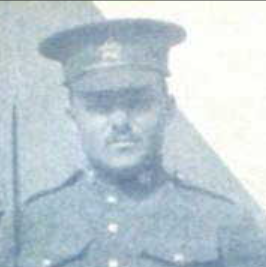
Informationen zu Geburt
|
Geburtsdatum: 15/10/1892 |
|
Geburtsort: Eden, Bayham, Onatrio, Canada |
Allgemeine Informationen
|
Letzter bekannter Wohnsitz: Rural Route 7, Saint Thomas, Ontario, Canada |
|
Beruf: Elektriker |
|
Religion: Congregationalist |
Informationen zum Armeedienst
|
Land: Canada |
|
Truppe: Canadian Expeditionary Force |
|
Rang: Private |
|
Dienstnummer: 190158 |
|
Einberufung datum: 30/03/1916 |
|
Einberufung ort: Saint Thomas, Ontario, Canada |
|
Einheiten: — Canadian Infantry, 38th Bn. (Ottawa) (Letzte bekannte Einheit) |
Informationen zu Tod
|
Sterbedatum: 30/10/1917 |
|
Sterbeort: South of Passchendaele, Belgien |
|
Todesursache: Im Kampf gefallen |
|
Alter: 25 |
Begräbnisplatz
|
Tyne Cot Cemetery Grabstelle: VI Reihe: A Grab: 13 |
Auszeichnungen und Orden 2
|
British War Medal Medaille |
|
Victory Medal Medaille |
Punkte von Interesse 3
| #1 | Geburtsort | ||
| #2 | Einberufung ort | ||
| #3 | Sterfteplaats |
Meine Geschichte
190158 Private Clarke, Guy Handford is born on 15 October 1892. (birth certificate shows Clark (no ‘e’) and Hanford (no ‘d’)
He is the eldest son of farmer William Clark and Sarah Jones and has two sisters (Alma and Nina) and one brother and Glenn. The family lives in the city of St Thomas, Ontario. Guy is 22 yrs old, works as an electrician, when he joins the 91st overseas Btn on 30 March 1916 at St Thomas, Ontario.
Guy’s younger brother Glen had joined the 91st one week earlier.
The 91st Battalion (including the two brothers) leaves Canada for England on 29 June 1916. Upon arrival in England Guy is transferred to the 36th. Shortly after he is transferred to the 38th Battalion as reinforcement, which he joins in the field near Mont Kemmel (Ypres salient, Belgium) on 9 sept 1916.
(Guy’s brother Glen is transferred to first the 12th and later to the 75th Btn. Glen will survive the war)
On 26 March 1917 Pte Clarke is gassed near Vimy. The War Diary shows the incident:
(in the trenches , front line) … at 5:30 am the enemy blew a camouflet opposite the neighbourhood of our front line at Oakley Communication Trench. One of our dug-outs was badly affected, being filled with gas and flames: Seventeen members of nr 13 platoon were gassed. 6 were unable to get out and died, the others (?) though badly burned and seriously gassed, were able to reach the trench, one of them subsequently dying.
Guy is sent to a CCS, recovers and returns to his unit in May 1917.
In July 1917, the battalion was withdrawn from the front for three weeks of reorganization and training. August and September were spent back in the line at Avion.
In October 1917, the 12th Canadian Infantry Brigade (including the 38th, 72nd, 78th, and 85th Battalions and the 12th MGC) was withdrawn from the front in northern France to be deployed in Flanders (Belgium)
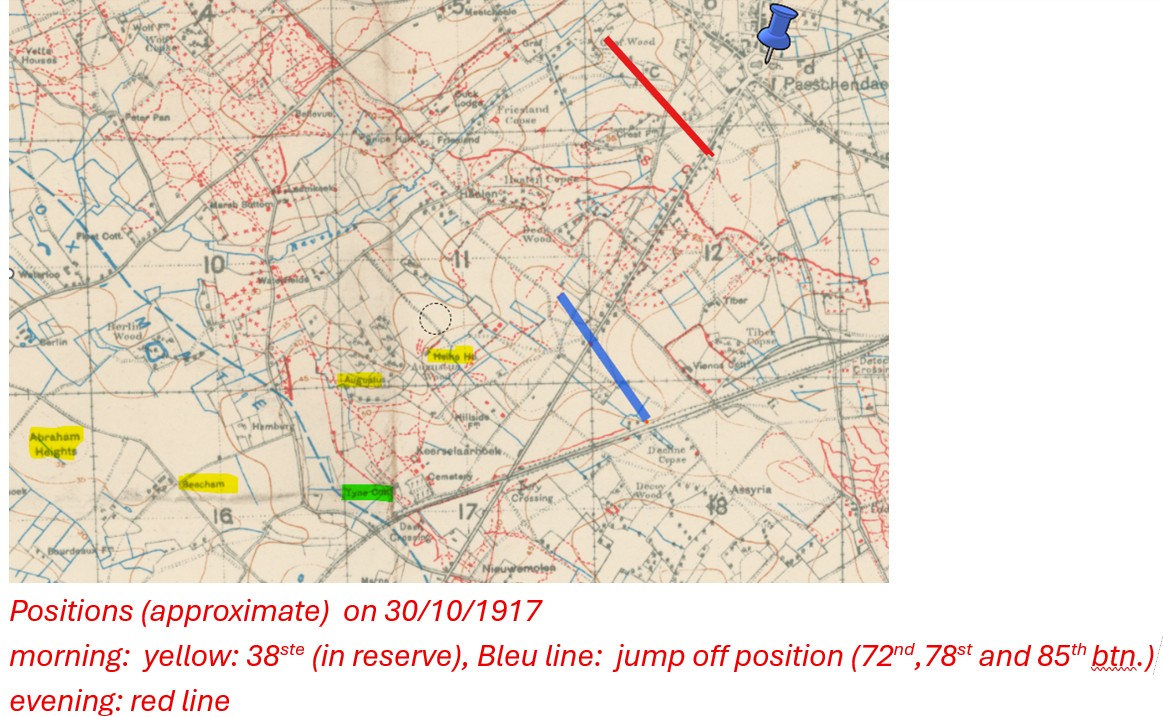
The 38th arrived in the Poperinge area (Belgium) on 23 October and moved five days later via Ypres to a camp in Pottijze where they prepared for the upcoming actions: the Brigade will attack on 30th October with the 85th, 72th and 78th Battalion, while the 38th Battalion will be kept in reserve.
In the night of 29/30 October, the 3 battalions took position in the frontline, the 38th just behind them in support. The positions of the 38th: B and D company near Augustus and Hillside Farm and the A and C company near Beecham and Abraham Heights.
The attack was launched on 30 October 1917, at 5:40 am. Despite the heavy enemy shelling, the three battalions manage fairly quickly to capture the objectives. German artillery also targeted the positions of the 38th which was hold in reserve The losses in the 38th are considerable, especially the B company suffered heavily. The heavy German bombardments continued for almost the entire day. The Germans seemed to deliberately spare the aid post at Tyne Cottage.
In the afternoon, the B, C, and D companies of the 38th were sent forward to consolidate the newly acquired positions.
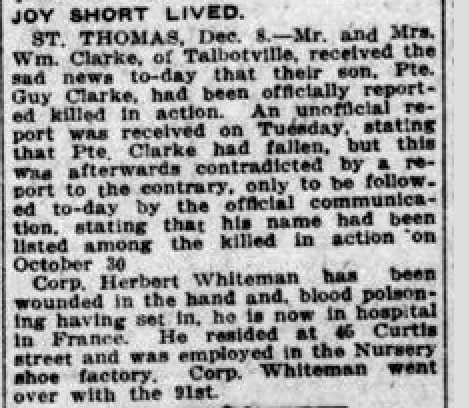
Although his file states ‘K.I.A.’ on 30 October 1917, it seems highly likely that Pte Clarke died of his wounds at the first-aid post. Pte Clarke was , in fact, initially buried 21 paces from the ‘pill box’ (German bunker) which served as a dressing station. The grave was to fall within the boundaries of what would later become Tyne Cot Cemetery, which was laid out after the war.
In 1919, his body was exhumed and reburied in Plot 4. Later, the Cross of Sacrifice was erected on that pillbox (centrally located within Tyne Cot Cemetery).
On 31 October and 1 November, the 38th remained in the front line to reinforce and hold the advanced positions that were taken on 30 October. There were no organized German counterattacks, but German artillery continued to heavily shell the Canadians, causing many casualties. The A-coy assists, among other things, in bringing up supplies and carrying away the wounded. In the late evening of 2 November, the 38th is relieved.
Back in the camp at Pottijze, the battalion (according to the War Diary) counts its casualties*: 1 officer and 48 OR / wounded: 4 officers and 163 OR / missing 22 OR.
On 3 November, the 38th left Ypres Salient in order to return to France.
According to CWGC.org: the Battle of Passchendaele ultimately cost 79 men of the 38th their lives, of which 14 of them are buried at Tyne Cot Cemetery. Another 37 have an unknown grave; their names are inscribed on panel 28 of the Menin Gate.
Quellen 5
|
Circumstance of Death (Library and Archives Canada, Ottawa (LAC), RG150, 1992-93/314, 164) https://library-archives.canada.ca/ Verwendete Quellen |
|
Commonwealth War Graves Registers, First World War (Library and Archives Canada, Ottawa (LAC), RG150, 1992-93/314, 56) https://library-archives.canada.ca/ Verwendete Quellen |
|
Commonwealth War Graves Registers, First World War (Library and Archives Canada, Ottawa (LAC), RG150, 1992-93/314, 56) https://library-archives.canada.ca/ Verwendete Quellen |
|
Personnel Records of the First World War (Library and Archives Canada, Ottawa (LAC), RG 150, Accession 1992-93/166, Box 1740 - 50) https://library-archives.canada.ca/ Verwendete Quellen |
|
War diaries: 38th Canadian Infantry Battalion (Library and Archives Canada, Ottawa (LAC), RG9-III-D-3, Volume number: 4938, Microfilm reel number: T-10743, File number: 432, File part: 1=1916/08/13-1917/12/31;2=1918/01/01-1919/05/31) https://library-archives.canada.ca/ Verwendete Quellen |
Weitere Informationen 5
|
CWGC https://www.cwgc.org/find-records/find-war-dead/casualty-details/462288 |
|
Namenlijst (In Flanders Fields Museum) https://namenlijst.org/publicsearch/#/person/_id=e625b652-fcc1-4141-b908-a6b56df15b14 |
|
Lives of the First World War (Imperial War Museum) https://livesofthefirstworldwar.iwm.org.uk/lifestory/5521209 |
|
The Canadian Virtual War Memorial https://www.veterans.gc.ca/en/remembrance/memorials/canadian-virtual-war-memorial/detail/597932 |
|
A Street Near You https://astreetnearyou.org/person/462288/ |